Güneş Duru hybrid lecture: ‘Central Anatolian Neolithic: Tracing the Emergence of Early Sedentary Communities’’, 5 June 2025 - flyer: - slides:
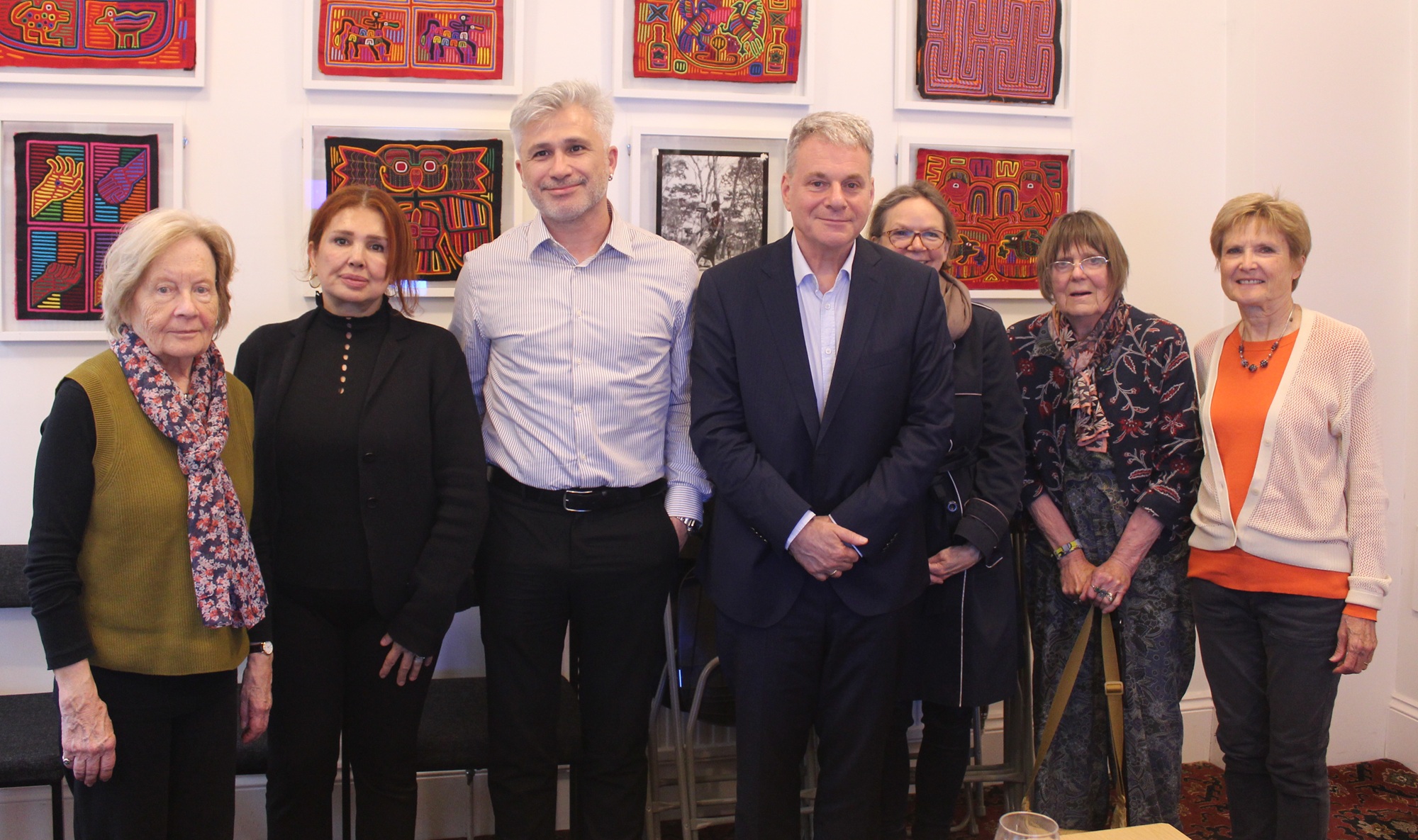
Güneş Duru in the centre post lecture.
Güneş Duru hybrid lecture: ‘Central Anatolian Neolithic: Tracing the Emergence of Early Sedentary Communities’’, 5 June 2025 - flyer: - slides:
1- 2 days after you gave the presentation to our society you were one of the speakers at the conference organised by the Royal Anthropological Institute & UCL Institute of Archaeology: ‘Cycles of Theory: a critical review of 60 years of archaeological theory and practice’ where your presentation was titled: ‘Against the Tide: Çatalhöyük in Context’. With this title are you suggesting the methodology and interpretations at Çatalhöyük has been more resistant to modern trends in the wider field?
Not exactly. With the title “Against the Tide: Çatalhöyük in Context”, I did not mean to suggest that the Çatalhöyük project has been resistant to modern trends in archaeological theory on the contrary, it has often anticipated or even catalysed them. What I intended to emphasize was that Çatalhöyük, particularly under Ian Hodder’s direction, became a site of epistemological contestation, a space where dominant assumptions about objectivity, linear narratives, and hierarchical interpretations were challenged. My use of “against the tide” speaks to a different kind of resistance: not a resistance to modern theory, but a resistance to simplification, closure, and ideological projection, especially within contexts like Turkish archaeology, where interpretations of the Neolithic are increasingly being read through nationalist, hierarchical, or class-based frameworks. Çatalhöyük instead insisted on a reflexive, pluralistic, and interpretively open archaeology, one that foregrounded fragmentation, contradiction, and positionality. So, in a way, the “tide” I was referring to includes both older forms of scientism and newer essentialist readings of social complexity. In that sense, Çatalhöyük—far from resisting theoretical innovation, became the very terrain where theory, ethics, and practice were actively rethought.
2- When you stated in your talk ‘beyond the academic dimension I also see in this work carrying a political and human responsibility in exploring early human societies. I seek not only how people lived but also to reflect crucially on the ways that we live today’. Do you thus see interpretation of those past lives as carrying a burden of responsibility for you to transmit a more universal message that can be applied today for a deeper understanding of our own sense?
Yes, I do see the interpretation of past lives as carrying a responsibility not in the sense of delivering moralistic lessons or extracting simplistic analogies, but in acknowledging that all knowledge production, including archaeology, is embedded in the political, ethical, and social conditions of the present. When I said that this work carries a political and human responsibility, I meant that archaeology should not confine itself to reconstructing how people lived, but must also interrogate the values and frameworks through which we choose to study and represent those lives. My aim is not to universalize the past, but to resist the appropriation of prehistory into dominant narratives (be they nationalist, capitalist, or hierarchical) that naturalize inequality and suppress alternative ways of being. I believe that the Neolithic world, with its diverse and often non-hierarchical social configurations, offers not a direct model for the present, but a conceptual resource for imagining other possibilities. To interpret the past without reflecting on its political uses today would be to remain complicit in the very systems of exclusion, marginalization, and ideological control that archaeology has too often supported. So yes, the burden, or better, the commitment, that I feel as an interpreter is to ensure that the act of reconstructing the past is also an act of political awareness. It is to insist that archaeology is never neutral, and that how we choose to tell stories about early human societies inevitably reflects how we position ourselves in the world today. In that sense, the past becomes a terrain not only of inquiry, but of responsibility.
3- Anatolia was and is a true geographic cross-roads but was this reason enough for the first domestication of plants and all that followed to happen and later spread globally? Could other factors such as climatic, geologic variations within that region also have been keys that meant it was the first of 10 regions around the globe that independently underwent the ‘Neolithic revolution’. Finally, is the word ‘revolution’ problematic, would it be better replaced by ‘evolution’?
This is a crucial and deeply layered question. Anatolia’s geographic location at the intersection of continents certainly made it a crossroads for human movement, species dispersal, and cultural exchange, but geography alone does not fully explain why it became one of the first regions to witness plant domestication and what we call the “Neolithic transformation.” I believe that we must look beyond mere location and consider the intricate interplay of climatic shifts, ecological diversity, soil variability, and the co-evolutionary dynamics between humans, plants, and animals. The climatic fluctuations of the Late Pleistocene and Early Holocene created mosaic ecologies across Anatolia, zones where wild cereals, legumes, and herd animals flourished in proximity. These were not only biologically rich environments, but ecotonal spaces, transitional areas where different ecosystems meet. Such zones tend to foster both biodiversity and cultural innovation, not through domination but through entanglement. In this light, domestication was not an abrupt human imposition on “nature,” but rather a gradual, situated process of mutual adjustment what some scholars now call niche construction. Moreover, domestication was not a one-directional act of control, it was a relational shift involving species co-dependencies. Human communities altered landscapes, yes, but they were also altered by the biological and climatic rhythms of those landscapes. This reframing challenges the idea of the Neolithic as a human triumph over nature, and instead centers the multi-species negotiations that gave rise to new life-worlds. As for the term “revolution,” I agree that it is problematic. It implies suddenness, universality, and perhaps most misleadingly, a linear progression toward “civilization.” It conceals the ecological costs, the social ruptures, and the species extinctions that accompanied domestication. I prefer to think in terms of “transformation” or even “entangled evolution.” These terms better capture the uneven, often reversible, and highly localized nature of what happened in the Neolithic. They also open space for recognizing the resilience of non-domestic lifeways and the plural ecologies that coexisted alongside early farming. In sum, the emergence of agriculture in Anatolia was not inevitable, nor was it singularly human-driven. It emerged from deeply contextual environmental and relational dynamics, and its global consequences both creative and destructive should compel us to reflect critically on how we live with the earth and with other species today.
4- You mention a ‘threshold’ moment in your (Turkish archaeologists) interaction with members of the British Institute of Ankara, led by Ian Hodder in the Çatalhöyük excavations, with his invitation and collaboration with you and your Istanbul team mates lasting 5 years. Was Ian Hodder ground-breaking in terms of methodology and epistemology in terms of archaeological investigation where by nature in pre-history there is no written record so correct data retrieval, analysis and interpretation is key and of these key steps need to be done with diligence?
Yes, I do believe Ian Hodder’s approach at Çatalhöyük was ground-breaking—particularly in terms of methodology and epistemology. In a discipline like archaeology, and especially in prehistoric contexts where there are no written records, how we retrieve, analyse, and interpret data becomes inseparable from how we understand the very nature of the past. Hodder’s work was transformative precisely because he questioned the illusion of objectivity that had long dominated the field.
The threshold moment you mention—when Turkish archaeologists began to collaborate more directly with the British team—was both symbolic and practical. It marked a shift in the landscape of archaeological practice in Turkey, which had historically operated under a positivist, state-driven, and culture-historical model. Hodder’s invitation was not simply about expanding participation; it was about opening a space for reflexivity, for questioning the authority of the excavator, and for situating knowledge within a web of social, political, and institutional relations.
Rather than treating excavation as a neutral process of data extraction, Hodder emphasized that interpretation begins the moment a trowel touches the earth. He integrated methods such as contextual recording, daily interpretive diaries, interdisciplinary collaboration, and public engagement—approaches that demanded not only diligence, but ethical awareness. His insistence on making the position of the interpreter visible—on foregrounding subjectivity and multiplicity—was revolutionary for prehistoric archaeology.
That said, the success of this model depended on the ability to translate theory into practice, often across cultural and institutional boundaries. While Ian’s framework allowed for a plural, open-ended archaeology, it also faced resistance—both within Turkey and from those within the project who were not fully aligned with its theoretical ambitions. Our team’s five-year involvement was shaped by this tension: we were committed to reflexive practice, but also confronted its limits within hierarchical excavation cultures, postcolonial academic dynamics, and nationalist heritage frameworks.
So yes, Ian’s work was methodologically diligent and epistemologically expansive—but it was also politically charged, and its legacy must be understood in relation to the broader conditions under which archaeology is practiced. The threshold we crossed at that time was not only disciplinary—it was ideological. And I believe that, despite its complications, it moved the field toward a more critical, inclusive, and ethically responsible future.
5- You mentioned a ‘knowledge gap’ for central Anatolia for the period of 11,000 and 8,300 years ago (epipaleolithic) except for the ‘Levantine knappers’ who came to Kaletepe obsidian source often from great distances. Is this an expected feature of mostly roving hunter gatherers who leave little behind in evidence as that population tended not to remain in one place too long or do you think future discoveries in rock shelters etc. is likely to create a fuller picture in the coming decades? Was there any regional or time variations in obsidian craftsmanship or even a suggestion of a community who specialised or even traded in this commodity?
Yes, the gap for Central Anatolia between roughly 11,000 and 8,300 years ago—the Epipaleolithic and early Aceramic Neolithic—is both real and deeply consequential. It reflects, in part, the material challenges of working with highly mobile hunter-gatherer populations whose lifeways often left minimal or highly scattered archaeological traces. These groups may have moved seasonally across broad ecotones, using organic materials, light shelters, and open-air sites that rarely preserve well in the archaeological record. So in that sense, the relative absence of evidence may be, to some extent, expected.
However, I also see this gap as a product of where and how archaeological attention has historically been focused. Compared to the Levant or Upper Mesopotamia, Central Anatolia has been under-investigated for this period, especially when it comes to micro-sites, upland zones, and rock shelters that require more targeted and environmentally sensitive survey strategies. I do believe that future research—in rock shelters, caves, and highland transit routes—have the potential to significantly change our understanding of mobility, resource use, and cultural continuity during this transitional era.
Kaletepe’s obsidian is a fascinating anomaly within this sparse landscape. The fact that Levantine knappers travelled hundreds of kilometres to access it suggests both the significance of the material and the capacity of Epipaleolithic communities to move across vast terrains and maintain interregional knowledge networks. Obsidian, as a volcanic glass, was not just a raw material for tool making—it was a medium of technological skill, mobility, and perhaps social connection.
Obsidian also allows us to trace patterns of learning, transmission, and memory—how people not only moved through landscapes, but also sustained relationships with certain places, materials, and perhaps even ancestral paths. So I would argue that obsidian is not just about exchange or economy; it’s about relational geographies that connect humans, tools, and landscapes in enduring ways.
In the coming decades, if we commit to more context-sensitive and micro-regional research—especially in ecological margins and upland zones—I believe the so-called ‘gap’ will not only begin to close, but will be reframed entirely, offering a richer, more complex picture of Epipaleolithic Anatolia.
Yes, the data from Kaletepe and other Central Anatolian sites does point to both regional and temporal variations in obsidian craftsmanship, as well as to the possibility of communities with a degree of specialization. At Kaletepe, the presence of large workshop areas with abundant débitage and cores suggests on-site knapping activities geared toward producing standardized blades. This indicates not only a highly developed technological know-how but also a degree of organization in craft production.
When compared with earlier assemblages from Aşıklı Höyük, where obsidian was also intensively used but often in less standardized forms, one can trace a shift in both technique and scale. While the earliest phases emphasize local consumption and more opportunistic reduction strategies, later Neolithic contexts in Central Anatolia display evidence for more regular blade production, implying the circulation of technological knowledge and perhaps even the movement of finished products.
Moreover, the distribution of Kaletepe obsidian beyond Cappadocia into sites in the Konya Plain and further west suggests that the communities there did not merely exploit the raw material but were engaged in networks of exchange. Although it is difficult to argue for a full-time ‘specialist’ class in the modern sense, the evidence for consistent, high-quality blade production and long-distance distribution does imply that certain groups had greater expertise and played a central role in facilitating the trade of this commodity within the wider Neolithic interaction sphere.
6- In Aşıklı as opposed to the contemporary communities of SW Anatolia, the building shapes and even the place of the fire-places seem to stay static even as the earlier structure is pulled down and the foundations used as a base for the next mudbrick domestic dwelling, showing around 10 levels (level 2A-2J) in around 350 year period or around a generation. Do you think this rebuilding was the function of the mudbricks degrading with the elements over time or perhaps a custom of the next generation in creating a ‘clean house’?
I would argue that the repetitive rebuilding of structures—often with identical or near-identical floor plans, hearth placements, and spatial orientations—cannot be reduced solely to the decay of mudbrick over time. While environmental degradation is certainly a factor (mudbrick does weather and slump, particularly in unroofed or exposed areas), the consistency and intentionality of rebuilding over multiple generations suggest a far more cultural and symbolic process at work." The regular superimposition of domestic units—particularly in levels 2A–2J across centuries—implies a meaningful commitment to place. This spatial conservatism may have been linked to notions of house-based identity, ancestral memory, or even ideas of territorial continuity. In this sense, rebuilding may have functioned not just as maintenance, but as ritual renewal—a way for each generation to affirm its relationship to a specific domestic space, lineage, or social role within the settlement.
The idea of a “clean house” is particularly compelling. In many traditional societies, the act of demolishing and rebuilding carries symbolic connotations: a renewal of social life, a severing from past pollution or conflict, or a ceremonial gesture of generational succession. In Aşıklı, the architectural act may have marked the transition from one social or familial generation to the next—not simply out of necessity, but as an embodied expression of continuity, transformation, and belonging. Moreover, the relatively fixed placement of hearths and workspaces across phases suggests not just architectural copying, but structural memory. These were not just homes, but socialized spaces—locations that held meaning beyond function. They were inhabited by routines, relationships, and perhaps even spiritual or cosmological associations. So while mudbrick degradation undoubtedly played a practical role, I believe the deeper logic behind Aşıklı’s architectural continuity lies in intentional cultural practice—one that saw rebuilding not as replacement, but as renewal.
7- In Aşıklı in its later stages of around 7,500 BC a ‘special purpose building’ was erected at the southern end of the mound presumably for group ceremonies. Do you think this also points to a possible stratification of this society with a group of decision makers, for the construction and the organisation of such a feast or similar event and do you think this may have strengthened social bonds through a communal activity or conversely created internal stresses with a gradual elimination of the earlier homogeneity of status of the village inhabitants?
The appearance of a special-purpose building at Aşıklı around 7,500 BCE does indeed mark a shift in spatial and perhaps social organization. But I would hesitate to interpret this as clear evidence of emerging stratification or a formal class of decision-makers. Rather than immediately projecting hierarchical intent onto such structures, I believe it is more productive to approach them as part of a ritualized negotiation of social cohesion within an increasingly complex and sedentary community.
The building’s architecture and spatial setting suggest a space for periodic collective gatherings, feasts, or ceremonial acts that may have been essential for reaffirming shared identity and regulating tensions in a growing settlement. In that sense, its construction could indicate not the rise of elite control, but the community’s investment in maintaining symbolic and social unity. These types of spaces can function as instruments of inclusion—designed not to separate or elevate, but to bind diverse households into a collective framework of meaning.
That said, we must also acknowledge that any concentration of labour, planning, or ritual authority carries with it the potential for social differentiation, even if only situational or temporary. Certain individuals or kin groups may have taken on organizing roles during feasts or ritual events. But this does not necessarily translate into fixed hierarchy or status stratification. It may instead point to a form of functional heterarchy, where leadership was rotational, performative, and embedded in ritual context rather than institutionalized or inherited.
In this light, the building at Aşıklı should not be seen as the beginning of inevitable social inequality, but as an architectural response to the challenges of scale, co-residence, and shared meaning. It represents the community’s effort to ritualize integration, not to formalize division. If tensions did emerge—as they often do in any human group—they may have been negotiated through symbolic practices rather than political domination.
So, I would argue that the special-purpose building reveals a community grappling with the demands of social complexity, but doing so within a framework that remained—at least at this stage—deeply egalitarian in ethos.
8- Sheep and goat husbandry in Aşıklı started from the beginning and increasingly became a mainstay of the diet and evidence points to more efficient ways of husbandry by moving the enclosures to outside the mound, presumably with more room to roam. Do you think domestication was going hand-in-hand so these creatures didn’t have be so severely penned in later levels (9 to 8 millennium BC) or was domestication already completed but better husbandry was passed through the generations allowing for bigger herds to be managed?
This is an important and nuanced question because it challenges us to think beyond fixed thresholds like “wild” versus “domesticated,” and instead to focus on the long arc of human-animal cohabitation in early Neolithic communities like Aşıklı. The zooarchaeological evidence does suggest that sheep and goat management was part of daily life from the earliest levels of occupation, and that by the end of the 9th and especially the 8th millennium BCE, these practices had intensified and spatially reorganized with enclosures being relocated outside the mound.
Rather than assuming that full domestication was either already complete or just beginning, I would argue that what we are seeing is a co-evolutionary process still in motion. Early herding at Aşıklı was not yet defined by hard boundaries or absolute control, but by a growing familiarity, habitual interaction, and mutual accommodation between species. The gradual movement of pens beyond the domestic core could reflect not just efficiency in animal husbandry, but a changing understanding of how to live with animals—one in which control became more diffuse and embedded in routine spatial practice.
This points to a significant shift: from more bounded, experimental management in the early levels toward scaled-up, yet still embedded, forms of pastoral care. What changed may not have been only the number of animals, but the social and ecological choreography of keeping them. Knowledge of animal behaviour, birth cycles, grazing rhythms, and spatial requirements would have been accumulated experientially and passed down, generation by generation not as abstract “techniques,” but as living practices rooted in the daily fabric of village life.
So rather than interpreting this development as a moment of technological progress, I see it as evidence of deepening entanglement. Domestication at Aşıklı wasn’t a singular achievement but a slow, situated relationship shaped by memory, space, seasonality, and reciprocity.
In that sense, yes. Later changes in enclosure use and spatial planning reflect improved herd management, but they do not mark the end of domestication. They show that domestication was an ongoing social and environmental process, always negotiated, always evolving.
9- There seems to be new discoveries of neolithic settlements each decade in central Anatolia with one of the latest being in 2016 Balıklı contemporary with the earliest layers of relatively nearby Aşıklı, yet you describe them as being socio-culturally very different, such as use of stone in their dwellings in Balıklı, which is clearly more practical for winter conditions as well as more in-house burials, some with burial gifts. Could this point to these groups coming to the region at different times bringing their different culture with them, or would this be pure speculation?
The differences between contemporary early Neolithic sites like Aşıklı and Balıklı—despite their temporal proximity—do indeed suggest that early village life in Central Anatolia was not homogeneous, but highly variable in social practices, architectural choices, and symbolic grammars. That Balıklı shows the use of stone-built architecture and a higher incidence of in-house burials with grave offerings, while Aşıklı does not, points not simply to environmental adaptation, but to divergent cultural logics.
Rather than assuming that one community “borrowed” from another or that such variation must result from separate migratory waves, I believe we need to allow for the possibility that these settlements were part of a shared but internally differentiated landscape—each expressing different ways of engaging with memory, death, seasonality, and dwelling.
It is tempting to explain these differences through distinct origins, but such interpretations can easily slip into speculative diffusionism. What we need instead is a framework that treats early Neolithic communities not as passive recipients of a “Neolithic package,” but as active co-creators of place, working with different material conditions, local histories, and cosmological imaginations. In this view, the choice to use stone, to bury within houses, or to include offerings is not a sign of cultural distance per se, but of contextual expressions of social meaning.
That said, I do not rule out the possibility of regional mobility, exchange of ideas, or even seasonal interaction between communities like Aşıklı and Balıklı. But instead of reading these through the lens of replacement or hierarchy, we might view them as horizontal encounters between groups experimenting with Neolithic life in diverse ways. This kind of variation is, in fact, what makes the early Neolithic in Central Anatolia so fascinating—not a uniform model, but a mosaic of coexistence, adaptation, and local invention.
So yes, the differences are real, and they matter—but they do not necessarily point to distinct migratory events. They more likely reflect multiple trajectories of social becoming, shaped by localized ecologies, materials, and inherited meanings.
10- Do we know if people carried on living in the buildings under which burials were made or do you think some buildings were for that specific purpose in Balıklı?
We don’t yet have definitive evidence at Balıklı to say whether people continued living in buildings after burials were made beneath them, or whether some structures were used specifically for burial. However, early Neolithic communities often did not draw strict lines between domestic and mortuary space.
It’s likely that some houses served both purposes first as living spaces, then as places of burial, possibly later becoming memorialized or ritually charged. This suggests a fluid use of space rather than separate “houses for the dead.” Buildings may have evolved in function over time, reflecting memory, ancestry, and community ties.
11- You describe the later levels of Aşıklı as an ‘egalitarian society’, with the ‘communal buildings’ intended to strengthen that bond. Do you think from the evidence this ‘egalitarians’ was led by a group of leaders imposing social and building controls or was it purely communal?
Describing the later levels of Aşıklı as “egalitarian” does not imply the absence of structure or coordination. Rather, it speaks to a non-hierarchical social logic, in which cohesion was maintained through embedded practices, spatial norms, and shared symbolic codes—not through centralized leadership or imposed authority. The architectural homogeneity, repetition in domestic layouts, and uniformity in burial treatment all suggest a society invested in maintaining parity across households.
While it is conceivable that certain individuals held situational roles such as mediators during rituals, or coordinators during construction phases there is no material evidence for institutionalized leadership or social stratification. The absence of prestige architecture, storage monopolies, or differentiated access to goods indicates that authority, if present, was diffuse, performative, and likely rotational rather than formalized.
The communal buildings often interpreted as venues for feasting, gatherings, or symbolic activities should not be seen as the product of top-down control, but rather as ritual investments in shared identity. They embody what I refer to as “ritual egalitarianism”: the use of space and collective action to reaffirm balance, resolve tensions, and ritualize unity in a growing and increasingly complex settlement.
Importantly, egalitarianism in this context should not be romanticized as an absence of conflict or difference. Rather, it was a social technology an ethos actively sustained through spatial memory, cyclical rebuilding, and communal labour. It required continuous negotiation, not submission to a controlling class. Thus, Aşıklı’s egalitarianism was not imposed from above but enacted from within rooted in lived practice, symbolic ordering, and an architectural grammar of inclusion.
12- Current Turkish government restrictions prevent you from export and thus performing strontium isotope analysis on bones from these sites. What information would be gleaned if you were able to receive this data from animal and human remains?
Strontium isotope analysis of human and animal remains would be tremendously valuable for understanding the mobility patterns, ecological relationships, and landscape use of early Neolithic communities like those at Aşıklı and Balıklı. Strontium signatures, which reflect the local geology absorbed through diet, can indicate whether an individual—human or animal—was raised locally or originated elsewhere.
For humans, this could help us identify first-generation migrants, reveal marriage or kinship practices across regions, or track seasonal movements between ecological zones. For example, a strontium mismatch between a buried individual and the local signature might suggest exogamy, mobility related to craft or herding specialization, or even ritual relocation of bodies.
For animals, the data would shed light on the management of herds, including whether livestock were born and raised locally or moved seasonally from other zones. This could help clarify whether early herding at Aşıklı involved localised control or broader transhumant systems. It could also test whether changes in pen location over time correspond to shifts in mobility or land use.
More broadly, strontium data would allow us to move beyond static models of “local community” and explore early villages as dynamic nodes in wider social-ecological networks. Unfortunately, current restrictions prevent this type of isotopic export and analysis—but if such data became available, it would offer a more relational and landscape-centred understanding of early Neolithic life, rooted in mobility, interaction, and environmental entanglement, rather than bounded cultural units.
13- What are you working on right now?
Currently, I’m working on a critical piece that addresses a growing concern I have regarding the increasingly dominant narrative in Turkey that frames early Neolithic communities through concepts such as elites and priesthoods. While these interpretations may draw from monumental architecture or symbolic artifacts, I believe they often reflect a projection of contemporary hierarchical logics onto prehistoric societies.
This work aims to challenge such linear and anachronistic readings by foregrounding the local, contextual, and functional meanings of Neolithic symbolic expressions. Rather than viewing ritual or communal structures as evidence of top-down control, I argue for alternative frameworks such as ritual egalitarianism, functional heterarchy, and localized socio-symbolic organization that better capture the relational, negotiated nature of early village life.
Ultimately, this piece is part of a broader effort to resist the naturalisation of inequality in archaeological discourse and to open conceptual space for interpreting the past without importing the ideological assumptions of the present.