Prof Muhammed Hasanov hybrid lecture: ‘Tracing the Ottomans in Britain: Newly Discovered Graves and Their Stories’, 9 November 2026 - flyer:
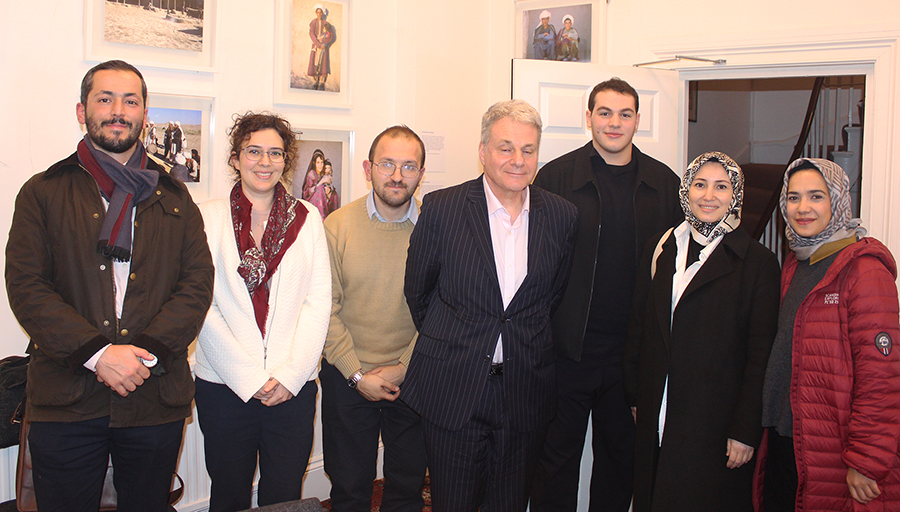
Prof Muhammed Hasanov in the centre at the end of the lecture.
Prof Muhammed Hasanov hybrid lecture: ‘Tracing the Ottomans in Britain: Newly Discovered Graves and Their Stories’, 9 November 2026 - flyer:
1- During lockdown you were based in Liverpool working on your thesis and while browsing the British Newspaper Archive out of curiosity, searching for any references to Ottomans who had visited Liverpool you came across the name of a Turkish sailor, Hasan Mehmed. Further research by you let you to the frigate Geyvan-i Bahri, which arrived in Liverpool on June 19, 1856 and remained there for just under a year for the instillation of modern guns and machinery. Over the next 11 months, 28 more Ottoman soldiers died and were buried alongside Hasan Mehmed who was the first to die from cholera. Do we know any thing more about the these other soldier apart from their names?
Apart from their names we don’t have much information we only know their which on average was 26 years old. Also one of the them which is Mustafa Omer was a Navy officer.
2- Mehmed Kamil was specially appointed by the then-Sultan as Ottoman Consul General in Liverpool to establish close ties with the Muslim community there. Kamil quickly established himself as a visible and active figure, distinguishing himself from previous Ottoman consuls. Mehmed Kamil reported that there were “forty-four existing Muslim graves in the cemetery, more than half belong to Ottoman Navy soldiers who died as martyrs while in a foreign land, reaching the rank of martyrdom and divine forgiveness”, a cemetery now closed for burials and with a future threat of the burial ground being erased. Kamil suggested to the Sultan of “acquiring a suitable piece of land nearby and turning it into a cemetery”, and transferring the remains of the aforementioned martyrs there, however his request to the Sultan was unheeded. Do you think this was purely a matter of lack of funds from a strained Ottoman Empire facing many disasters at home?
Yes, it could be possible, but next year, in 1900, when Kamil repeated his request, this time through the London Embassy, about purchasing suitable land, this time it was accepted. So, it is highly possible that there had been a bureaucratic issue or simply the document was forgotten to proceed.
3. 66 Ottoman soldiers were buried between 1857 and 1859 in the Royal Naval Hospital burial ground (No Place Field Cemetery) in Plymouth, but today no tombs remain. During this period, two ships, Fathia and Shadia, were stationed in Plymouth, and around 1,500 Ottoman soldiers were present and again presumably this was connected to modernisation of these ships to face up to the growing Russian threat. Did Ottoman captains keep ship logs and if so, is there a central place where these would be kept today?
Under normal circumstances, Ottoman captains kept ship logs. However, for Fathia and Shadia, I have not yet identified any logs dating from 1859. I have, however, found Fethia’s log from 1861. There needs to be more research on this point. Personally, due to time restrictions, I have not been able to do it. The surviving Ottoman naval logbooks are primarily held at the Ottoman Archives in Istanbul, within the Deniz Tarihi Arşivi, particularly the Erkân-ı Harbiye-i Bahriye Jurnal Kalemi Defterleri collection (EHB.J.d.).
4- Were all Ottoman sailors Muslims? Did you ever come across any Christians and thus could the number of known burials in Britain be an under-estimate as they would have been buried randomly in existing Christian cemeteries?
In the Ottoman Navy, ordinary sailors (enlisted men) were recruited mainly through a conscription system from young men living in Muslim towns and villages, particularly along the Black Sea and Aegean coasts. During the period I researched, although a few individuals serving as ship interpreters or doctors were non-Muslims, the crew members were Muslims. Therefore, I did not encounter any non-Muslim names in the records I examined.
5 You recently discovered a written reference to a lost Ottoman tombstone dating from 1794 in West of Middle Temple Garden near Essex Street, London. The tombstone has since been lost but was discovered by an Orientalist in 1853. He transcribed the text both in Ottoman and in translation and the name of the person was Al Hajj Ghoubin Teza. His name is clearly Arabic and you posit that he may have been a wealthy North African merchant, but then why would the script be Ottoman and not Arabic?
It is an interesting question. I believe that the person was a North African merchant, and I believe that it is highly possible that, given the very small Muslim population living in London at the time, the Ottoman ambassador Yusuf Aga and his entourage were the only organised community who could carry out the funeral and also arrange for the tombstone. This could explain the reason for it.
6.There are 6 well kept Turkish graves in the Isle of Man from the First World War, prisoners of war who died of natural causes. Do we know their names?
Actually number is not six but seven: Ramazan Mehmet 17 November 1916; Hüseyin Halit İbrahim16 February 1917; Hüseyin Ali 20 April 1917; Hasan Derviş 18 May 1917; Mehmet Ali 17 September 1917; Kalan Yeğen 9 April 1918; Ahmet Hasan 15 July 1918
7. Brookwood Cemetery, also known as the London Necropolis, is a burial ground in Brookwood, Surrey, England with a dedicated Muslim section dating back to the late 19th century. You noted a number of Turkish burials from the Second World War period. Were these Turkish soldiers that somehow ended up in Britain during war-time conditions? Do you know if Turks were buried in this cemetery before this time?
The Turkish graves at Brookwood Cemetery belong to the Turkish Air Martyrs’ Cemetery, where fourteen Turkish Air Force officers who died in Britain between 1942 and 1945 are buried. These officers had been sent to Britain for pilot training during the Second World War, and most died in training accidents rather than in combat. The cemetery also contains the grave of Arif Bey, a young Ottoman military officer who was sent to Britain by Sultan Mahmud II for military training. He died in 1836 and was originally buried in Woolwich. His remains were transferred to Brookwood Cemetery in 1962. Therefore, although the Turkish Air Martyrs’ Cemetery mainly contains Second World War burials, Arif Bey represents a much earlier Ottoman presence in Britain.
8. A sort of forgotten person in history, Ismail György Kmety Pasha who after the failed Hungarian revolution of 1848 then served the Ottomans as a general in various battles including the Crimean War. He died in 1865 and is buried in Kensal Green cemetery in London and the Ottomans paid for a substantial monument for him. Is this usual or unusual for the Ottomans to honour foreign born soldiers in this way? Rüstem Mariani Pasha served for 10 years as the Ottoman Ambassador in London and is also buried in St Mary’s catholic cemetery in Kensal Green. Do we know if his tomb was also paid by the Ottoman Government?
Personally, I have not come across any other examples of the Ottoman government honouring foreign-born soldiers in this way, apart from İsmail Kmety Pasha. Regarding Rüstem Pasha, unfortunately, I do not have any information about whether his tomb was paid for by the Ottoman government.
9. Mehmed Sıdkı Efendi was the Ottoman chargé d’affaires in London between 1803-1811 where he died and while his grave no longer exists, an obelisk bearing 60 names for a former cemetery at St Pancreas also lists his name. Do you think that obelisk was the only memorial stone that the local municipality decided to save when the cemetery was converted to a park and the names listed are sort of random, perhaps the tombstones still lying around whose names could be read, and so the tablet recorded for posterity in one line each those names before those stones were then removed? Is it possible that the former cemetery had a Muslim section?
It was not an obelisk, but rather the Burdett-Coutts Memorial Sundial, erected in 1879, where Sıdkı Efendi's name is mentioned. Following the construction of the railway through part of St Pancras Old Churchyard in the 1860s, many tombstones were removed and placed around the Hardy Tree, an ash tree surrounded by relocated gravestones associated with the young Thomas Hardy, who helped oversee the clearance of graves. The Burdett-Coutts Memorial Sundial was subsequently built to commemorate those buried in the churchyard. I have carefully searched the site, but I have not found any grave bearing the name of Sıdkı Efendi. In fact, most of the inscriptions on the surviving tombstones were illegible. I have also not found any evidence suggesting that the former cemetery had a dedicated Muslim section.
10.The well-known Portsmouth burial ground displays 26 Turkish tombstones but you estimate the true number of burials is more like 50. Which archives made you come up with this figure of non-visible graves?
Last August (2026), while conducting research at the National Archives in Kew, I was looking for burial records relating to the 66 Turkish graves in Plymouth, which we have still not found. By coincidence, I came across burial records at Haslar Cemetery revealing the existence of 26 additional Turkish graves.
11. Kostaki Musurus Pasha who was the Ottoman ambassador to Britain, which he served for 35 consecutive years, until his retirement in 1885. Do we know if his correspondence or writings survive and perhaps provide clues to the nature of the Turkish community in Britain at the time?
There are documents relating to Kostaki Musurus Pasha and his correspondence in the Ottoman Archives, but I am not aware of any separate book containing his writings or correspondence.