Nagihan Haliloğlu hybrid presentation: ‘Halide Edib in Hampstead: The English as Occupier and Host’, 3 September 2024 - flyer:
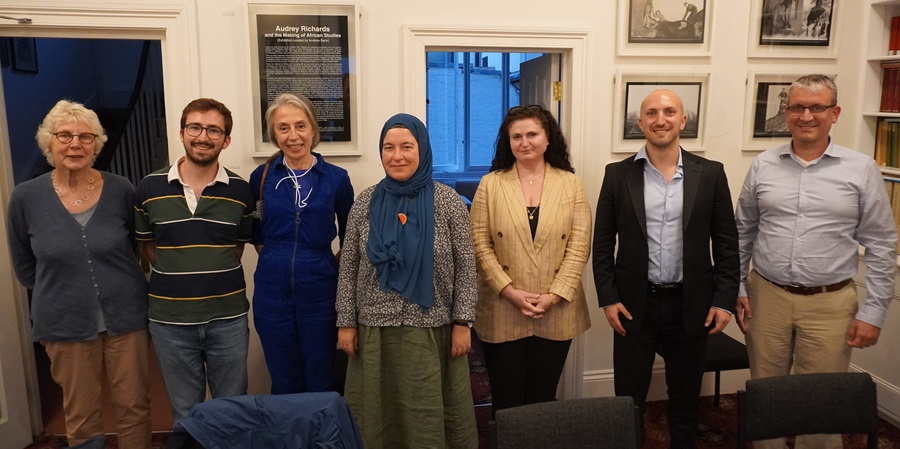
Nagihan Haliloğlu in the centre post lecture.
Nagihan Haliloğlu hybrid presentation: ‘Halide Edib in Hampstead: The English as Occupier and Host’, 3 September 2024 - flyer:
1- Clearly Halide Edip is a person who crossed the Ottoman and Republican times, also the Muslim and Western worlds with her education both with an English nanny and later Robert College with an American style of education. Would you describe her as belonging to a small minority of late Ottoman era women who were this well exposed to multiple cultures or do you think high-calibre education for late period Ottoman women wasn’t too dissimilar in numbers to men of that era who were also foreign language educated?
I’m afraid I do not know the late Ottoman era well enough to give you an answer but there seems to have been many women’s organizations which were peopled with elite Ottoman women and the more I read the more I come across these figures who actually have written their memoirs. Figures like Suat Derviş and Sabiha Sertel come to mind, but there are many more to be discovered. These women were of course all connected to either the court or the professions through their fathers. One such figure that came before Halide Edib was Fatma Aliye, so there is definitely a genealogy of these women, who were educated sometimes despite their father’s wishes. Fatma Aliye is a great case in point- she learnt French while listening to the classes that her brother was taking, and seeing her progress her father decided she merited a tutor on her own. I think we can extrapolate from here that women, compared to their brothers, had to work a bit harder to get the education they deserved.
2- Halide Edip stayed in Istanbul during the first 2 years of Allied occupation of Istanbul between 1918-23 and she famously gave a speech condemning the Greek occupation of Izmir in 1919. Does this act suggest Turkish women of this period were viewed by the menfolk as near equals worth listening to and do you think her being a woman allowed her more freedom in this activism under the noses of the British military command that was busy arresting men it saw as siding with the Kemalist forces?
I must admit that Halide Edib’s Sultanahmet speech remains a wonder for me. My explanation is that it was already accepted in Ottoman society that women could work as teachers, nurses and writers and having pretty much shown herself to be good at these things, and having been part of the Türk Ocağı the predominantly male intelligentsia of the time was aware of Halide Edib’s potential. Her father putting so much effort into her education, and her knowledge of the world did make her stand out as an orator. It looks like she wasn’t just addressing the Turkish crowds in Sultanahmet but the Allied Forces who all present there knew were listening. She must have been seen as a cultural negotiator- and when she moved to Ankara she was the one reporting to news outlets in the world what was happening in the war of independence- and so she is named as the founder of Anadolu Ajansı.
And yes, being a woman did allow her to move more freely in Istanbul for a while, and she became the carrier of messages, but even this didn’t last very long we see in İpek Çalışlar’s biography. Also, as her novel Shirt of Flame shows, the Turkish public was keen to put a female face to the suffering that the country was going through, and Halide Edib appealing as a woman to the men of the country to defend the land rings more urgent than a male call to arms.
3- Presumably occupied Istanbul had a fair sprinkling of foreign correspondents reporting on the situation on the ground. Do we know if Halide Edip interacted with any of these or even tried to provide a more balanced view regarding the aspirations of the Ottoman Turkish nation?
The English villain in Shirt of Flame is a journalist, however in Halide Edib’s autobiography one doesn’t come across any journalists- she mentions high ranking English officers in Istanbul. When she moves to Ankara she must’ve had more dealing with journalists, writing the resistance’s press releases as it were but this is not an area I have not looked into.
4- Halide Edip came from a conservative background so presumably she would have recognised the authority of the Sultan and his status as Khalif. Do her writings convey how the Sultan might have lost legitimacy with her and the broader population with his passive support of the occupation?
This is a very interesting question. There seems to be different strands running through her childhood when it comes to her education. In The Turkish Ordeal she focuses on the Turkish people’s struggle and although a take-down of the Sultan could fit into the narrative very well she doesn’t seem to dwell upon that much.
5- In 1908 Halide Edip began writing articles on education and on the status of women for Tevfik Fikret’s (prominent educator and poet) newspaper Tanin and the women’s journal Demet. She later became involved with the Turkish Hearths (Türk Ocağı) in 1911 and became the first female member in 1912. She was also a founder of the Elevation of Women (Taali-i Nisvan) organization. Would you describe Halide Edip as the most prominent feminist of the late Ottoman period?
Her putting the country and ‘the state’ in imperial or republican form first can also be seen in her particular feminist approach. She certainly lives the life of a feminist, not bowing down to male pressure, divorcing her husband, and while in novels like Handan she makes troubled marriages her subject matter, she doesn’t much talk about the societal aspects of how men-women relationships are regulated, but takes a romantic approach. The national struggle is first and foremost- I would say even ‘conservative’ Fatma Aliye (though she is a bit earlier) has a more feminist approach, dealing with the norms of patriarchal marriage in her novels. And if you want to talk about the ‘most prominent’ figures like Suat Derviş (a bit later) and of course Fatma Aliye’s sister Emine Semiye were much more outspoken about women’s position in Ottoman society. I guess Halide Edib’s discourse is about improvement of the current system, while Suat Derviş and Emine Semiye were much more revolutionary.
6- Halide Edip has strong views and clearly didn’t always fit in with fellow nationalists. As a result of her second husband Adnan Adıvar’s participation in the establishment of the rival Progressive Republican Party, the family moved away from the ruling elite and when the one-party period started in 1926 with the Progressive Republican Party’s abolition. Yet in the same year the progressive Turkish civil code was enacted which meant that henceforth men and women were made equal with regard to inheritance and testimony. So was the reason for Halide’s escape to Europe was a mixture of the political climate and personal animosity with the new ruling elite? Do her writings give additional clues?
In her memoirs the immediate reason given for her exile is indeed her husband becoming a persona non grata in Turkey due to his involvement in Progressive Republican Party. In The Turkish Ordeal she paints him as a man who does not take kindly to opposition. In Atatürk’s purges even before her husband’s party she paints herself as someone who would ask for mercy and he giving none- incrementally making herself a thorn in his side.
7- Which of Halide’s works do you admire the most? Do you think the messages in those still resonate today? Do you think her work is recognised sufficiently for what they are in modern Turkey?
I like Sinekli Bakkal and the first part of her memoirs for her descriptions of life in Istanbul. House with Wisteria’s first chapters are exemplars of modernist writing- she starts in the third person and switches to first in the later chapters once she has gained critical faculties, as it were. I don’t think she is recognized enough at all. I was especially interested in reading her writing on London, what it means to be a Turk in Britain at the time, how to approach academics in the UK etc.- there is so much material in there to be a guidebook for young people who want to study abroad. I personally wish I had read all that, including her Akşam columns on England, before visiting the UK myself. Her involvement with the establishment of the republic also makes people pay more attention to her ‘political novels’ for content- I think we need to reassess her work through its formal features and her connections to modernist style.
8- In 1945 towards the tail end of her very productive writing career she pens a play titled ‘Masks or Souls’, what you describe as an absurdist play on Shakespeare references. Do you think this was her playing on her deep love for Shakespeare and taking a different creative approach or do you think there is a deeper and maybe political meaning in a country still effectively a one-party state?
Masks or Souls is a very good case in point for Halide Edib’s work to be assessed through a literary rather than a political sense. It is a highly experimental, absurdist play which has never been put on- it presents several staging challenges, and this is precisely why it would be exciting to work with for contemporary artists. It is a play that brings together several important figures that Halide Edib has been ‘in conversation’ all her life, starting with Shakespeare. Halide Edib thought Nasreddin Hoca was a very Shakespearean character, Turkey’s own Falstaff, and this is the play where she brings them together. Another towering figure in Ottoman education, Ibn Haldun, makes an appearance in the play—it’s a veritable pantheon. And of course, the gist is political as with all of Halide Edib’s work, but I think we should move beyond that and recognize her playfulness.