Prof. Dr. Zeynep İnankur hybrid presentation: ‘An Ottoman Orientalist: Osman Hamdi Bey’, 9 March 2026 - flyer:
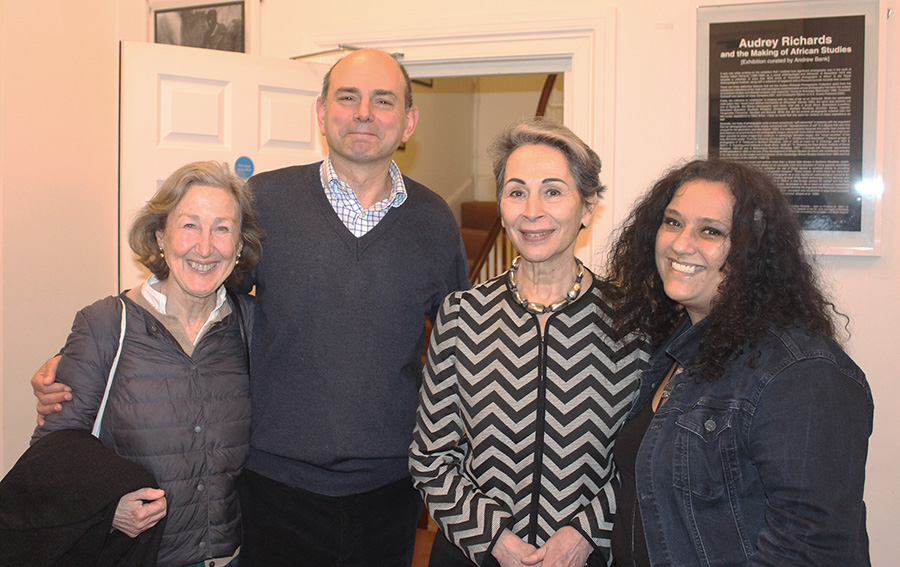
Prof. Zeynep İnankur with friends post lecture.
Prof. Dr. Zeynep İnankur hybrid presentation: ‘An Ottoman Orientalist: Osman Hamdi Bey’, 9 March 2026 - flyer:
1- Osman Hamdi bey studied law, first in Istanbul (1856) and then in Paris (1860). However, he decided to pursue his interest in painting instead, left the Law program, and trained under French orientalist painters Jean-Léon Gérôme and Gustave Boulanger. He must have upset his father in that decision having invested time and money in a profession that would have been seen as prestigious and financially secure to something far less, particularly in the Ottoman world at the time. Do you think this remarkable change of direction says a lot about a person who clearly was enraptured by the artistic environment Paris offered. Both these art teachers also trained a whole range of other international students as well and presumably there was cross-influencing amongst these peers as well. In addition, Paris was a centre for the dissident ‘Young Ottomans’, and presumably in the 9 years in that city he must have got to know of their agenda. Do we know much more about these interactions during Osman Hamdi’s time in Paris?
His father was quite upset that he had not completed his law studies, which was the reason he called him back to Istanbul and sent him to work under Midhat Pasha, the newly appointed governor of Baghdad. Osman Hamdi was definitely enraptured by the artistic environment of Paris, and after the success he enjoyed at several exhibitions, he became convinced that he could make a living as a painter. He was a generation older than the Young Turks but he was a great admirer of Midhat Pasha. We know that he was critical of Abdulhamid’s regime and expressed his satisfaction with the Young Turk Revolution and the Constitutional Monarchy of 1908.
2- Osman Hamdi’s father, Ibrahim Edhem Pasha was also trained in Paris as a mining engineer and rose high up in Ottoman administration and occupied various roles including the office of Grand Vizier in the beginning of Abdul Hamid II’s reign between 5 February 1877 and 11 January 1878. He resigned from that post after he deemed the Ottoman chances on winning the Russo-Turkish War (1877–1878) had decreased, which ended with an Ottoman defeat 2 months later. Do you see in Ibrahim Edhem Pasha also the results of a European education and thus this foresight of inherent Ottoman weaknesses exposes to modern armies. Was Ibrahim Edhem Pasha one of the Ottoman leaders who pushed for deep reforms while pursuing various Osman Hamdi bey was appointed head of the newly formed Archaeology Museum in Constantinople in 1881, and by obtaining the publication of the 1884 bylaw that forbade the export of finds, he established a de-facto monopoly over antiquities, which gave him power and leverage over foreign archaeologists, while providing the museum with a steady flow of artefacts. Do you think he had a game-plan before this date as he saw artefacts being shipped out of the country as in earlier times presumably non-Islamic finds were not considered part of the heritage of the Empire?
Despite his irascible temperament which earned him a nickname “Deli Corci” (“Mad George”) by his opponents and his shortcomings in matters of state, İbrahim Edhem Pasha was an honest man, known for his loyalty to the state. The first Ottoman Parliament opened during his tenure as grand vizier. He was, however, unable to exercise sufficient influence during his grand vizierate, and the decisions taken during this period largely reflected the will of the Sultan. He possessed extensive knowledge of the natural sciences as well as expertise in mining engineering. He contributed articles on the natural sciences to Mecmûa-i Fünûn and, in 1869, published a regulation concerning weights and measures. He played an important role in the reform of the observatory and the Imperial Printing House (Matbaa-i Âmire) and made considerable efforts toward the establishment of Darüşşafaka. He was also instrumental in introducing the decimal system. His treatise on the new system of measurement, Yeni Mikyaslara Dair Risâle, was published under the name of his son İsmail Galib. For the 1873 Vienna World’s Fair, he collaborated with Ahmed Vefik Pasha in preparing Usûl-i Mi‘mârî-i Osmânî (Principles of Ottoman Architecture), which was published in three languages. He also wrote the first volume of a History of Andalusia (Endülüs Tarihi). He ensured that his sons received an excellent education, and all three went on to occupy important places in the history of Turkish culture and art.
When Osman Hamdi was offered the position of Museum dirctor, he was very surprised and initially tried to turn it down, as he had no knowledge or experience of archaeology.So no game-plan before this date.
3- Osman Hamdi focused on building relationships with international institutions, notably the University of Pennsylvania, from which he received an honorary degree in 1894. In 1902, he painted the excavation of Nippur as a gift to the University of Pennsylvania Museum. This arrangement clearly suited this University as permits were hard to come by now but do we know if this was also a ‘training board’ for budding Ottoman archaeologists as part of the plan?
I don’t know if young Ottoman archaeologists worked at Nippur excavations, but I am sure they took part in other excavations organized by other foreign archeological institutes. So yes, these excavations must have served as an important training ground for them.
4- In 1882, Osman Hamdi instituted and became director of the Academy of Fine Arts, which provided Ottomans with training in aesthetics and artistic techniques without leaving the empire. When it opened in 1883 it had eight instructors and 20 students and all these teachers were either foreign or non-Muslim Ottomans, so not selecting from any of the Moslems such as Seker Ahmet Pasa and by inference rather than selecting still-life / landscape painters choosing those who practiced on the human figure. Did this show Osman Hamdi bey was by this stage influential enough to go against any pressure from the palace to deliberately exclude existing capable Muslim artists so as to instil a full European mode in this new school? Do we have evidence that there was push-back developing by some of the conservative elements in Ottoman society through this artistic reform?
Although there were some complaints in Ottoman circles (not directly from the Palace) that the project was too Western in character, that non-Muslim professors were employed as its teaching staff, it was generally supported as an important “civilizing project.” Certain adaptations, however, were necessary. Since the use of live models was either impossible or extremely difficult, plaster casts were used instead, and students could even turn to the museum’s sculpture collection for the study of the human figure. In fact, when some students attempted to paint from a live model, Osman Hamdi summoned them to his office and reprimanded them.
5- In 1901 Osman Hamdi painted his most controversial work, Mihrap / Genesis, where the visibly pregnant sitter in Western clothes is sitting in the Rehal, where the Qur’an is usually placed, she has displaced the Qur’an now on the floor and is now herself the focus of attention in this painting and she has also turned her back away from the prayer niche, and thus also has turned her back against Mecca, the holiest site in Islam. This painting was clearly for the foreign audience like most of his other paintings and exhibited in 1903 at the Royal Academy Exhibition in London. Do you think we can over-interpret this painting, in today’s lens, as somehow revolutionary or blasphemous, but merely continuation of his Orientalist theme for selling to a market where such concerns wouldn’t matter – or just symbolically raising the value of pregnancy leading to creation of new life?
Osman Hamdi placed motherhood and the act of giving life above everything else, even above religion itself, presenting the woman almost as a goddess seated before the mihrab. He had no concerns in exhibiting this painting in Europe but even today it is quite a revolutionary and even a blasphemous painting for Turkey considering the Qur’ans lying on the floor and their place taken by a pregnant woman. That is why the identity of the painting’s owner has been kept confidential.
6- Do you think it is somewhat simplistic to label Osman Hamdi’s work as ‘Orientalist’ as first he was from the ‘Orient’ himself and secondly, he was hyper-realistic in the depictions of places and people and didn’t venture in the any ‘titillation’ themes, such as hammams and harem scenes? Could we characterise him as the one to push back on a damaging fantasy aura created by Western artists and using the same medium, to create a sense of pride and dignity in the depiction of Ottoman lives?
For me he is still an Ottoman Orientalist but differing from his European colleagues in the way he represented his own culture, his own people. His painting technique is very similar to the Orientalists but the subject matter is different, he depicts them with dignity, in settings free from the usual Orientalist fantasies. Although all these paintings were done for the European market, he strives to present his own country in a positive light and I believe that he takes pride in being part of the Ottoman civilization.
7- There was a recent auction sale of an important Osman Hamdi painting (25 March 2026 - At the Mosque Door, Bonhams of London) that sold for just above estimate range at £3.6 million. Would you rate the works of Osman Hamdi bey to be of national importance to Turkey, and though no doubt the price is likely to be considerable for similar pieces in the future, should the state set aside funds to purchase similar pieces (or by other high-profile artists) to build up further their national collection?
The works of Osman Hamdi are of national importance to Turkey, but I don’t think the state will set aside funds for Osman Hamdi paintings as both he and his paintings are still somewhat controversial for the present conservative regime.
8- Amongst your achievements is an exhibition of Osman Hamdi bey’s paintings and private objects held in 2022 in the Istanbul Painting and Sculpture Museum. The exhibition was divided into three sections as portraits, landscapes, and orientalist works, his lesser-known landscape paintings are among the remarkable parts of the event, as recorded by the news article at the time. Can you tell us more about these landscape portraits, their location and were these more for the few exhibits in Istanbul earlier in his career? Are any of these items still on public display?
Apart from some landscapes dating from his years in Baghdad in the 1870s, he painted a landscape of Venice in 1878, a landscape of Saida in 1891 and a series of landscapes of Gebze and Eskihisar near Istanbul in the 1880s and 1890s. In later life Osman Hamdi bought or built a house in Eskihisar, a village near Gebze, as a country retreat. He painted landscapes of this area, for which he felt a deep affection. Sultan Abdülhamid admired Osman Hamdi’s work and in 1888 he was commissioned by him to paint a large landscape (whereabouts unknown). There are five other landscapes in private collections.
9- Some of Osman Hamdi bey’s paintings including his famous one (Genesis) are now listed as ‘location unknown’. Do you think this is an unfortunate feature of modern times when art is seen by some as an investment item and kept locked in safes away from eyes and thus depriving visitors and experts the in-person enjoyment a real painting provides?
Unfortunately, some private collectors prefer to keep these works out of the public eye, and some will not even allow them to be photographed or lent to exhibitions. I think this is a great loss to the art world. And when these works come up for auction, there can also be problems with provenance, since some owners prefer to remain anonymous. But Genesis is an exceptional case, and in this instance, I can understand and agree with the owner’s decision to remain anonymous.
10- Do you think Osman Hamdi bey had an influence on other foreign ‘Orientalists’ of the time, such as increased attention to authentic detail, including visiting the actual places and using photographs and props to ensure that accuracy?
I don’t think that he influenced other foreign Orientalist painters, on the opposite he copied their techniques. When he first encountered Orientalist painting in Paris, Orientalism was already well established. But in the years that followed, he had one important advantage: he had the collections of the Imperial Museum at his disposal.