Andrew Finkel hybrid lecture: ‘Constantinople in Olympia: How the nineteenth century Eastern Question was transformed by spectacle, song and dance’, 27 May 2025 - flyer: - slides:

Andrew Finkel in the centre post lecture.
Andrew Finkel hybrid lecture: ‘Constantinople in Olympia: How the nineteenth century Eastern Question was transformed by spectacle, song and dance’, 27 May 2025 - flyer: - slides:
1- Travel to Constantinople in the latter part of the 19th century wasn’t for the feint hearted coming from the other end of Europe so the marketing of bringing Constantinople to London makes perfect sense even today. But for this obviously it requires an amazing organiser and investors ready to make the considerable initial outlay. How much do we know of these investors, some of which you named in the group photo of the ‘Lyons team at Olympia’?
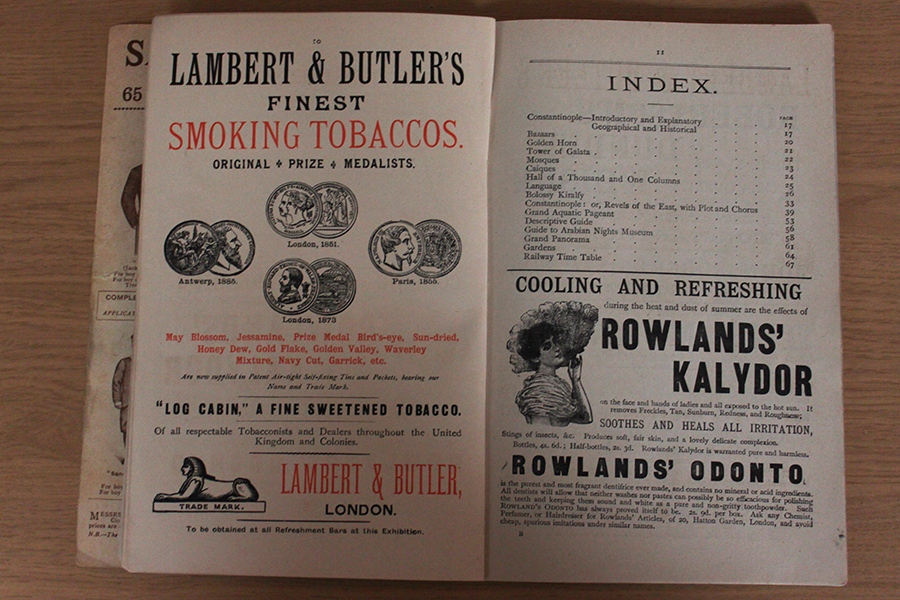
The driving force was Montague (“Monte”) Gluckstein, director of Salmon & Gluckstein-- tobacco merchants and manufacturers - and a founder of J. Lyons and Co. - the restaurant chain and hotel conglomerate. He was then the patriarch of what approximated to a family cooperative. Rags to riches dynastic fortunes were founded in what was heralded as the “largest tobacco retailing chain in the world” but were consolidated by the genius of Gluckstein and relations – that included Joseph Lyons - for running catering concessions for the large fairs and exhibitions so popular at the time. After successfully providing restaurant facilities for the Barnum and Baily Circus at Olympia, the company set off on their own in 1891 to lease the exhibition space for the spectacular “Venice, Bride of the Sea” – transforming the exhibition hall into a replica of the city with a vast theatre for a musical performance. In 1893, Olympia was going into liquidation and Gluckstein formed a syndicate that purchased it from creditors for a declared £140,000 pounds, on the condition that it be immediately resold to a syndicate for £180,000. It was here they produced Bolossy Kiralfy’s Constantinople. A few years later the deal which was to become the subject of litigation and scandal when it successfully alleged that Gluckstein had, among other things, inflated the initial purchase price by £20,000 at the expense of shareholders.
Regardless, the investment was considerable. The Constantinople advertising budget alone was £60,000 or £6.6 million in today’s money. In a curious way, Olympia Constantinople foreshadowed package tourism to the Turkey today where the fare and accommodation can be a loss leader to the profits made from the shopping which visitors do along the way. The basic admission charge to Olympia was a shilling but visitors could be expected to spend much more on refreshment and souvenirs. This accounts for the participation in the venture of Harold Hartley, a famous bibliophile but also the owner of a mineral water factory.
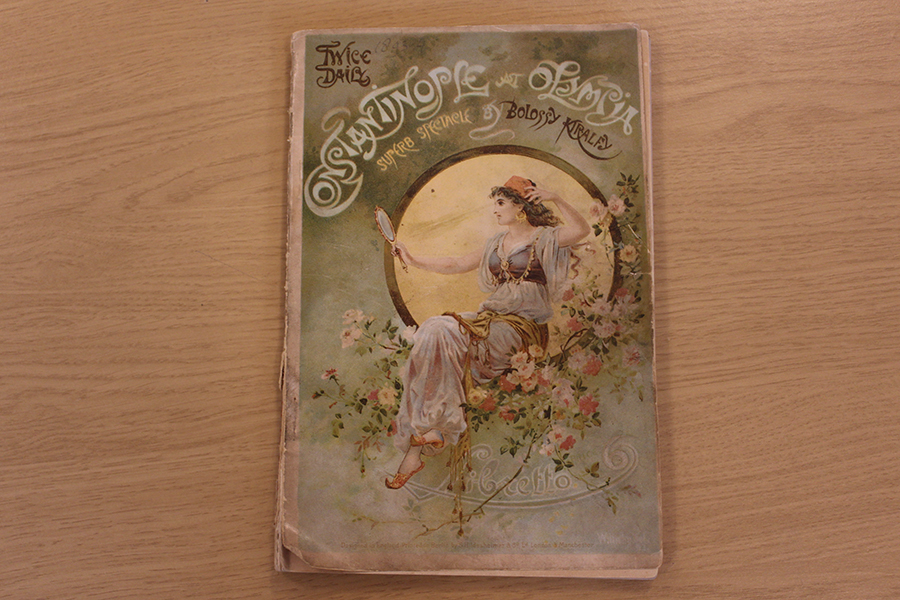
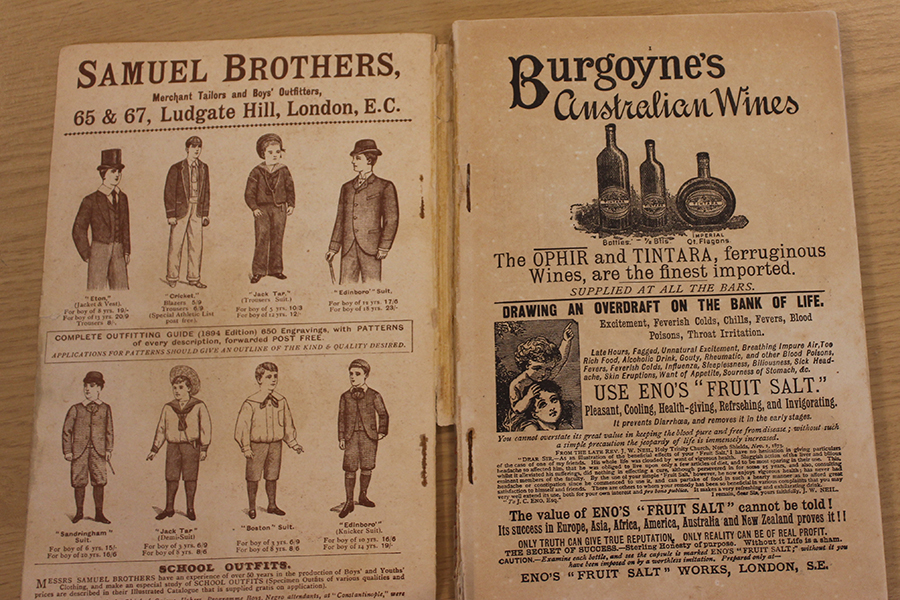
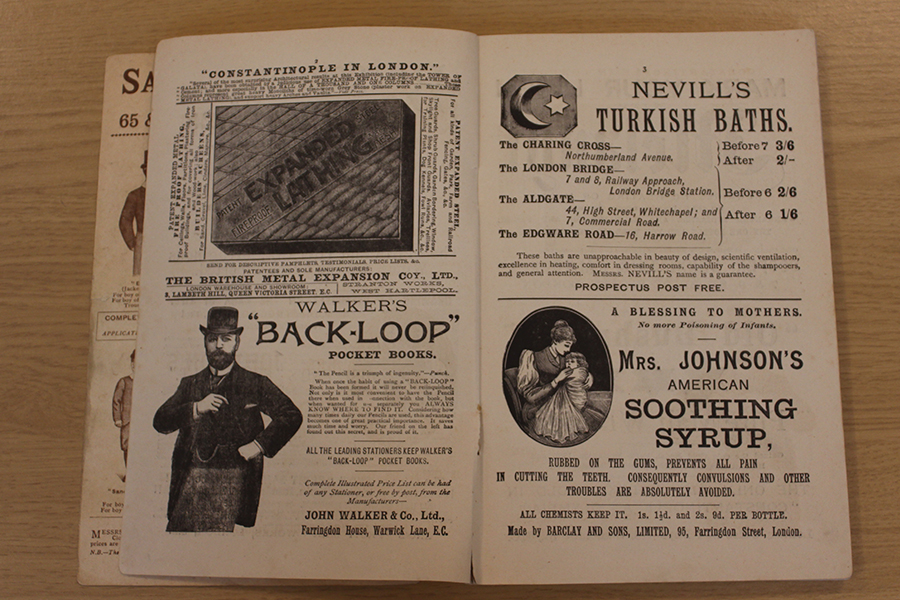
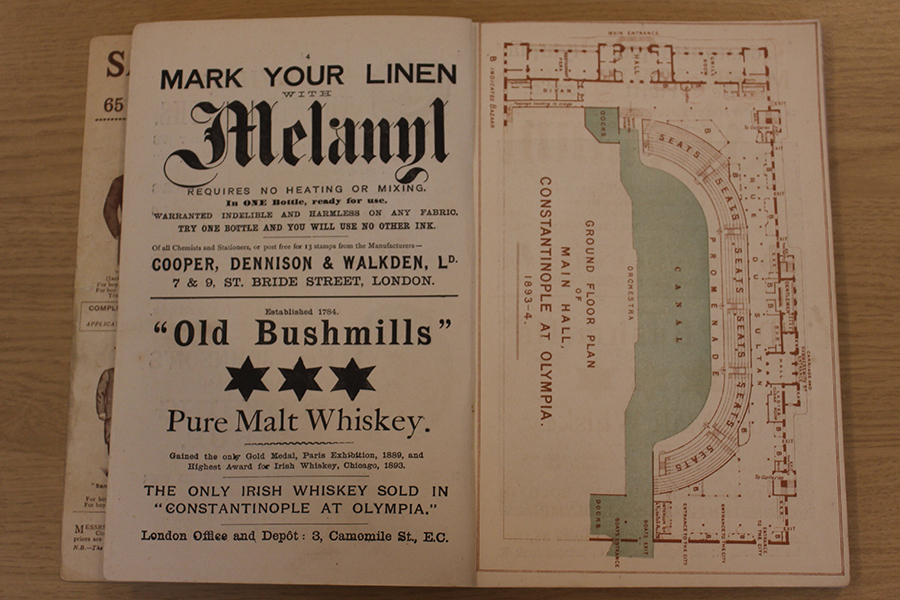
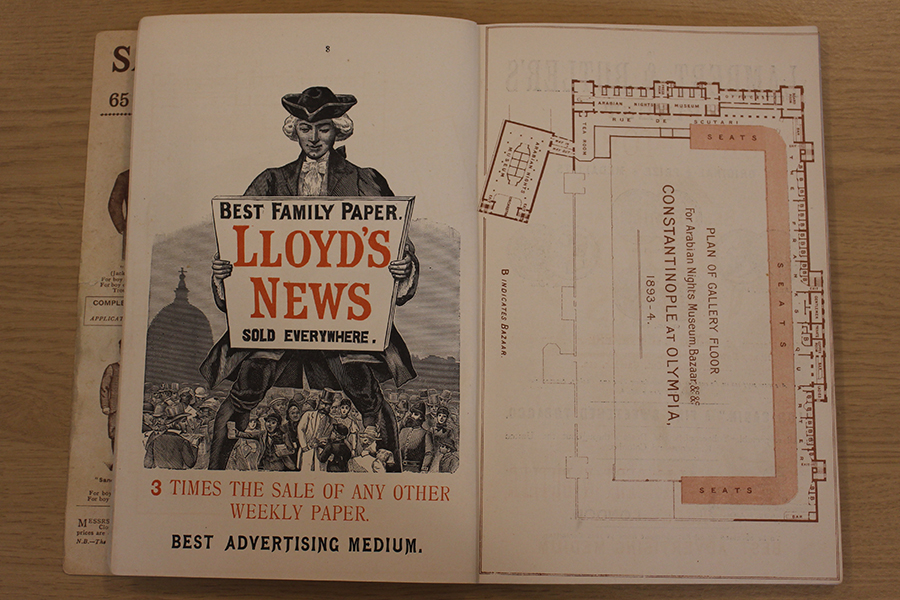
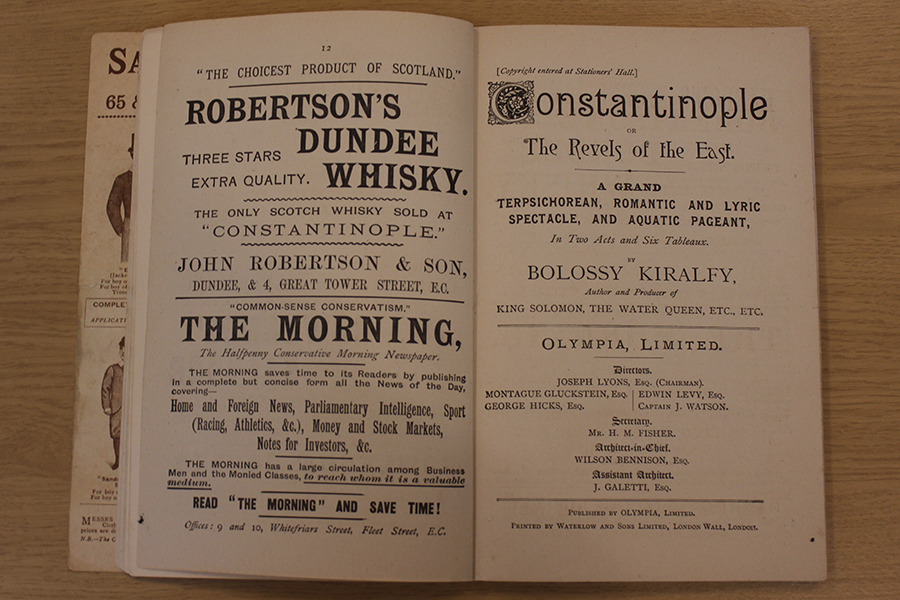
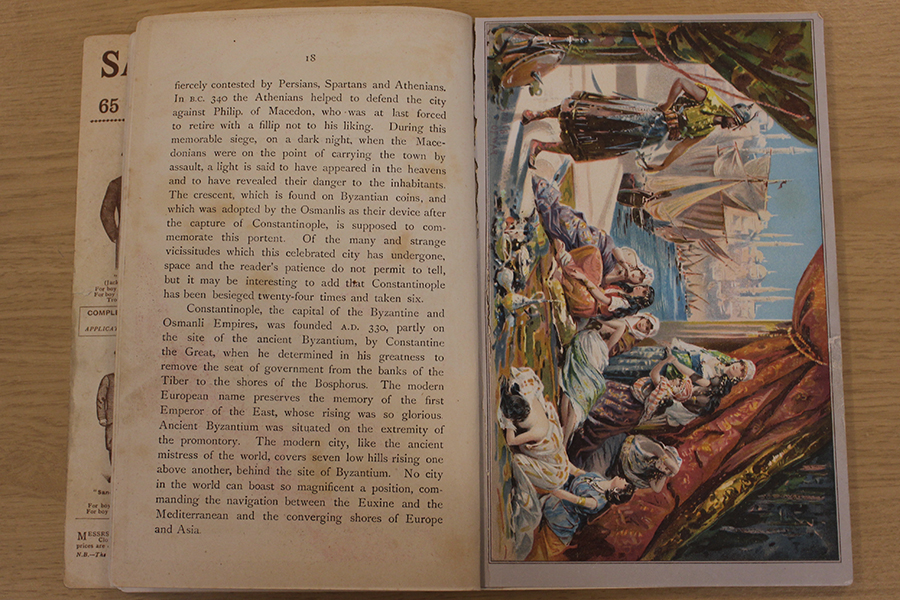
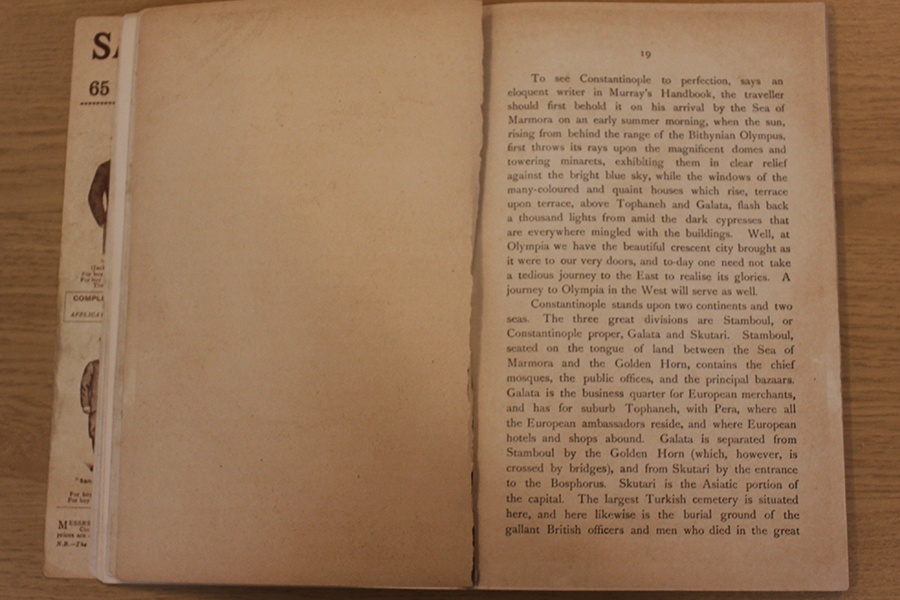
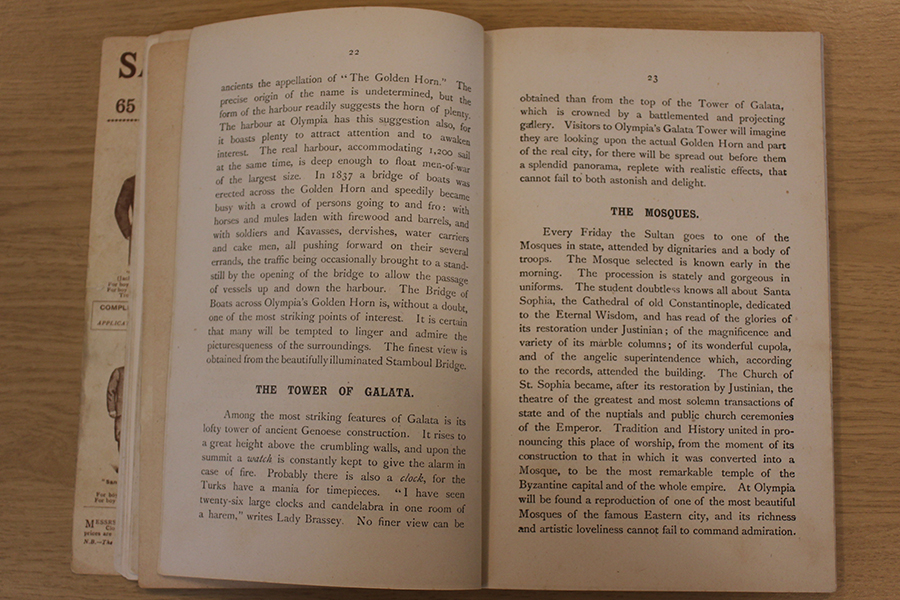
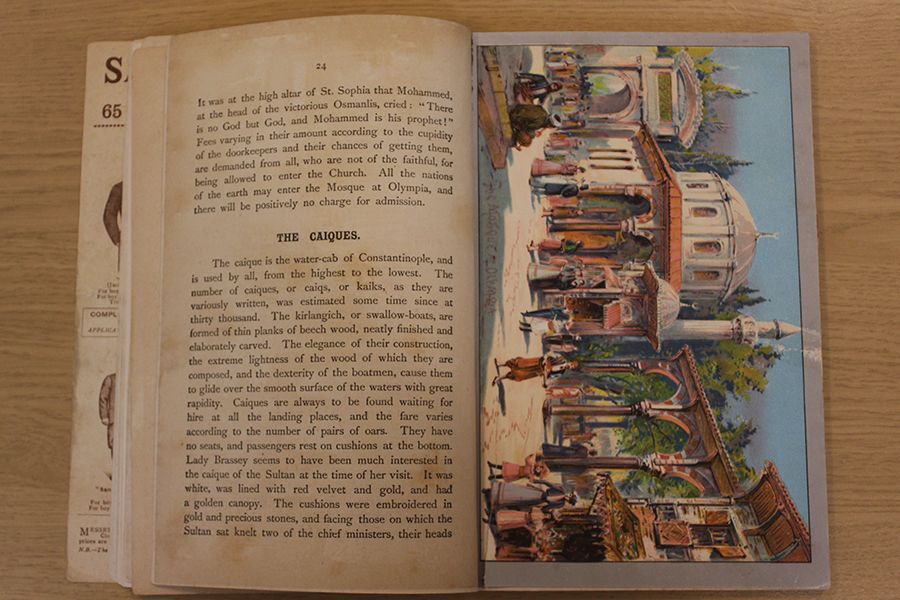
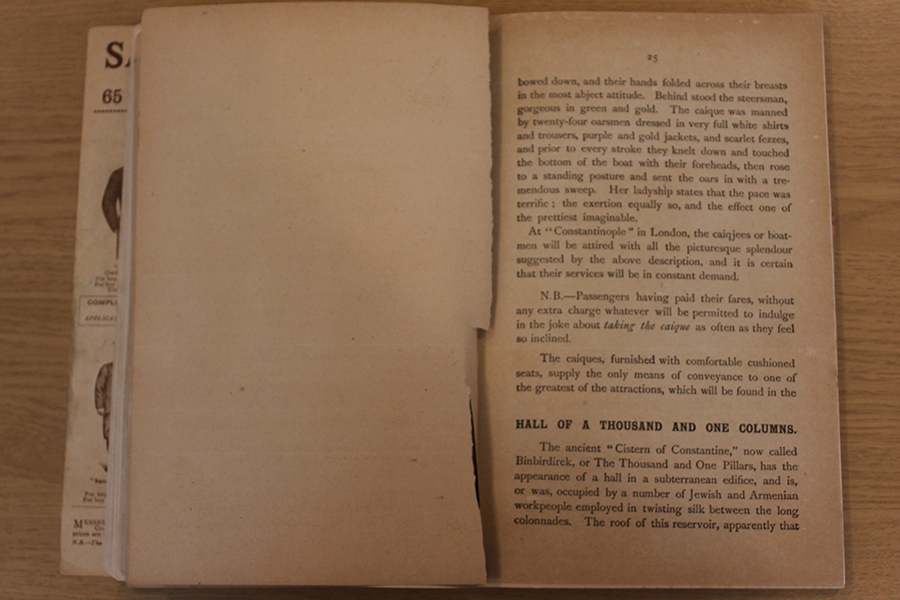
2- The 82 page programme of the 1893-94 Constantinople in Olympia Exhibition of which you have a copy is organised a bit like a Murray Guide (as well as being a theatre programme and a glossary of Turkish terms) and do you think beyond the spectacle of an imagined Constantinople there was a Victorian sense of ‘elevating the masses’ through information and education?
That this was clearly the case was made explicit in the programme as well as by the newspaper coverage of the day. The Manchester Guardian was impressed ‘that thousands of our toiling countrymen and country women will see faithful reproductions of scenes of Oriental art and interest which they can never hope to look upon in reality.’ It also praised the lack of alcoholic refreshment (Joseph Lyons was famously teetotal) for “fostering of habits of sobriety among holiday folk.’ The theatre programme was indeed meant to be educational in that it sets out a potted history of the city and its cultural institutions as well as a description of the Turkish language and a (presumably unnecessary) glossary of Turkish expressions to help visitors navigate a “foreign” place. At the same time, the organisers knew that the real draw of Constantinople in Olympia was the shock and awe of spectacle. The programme immodestly claimed that the production was “fired by the laudable ambition to produce an entertainment that should surpass any previous effort in the annals of amusement.” It was an attempt, largely successful, was to have one’s cake and eat it: present something opulently or perhaps Kitsch-ily over the top, but in the guise of an educational experience. The aim, as the programme confessed, was “pictorial beauty and exhilarating ‘business’ rather than historical accuracy.” At the same time there was an effort to “avoid glaring anachronism, and even to provide a modicum of instruction.”
3- The Times, The Manchester Guardian etc. had glowing reviews of the exhibition and you calculate around 5 or 6 million people visited it over the year the show was on, a huge number considering to smaller populations of the time. Do you think this positive exposure of the Ottoman Empire, both for newspaper editorials and the general public, had an ameliorating political effect vis-à-vis the Anglo-Ottoman relations at a time when reports of atrocities against Armenians and other agitating nations also filled newspaper columns?
This is the key question and as such not easy to answer. It informs the article I have written for Cornucopia magazine about to come out on the Olympia exhibition (with the clever title – Orient Excess!) To have – let’s estimate 6 million people, or what as at the time roughly the population of London visit this fairy-tale Constantinople must have had a huge impact on public perception – but what was that impact?
As a note of caution, it is worth considering that “Constantinople” succeeded “Venice in London” at Olympia which ran for over a year (1891-3) and attracted nearly five million visitors, but no one really bothers to think how this might have influenced Britain’s relations with the Kingdom of Italy. Are present day perceptions of Saudi politics coloured by last year’s Aladdin pantomime? Perhaps, more to the point, does today’s mass tourism to Turkey influence how that country is treated in the international arena; tourism is a form ‘soft power’ and I am inclined to believe that familiarity in this context breeds more tolerance than contempt. But it does not override the Realpolitik of international relations. It doesn’t take an Orwell to tell us that people can keep contradictory ideas in their head – a romantic interest in the Orient and a harder nosed interest in current events.
It is worth considering the timing of the Olympia “Constantinople.” It coincides with Gladstone’s return to office, and though he was notoriously scathing about Ottoman rule particularly when he was in opposition at the time of the 1876 Bulgarian uprising – there was no great deterioration in relations with the Porte during this, his last spell in government. The Conservatives – and most probably the Queen herself believed that maintaining the integrity of the Ottoman Empire was key to containing Russian ambitions and this was the gist of the article which introduced me to Olympia – a footnote in piece by the barrister Rafiuddin Ahmed that appeared in The Strand magazine. Olympia Constantinople closed in the autumn of 1894 just after the infamous Armenian uprising in Sasun in Bitlis province. I am no expert in this event but from what I make out the British press was initially ambivalent in its reaction – regarding it as a possible and deliberate provocation by Armenian revolutionaries and only later reacted to the harshness with which the insurrection was supressed by local commanders.
An interesting aside is that Today’s Guardian newspaper would have lamented the objectifying of Eastern culture, but the newspaper at the time was more concerned that Islamic culture was being glamorised and given some sense of equality to a non-Christian faith - using a slightly obscure quote from the then Archbishop of Canterbury to that effect.
More to the point, did the frivolity of the spectacle sanitise perception of what was going on in the actual empire or override the Gladstone government’s concern for the Ottoman Armenian and Christian populations. In my talk and in the article for Cornucopia which that talk informs, I trace the concern which the team that produced Constantinople had not to offend the Ottoman state. We also know that the Ottoman authorities came to regard the spectacle as potentially demeaning or at least tried to prevent it from being totally patronising. Again, as I say in the talk, the embassy in London was almost certainly ambivalent – trying to prevent any damage to national reputation but aware that it could increase the standing of empire in the public imagination. The programme described the stage “revels” as being set in the latter half of the seventeenth century and this I imagine was a deliberate attempt to set politics aside and create a setting equivalent to a fantasy never-never land. The three scenes of Act I took place around a maypole in England, a bull fight arena in Spain and a fairground in Vienna—so were every bit as patronising about Western Europe culture as Act II was about the East. Bolossy Kiralfy who produced the show writes that the Foreign Office encouraged him not to ruffle feathers as “They were increasing forces in Egypt and did not want trouble from a play in London.”
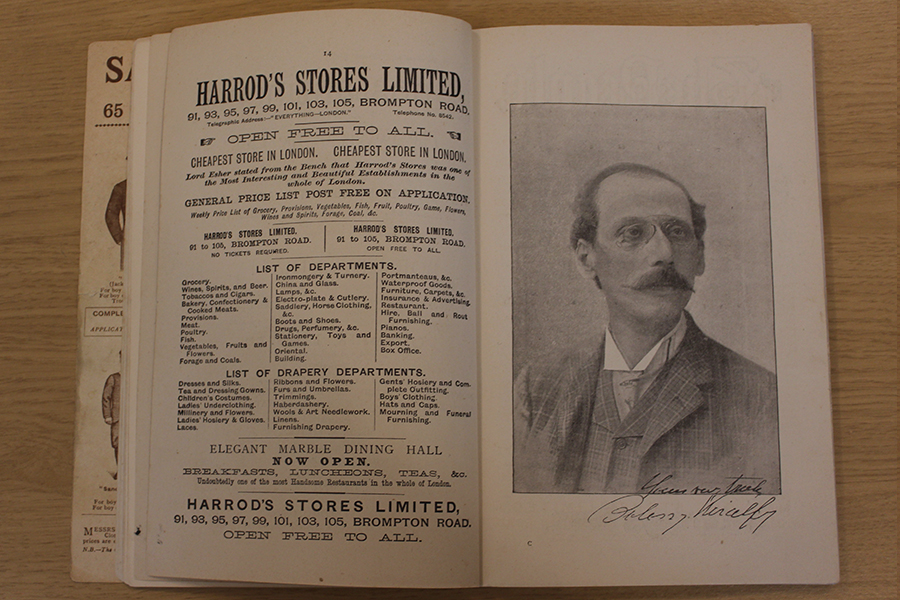
5- The man behind the venture, Bolossy Kiralfy was clearly a remarkable man as was his brother Imre Kiralfy who created the earlier similar production of Venice at Olympia as well as the venue of White city decorated in Oriental style for the London Olympics of 1908. These Hungarian brothers, sons of a revolutionary presumably never travelled to Constantinople (but did dance in Ottoman Belgrade earlier), so do you think Bolosy may have been advised by ‘real’ people from the Ottoman Empire, perhaps exiles and their families who sought escape in Europe and ready to take on roles such as ‘harem women’ which economic circumstances would force them to bear? There were 2,000 performers and there were matinees in the performances, so a huge undertaking. Do we know the ethnicities and the recruitment / training system gleaned from the various reports?
Bolossy Kiralfy who produced the stage performance writes of the near military tactics necessary to martial 2,000 performers twice daily and of the discipline involved. But he doesn’t write how the performers were recruited. We do know that the sultan withdrew a decree (irade) allowing Ottoman citizenry to work in the exhibition including boatman to steer the caiques that took visitors from Addison Road train station down an ersatz Bosphorus. According a report in the New York Times, this permission was suddenly withdrawn when a burlesque depiction of the Sultan was performed on quite a different London stage and the Ottoman ambassador successfully appealed to the Lord Chamberlain to have the scene removed. A book by Thomas Harding, a descendent of the Salmon family, records that as a result of this incidient,100 supernumeraries for the Constantinople performance had to be smuggled out of the empire at the last minute. These include the boatmen for the caiques. There was an exhibition of oriental carpets, and The Times refers to the inability to import weavers to demonstrate how to operate the looms - at least in time for the opening in December 1893 but that some workers were scheduled arrive later. Again The Times writes that “one of the loveliest things in the place is a harem - a luxuriously-furnished boudoir, in which genuine Turkish women, richly habited, are reclining,” but who these women were and how they were engaged remains a mystery. The named members of the cast, the principals, were all Italian (with one Swiss exception) as was the composer of the score. The programme includes a list of technical credits – the costumiers, the painters, the set designers and builders, some of whom also take out advertisements in the brochure – and these were largely English – or at least no one with a Turkish surname. And yet clearly the simulacrum of the city showed an eye for accuracy though no Ottoman Turkish advisors were credited.
6- The Constantinople at Olympia exhibition has long been forgotten and it is not even mentioned in the Wikipedia entry for the Kiralfy brothers. Do you think shortly after this era with the horrors of WWI Turkey had lost its mystic notion amongst the public or is it more a case of cinema and other entertainments had made stage spectacles and their memory long-since redundant?
There are different forces at play, here but I suspect the economics of Olympia style entertainments was more relevant than the mystique of Istanbul itself. The performance after Constantinople – called The Orient was not nearly as successful. The winter of 1894 was bitterly cold, there was an influenza epidemic and attendance figures were much lower. I imagine the Olympia productions were always a high risk investment. Plus, if it were true that the spectacle was something of a loss leader for the catering concessions, this would explain why the Gluckstein-Salmon-Lyons families began to invest in restaurants pure and simple – the famous Lyons Tea houses or the lavish flagship restaurant, the Trocadero near Picadilly Circus. Which is not to say that the Orient lost its hold on the London public’s imagination. Imre Kiralfy, Bolossy’s estranged brother, was the driving force behind the Empire of India Exhibition in Earl’s Court whose attractions included a huge “London Eye” style Ferris wheel, as well as White City - a vast fair ground that was used for the 1908 Franco-British Exhibition, and Olympic Games of that year as well as subsequent exhibitions. The First World War put an end, of course, to large public gatherings but also helped erase the allure of celebration of empire. Cinema competed with the sheer thrill of the scene shifts behind the Olympia proscenium. The real Istanbul became more accessible. And while Hamlet continues of be performed and reinterpreted, Constantinople or The Revels of the East – A Grand Terpsichorean, Romantic and Lyric Spectacle, and Aquatic Pageant, in Two Acts and Six Tableaux does not lend itself to revival but is a performance frozen in a particular era. I have yet to visit a performance the 3-D laser performance of Abba Voyage, but it strikes me as similar in spirit to a Krialfy production at Olympia as a triumph of form over content. Will its avatars stand the test of time?