Jeremy Seal online lecture: ‘A coup in Turkey: The Menderes decade, 27 May coup and aftermath’, 15 July 2021 - flyer:
1- Adnan Menderes comes from a rather developed and Westernised part of Turkey and attended the American (International) College of Izmir, so he would be fluent in English and very aware of the ways of Westerners at a time when most Turks had neither capability. Do you think his family farming tradition never left him and he never fully embraced the liberal Westernisation the urban classes almost universally embraced at the time?
I think it was the alien experience of leading in a democracy which derailed him; he discovered his temperament was not suited to it, which is to say that his embrace of liberal westernization failed when he learned the cost of daily life in a democracy – the need to compromise, consult and accept humiliation. What followed was a revert to the default – leadership in the old-school authoritarian tradition.
2- In 1945, Adnan Menderes was expelled from the ruling Republican (CHP) party with two other colleagues due to inner-party opposition to the nationalization policies of the then self-declared ‘National Chief’ İsmet İnönü. Could we describe Menderes as a ‘free marketeer’ at the time or do you think character clashed between these two people with clear egos was also a factor?
I think the decision to stand against the CHP, by Menderes and the other members of the renegade 4, was essentially opportunist: that they sensed that momentous change, in short multi-party politics, was in the air and would provide them all with political opportunities that loyalty to the single party would not. Part of this espousal of freedom was about the freeing of markets, of course, but it was also, initially at least, about a broader definition of freedom, including expression, press etc.
3- Menderes briefly fought against the invading Greek forces in the early 1920s and do you think this coloured his supposed motives in orchestrating together with the President Celal Bayar the 1955 pogroms against the Istanbul Greeks. Do you think he had remorse when events got ‘out of hand’, as court records do show and he did apologise in his trial and offer compensation for those affected?
It’s funny that Menderes’s opponents in politics accused him in fact of fraternizing with the Greeks during the independence war – as a means of contrasting his war record, I think, with that of Inonu. I think the pogroms were another act of political opportunism which went wrong: an attempt to protect the Cypriot Turks by showing the extent of the support they enjoyed in Turkey. It all got tragically out of hand, of course, as I think Menderes regretted to the end.
4- The most important event that brought Menderes's downfall from power was probably the establishment of Commission of Inquiries (Tahkikat Komisyonu), composed only of Democratic Party MPs and bestowed those MPs with the powers of public and military prosecutors along with the right to give a verdict. This was against the principle of separation of powers and gave the MPs the power to both prosecute and judge. Furthermore, the commission’s verdicts could not be taken to the appeal courts. Do you think ‘power went to Menderes’s head’ and he lost control of these MPs who probably had their own ambitious and prepared to ‘sell their leader’?
I think by the time of the establishment of the Tahkikat Komisyonu Menderes’s nerve was wavering. And I suspect that the hardline policy behind the Commission may have been driven elsewhere, perhaps by Bayar, who was the one who dissuaded Menderes from offering to resign at around that time.
5- Clearly the military tribunal was not well prepared and nearly lost the ‘moral high ground’ with the back-firing of the ‘Afghan dog-hound case’ but they clearly ‘played dirty’ and brought in women to the dock to highlight his philandering ways. Do you think the military also played on the prejudices of the mostly conversative population at the time to cynically play this game? Do you think the military tribunal wanted to completely erase this experiment in popular democracy and turn the clock back to the strongly secular but oppressive Inonu years style of rule?
The military were, I think, as divided in their views and ambitions as the politicians had been; which explains the coup-within-a-coup of November 1960 when 14 of the MBK were sacked and sent off to far-flung embassies. What the military had never been able to accept was the often difficult nature of political life in a democracy; but what they discovered upon taking power was that they were no less unified in projecting a way forward than the politicians. So yes, some of them wanted to revert to an authoritarian ultra-Kemalist regime while others intended something far less ‘revolutionary’.
6- We probably will never know the degree to which the Americans who had clearly a major interest in Turkey at the time, which side they favoured, and do you think they could have prevented the execution of Menderes and his two deputies if they fully supported that populist democracy? Could we go further and speculate the Turkish military at the time was strongly pro-American and did not like at all Menderes’s reopening of mosques, establishing better relations with Moslem countries etc. and Americans only made ‘diplomatic appeals for clemency’?
A good series of questions: but while it is probably the case that plenty of Americans did not like aspects of Menderes’s administration, I think Washington was wise enough to acknowledge that any intervention would have only served to destablise a region in which Turkey – even under Menderes – seemed like a bulwark of pro-western stability. You need only think of the red-tinged coups in Iraq, Syria and Egypt at the time. I also think, by extension, that they knew any executions would only exacerbate tensions in the country, as it did. I therefore take their appeals for clemency to have been sincere.
7- Menderes did infrastructure projects across rural Anatolia that it sorely lacked at the time and gained a lot of popular support throughout his decade of being in power, including in places like Van, the heartland of Kurdish speakers. Do you think had such policies were maintained by his successors some of the intractable problems of present day Turkey may have been avoided or not made so acute and militarized?
Yes, is the short answer. I think that a continuation of policies favouring the neglected peasantry would have helped heal the rift that Menderes’s execution especially did so much to confirm. You could say it another way: that the brutal curtailing by the military of Menderes’s mandate, largely predicated on rural support, was always going to cause resentment, and many of the problems in play today.
8- In Menderes’s time vast agricultural areas in both - Eastern and Western parts of the country were effectively ruled by feudal and semi-feudal landlords (and things are only slightly better now), one of which was Adnan Menderes himself. So it’s no surprise that Adnan Menderes became the rising star of Turkish politics with his opposition to the land reform that was aimed at redistributing lands owned by large landholders to landless peasants and smallholders. Yet he also courted votes from the poor villagers and was successful as he had conservative credentials. Do you think he could be described as a classic ‘real-politic populist leader’, perhaps first of a long-line in Turkey?
Interesting, that. For while he resisted land reform, he clearly wished to aid the peasant classes in other ways, not least in terms of the high prices peasants were guaranteed for their wheat, not to mention the wider raft of policies which did so much to transform life in the villages. I think the people saw him as an old-fashioned patriarch who ensured that he looked out for the interests of his constituency.
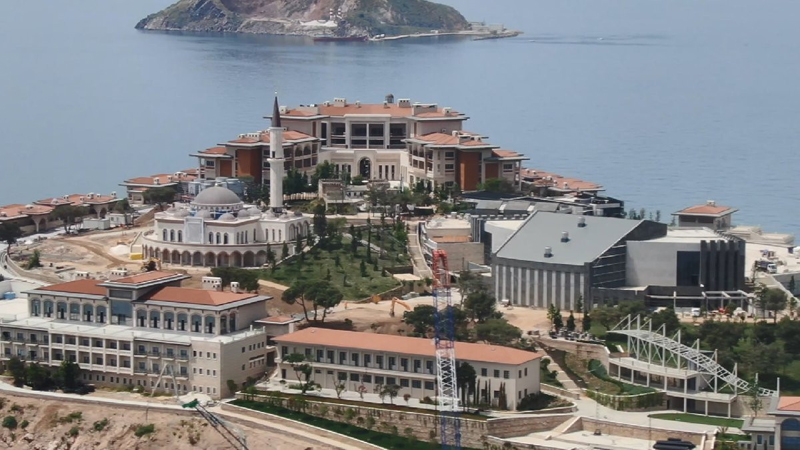
9- Do you think history has been ‘white-washed’ with the recent renaming of Yassıada where Menderes and deputies were tried, as ‘Democracy and Freedom Island’ and now crowded out by a whole lot of buildings which probably will have very little future use, perhaps a symbol of how ‘development’ is still understood by many in Turkey? Do you think his name is still used and abused by both sides of the debate in Turkey and the man gets crowded out in this noise and his legacy in trying to level up the peasantry is perhaps is not even appreciated by his supporters?
Lots of questions, but in broad yes. I think the development of Yassıada has been cack-handed and cynical, and absolutely a project which is intended to serve the current government rather than the memory of Menderes and Co. As to his legacy, I do believe that in time he will be recognized as a true supporter of Turkey’s oft forgotten masses.
10- What is your next project, if you wish to reveal it?
As for my next writing project, it’s not to do with Turkey, but an attempt at a novel set elsewhere. More anon on that. As to Turkey, I know I shall write something else about the country in due course. But quite what remains to be seen.
Questions by Craig Encer, July 2021
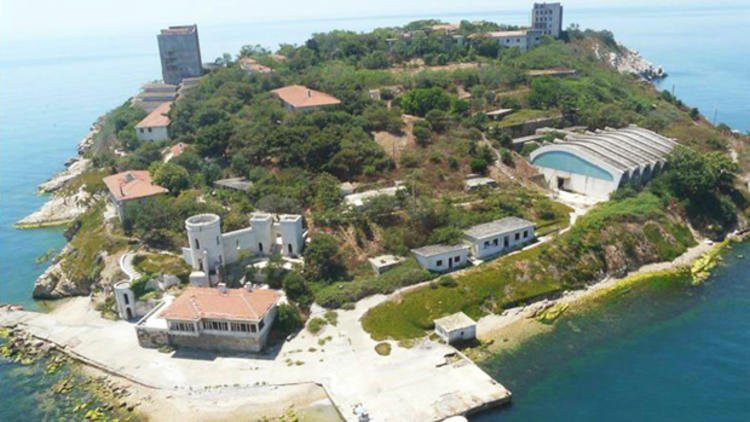
Yassıada (Democracy and Freedom Island) seen 2015 and post-construction in 2020.