In-person lecture: ‘The Pioneering Life of Mary Wortley Montagu: Scientist and Feminist’, Jo Willett, 13 July 2022 - flyer: - slides:
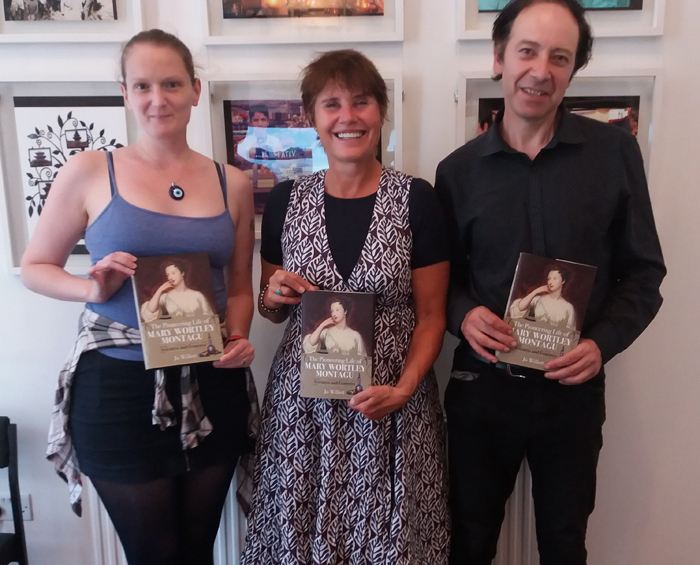
From left: Gemma Masson, Jo Willett, Craig Encer.
In-person lecture: ‘The Pioneering Life of Mary Wortley Montagu: Scientist and Feminist’, Jo Willett, 13 July 2022 - flyer: - slides:
1. How did you first become interested in Lady Mary?
I was looking for a subject matter for a biography I hoped to write. I thought it was likely I’d choose a female writer, having studied English and worked with writers all my working life. I was in Lichfield Cathedral and came across a memorial to Lady Mary, praising her for her work on smallpox inoculation. My husband, who also studied English in the past, said “Ah yes, she was Alexander Pope’s friend. You must have heard of her?”. I hadn’t so this piqued my interest, and I started reading Lady Mary’s writing.
2. What made you decide there was a story to be written about her?
I already knew Lady Mary was a writer with interesting literary connections – I didn’t know at that point that she had a famous falling out with Pope – and that she had done something interesting in the field of science. Once I started reading her letters, I realised how varied her life was, packed full of adventures, and how relevant her life is to those of us living today. I read the two existing, academic biographies, one by Robert Halsband and one by Isobel Grandy, and I began thinking that her story should be better known to the general reader.
3. How did you fix on the focus of your subtitle, Scientist & Feminist?
As I say, I was first interested in her as a writer, and once I started reading her own writing, I could see that she qualifies as an early feminist. This was my first line of approach. However, agents and publishers I approached told me they wouldn’t be interested in the story of an eighteenth-century feminist per se. I then realised that April 2021 marked the 300th anniversary of Lady Mary’s inoculation of her daughter in Twickenham – the first experiment to protect someone in the west. I thought I could use that as a publicity hook, and approached my publishers, Pen & Sword Books, with the idea. It should be said that I delivered the book to them in March 2020, so I wrote it before Covid even existed. Neither I nor they realised how topical this element of the book would be when it was published in April 2021.
4. What was your approach to researching the project?
I read as much as I could around the subject. I quickly realised that Halsband and Grundy had mined and published most of the material of Lady Mary’s in archives, although I did visit the some of the archives they suggested to see if I could find different angles or unpublished sources. I also tried to visit everywhere Lady Mary lived during her lifetime, including Turkey, Italy, France, Yorkshire and Wiltshire.
5. Were there any resources or collections you found especially helpful or unhelpful?
The Harrowby Manuscripts held at Sandon Hall near Stafford were extremely helpful, as were the Bute Manuscripts, held at Mount Stuart on the Isle of Bute. I was amused when I visited Pope’s Grotto in Twickenham. When I asked about whether they had any literature on Lady Mary the guide replied that she was a very difficult woman, and they didn’t have anything.
6. What other challenges did you encounter during this project?
My main challenge was to make her life as accessible and as resonant as possible. There was far too much material for the length of biography which Pen & Sword had commissioned.
7. This project seems very timely for all the conversations about illness, quarantine and vaccination that have been happening in current world events, was that a happy coincidence or something that guided your work?
I have to admit that it was a happy coincidence (see above). If I had written it once Covid existed, I’m sure I would have devoted more of the book to the story of how inoculation led to vaccination.
8. What distinguishes Lady Mary's work from her contemporaries, particularly male writers of the time?
She was always so interested in seeing the world from a female perspective. I suspect this is partly because she was self-taught. Even as a teenager she rewrote material she found in her father’s library from the position of the female characters she read about. Also, she writes from the viewpoint of a female, English aristocrat. I can’t think of any of her contemporaries who saw the world as she did.
9. You have achieved a very holistic view of Lady Mary as a whole person, wife, mother, scholar, pioneer, was that balance tricky to find in writing her story?
Yes, very. Now I have some perspective on her story, and have given lots of talks about her, I’d love to go back and make the book all the more rounded.
10. Finally, what's next for you in terms of research and writing projects?
Pen & Sword have commissioned my next book, which is about the actress and early celebrity, Sarah Siddons. I am due to deliver the book in March 2023 and all being well it will be published in Spring 2024. Sarah is a very different person from Lady Mary, but I think her story is equally fascinating. Please keep a look out for the book!