Professor Nezih Erdoğan hybrid presentation: ‘Adventures in Modernity and Spectatorship: Early Years of Cinema in Istanbul’, 26 February 2024 - flyer:
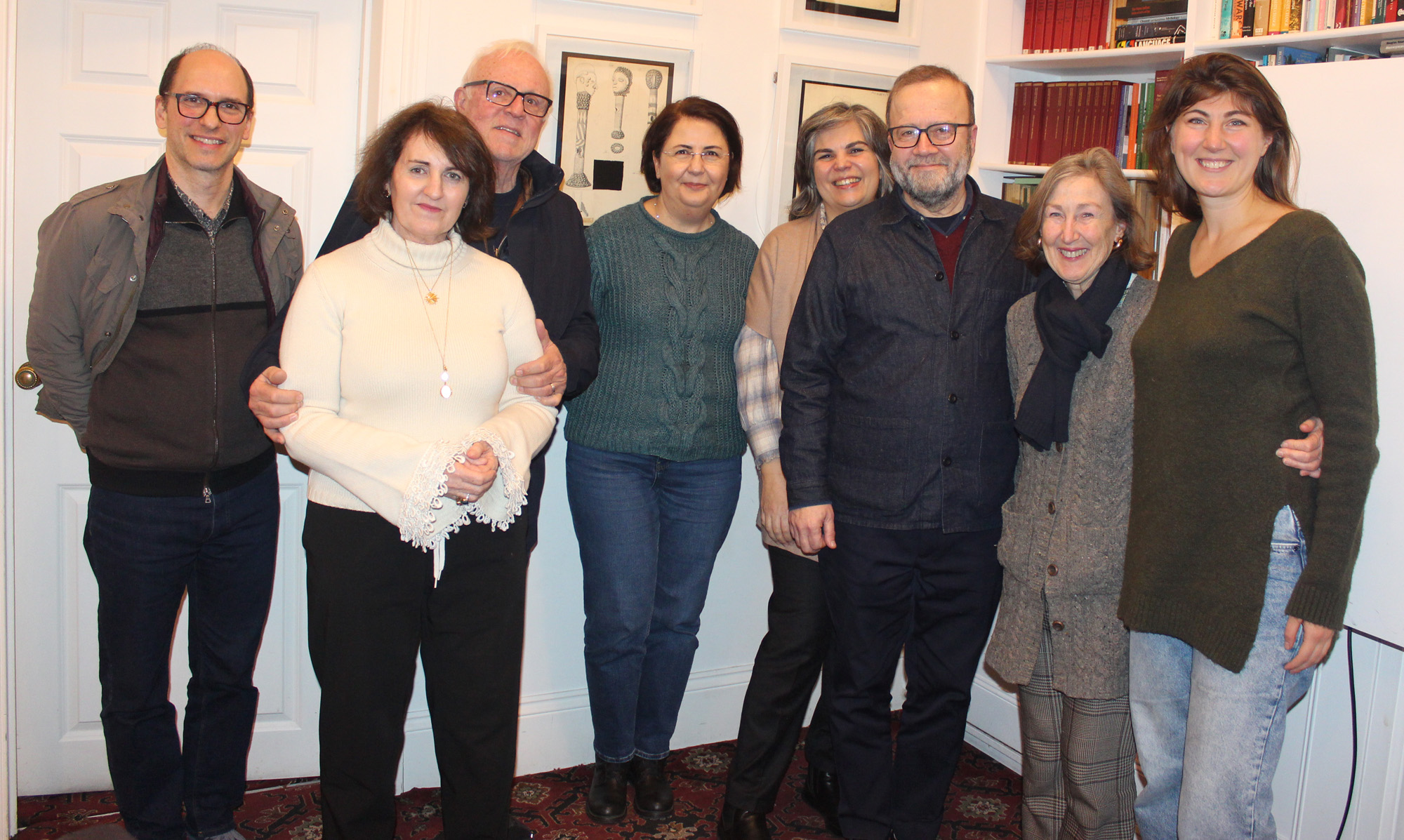
Nezih Erdoğan (in dark jacket) in the centre post lecture with friends.
Professor Nezih Erdoğan hybrid presentation: ‘Adventures in Modernity and Spectatorship: Early Years of Cinema in Istanbul’, 26 February 2024 - flyer:
1- On January 30th, 1908 the Pathé Frères Cinema Theatre, the first cinema-specific building, opened in Istanbul. Istanbul newspapers watched Pathé closely and kept their readers up to-date on the recent developments in and around the cinema. Do we know what was the first film shown at this film theatre and what can we glean on audience reaction from contemporary newspaper reports?
In reply to the first group of questions, may I give the link to an article of mine:
2- Were theatre buildings often converted to cinema theatres as repurposing buildings for this new medium or did a healthy theatre / opera scene continue right up to the period of the First World War?
Initially, schools, gardens, cafés, brasseries, theatres, etc served as cinema venues. The first permanent cinema venue was a theatre building (1908) which was repurposed, and in 1920 Cine- Magic was built. Others followed. For example the architectural style of Alhambra (1923) was praised in an American film magazine.
3- Do we know if and who was the first ‘local’ film star (if that is an apt term) to emerge, either during Ottoman or early republican period?
Local film stars were of course actually theatre actors, such as Hüseyin Şadi Karagözoğlu, Behzat Butak, Eliza Binemeciyan, Bedia Müvahhit. Then Muhsin Ertuğrul arrived from Germany and became a prominent star actor-director for decades.
4- Was dubbing done during this period more in French or Turkish language before the ‘talkies’? Were there ever piano players live in the cinema theatre to fill in the atmosphere during the silent movie period in Istanbul?
Both. Native Turkish speakers who read French also served as lecturers (for example: Burhan Felek), that is to say they did simultaneous translation during projection.
Not only piano players, cinema managers hired orchestras as well. Weinberg placed an ad in an Austrian periodical to hire musicians.
5- Censorship seems to be completely lacking during the Istanbul occupation period for mysterious reasons. Was there any censorship during the Ottoman period and if so what was deemed to be unsuitable for viewers? Did a proper censorship board emerge only during the republican period and was there a push to reduce to filming of foreign language films as part of the ‘Vatandaş Türkçe Konuş’ [citizen speak Turkish] drive from the late 1920s?
Still, to maintain peace and order the Allied Forces prohibited the exhibition of certain films. They also banned enemy films, ie German, Austrian, Hungarian and Bulgarian films.
Foreign language films were not reduced, however, when their titles and intertitles were given in the original language it caused some disturbance particularly in the provincial areas. For those who would like to read further on censorship, I am giving a link to an article:
6- There was a great proliferation of cinema theatres across Istanbul from the 1910s showing a thirst by the populace of this new entertainment medium. Were the owners of these film houses a select few who created their chains or was it highly dispersed across ethnic lines where minorities played a significant part? Do you detect a fragmentation of ‘quality’ of buildings in terms of the demographic / affluence of the audience?
Film exhibition was a profitable business especially for ex-pats because they were exempt from paying taxes. Also minorities formed a majority of exhibitors perhaps because they had international connections and spoke foreign languages. But many Turkish business people soon began to take an interest in cinema.
7- In 1896, due to the absence of electricity, cinema began with the first elements illuminated by gas lamps, and was initially introduced as a Ramadan event in Şehzadebaşı, acting as a bridge between modernity and tradition. Were these essentially a ‘Karagöz and Hacivat’ show for adults or was it a development of that theme while still sticking to the tale of slap-stick commentary on the human condition yet still safe from the dangers of questioning the wisdom of authority?
The earliest films were newsreels (or actualite). After they made a few attempts in operettas which failed due to the on-going war (the actors were drafted), The first features were made for MOSD in 1917. They were dramas and Chaplinesque comedies.
8- The Turkish military right from an early stage were keen to embrace film technology and had their own film unit. By the time of World War I, the film industry had developed considerably and was used as one of the most effective means of propaganda. The government of the Committee of Union and Progress (CUP), which dragged the Ottomans into the war, wanted to use it well. During this period, Sigmund Weinberg (long-term photographer resident in Istanbul and from a Polish Jewish background) was appointed head of the Central Army Cinema Department (MOSD), which was established by the order of Enver Pasha, minister of war and acting commander-in-chief. He was ordered to film the Romanian and Galician fronts. These important images were shown in the Palas Cinema on June 9, 1917. Are these movies still accessible today and why was Weinberg who clearly did useful work for the CUP, dismissed straight after the war?
Many of these films are lost. Still, you may want to visit the online archive of the Ministry of Culture and Tourism. It is bilingual:
Some European archives may contain films shot in Ottoman territory. This is just one of them:
There is evidence that in 1921 Darülaceze (The House for the Poor) commissioned Weinberg to a PR film, a choice which upset his rival the War Veterans Society - (the Society’s letter appealing to get the job can be found online in the State Archives). MOSD was inactive during the occupation.
9- Enver Pasha took many steps to bolster cinematography in pre-Republican Turkey. During this period, a film school was established and the Central Army Cinema Department was instituted at the War Ministry’s Post Office. Dersaadet (Gate of Felicity) Army Central and Military Museum Movie Theatre at the Hagia Irene Church were revived thanks to Enver Pasha's dedication. Did these efforts bear fruit also in the Republican era by the emergence of new film makers, directors, actors etc.?
Some camera operators and directors who used to work for MOSD found jobs in private companies. MOSD revived in the Republican era and today it operates by the name TSK Foto Film Merkezi (Army Photo Film Centre).
10- What are you working on right now?
Currently, I am researching cinema in occupied Istanbul, from 1918 to 1923. During my six-month stay in London, I combed through the correspondences and meeting minutes of High Commissioners, private papers and letters of officers, and British newspapers held at the National Archives, Imperial War Museum the British Library, King’s College, and Army Archives. I am planning to organise my findings into articles to publish in scholarly journals.