Dr Peter Alford Andrews in-person lecture: ‘The Engendering of Ethnic Groups in the Republic of Turkey, maps and book’, 28 March 2022 - flyer: - slides:
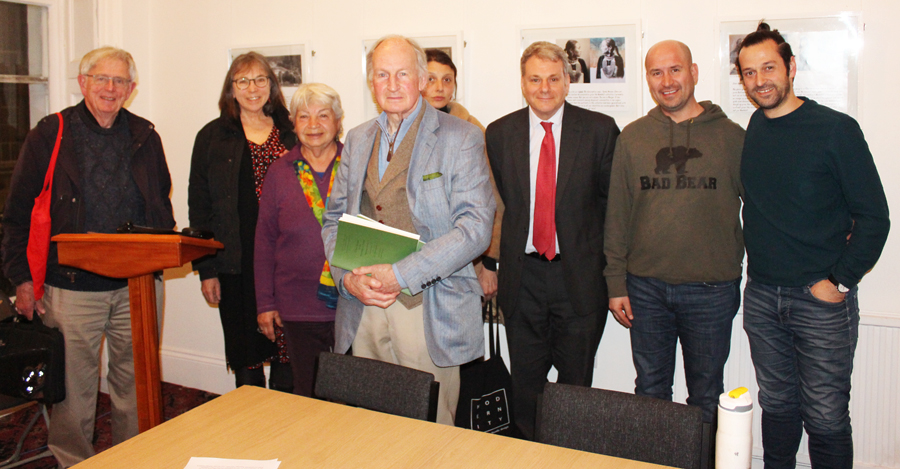
1- The way the work on the ethnic groups in Turkey developed seems to be a series of happy accidents and the starting point appears to be in 1980 when you were invited by the late Professor Ulla Johansen to join a recently formed team in Cologne, Germany. Did you feel this German centric project was the best possible means for such a complex project to be realised?
Life is the product of circumstances, and in this case the chain began with my admiration for Ulla Johansen’s work on the Yörük, and particularly her article on Alačyq (alaçık) of 1966, in which she demonstrated how ethnographical data could be combined with philology. That led us to visit her in Heidelberg in about 1968. When, after completing my thesis at SOAS in 1980, I was searching for university employment, it happened that she needed to replace a member of her TAVO team, so our needs coincided.
At that time Germany was spending twice as much on research projects as the UK, so a project of the size and ambition of TAVO was scarcely conceivable in the UK. It was extremely well organised. It was German-centric only in its origin in the German university system and the structure of German research funding through the DFG. In other respects it was truly international in the pool of collaborators it drew upon, and the reach of their work in the Middle East. I never felt constrained by the German context.
2- When defining ethnic groups of course there is no perfect marker but clearly language, religion or occupation are all ways of creating criteria that separate them out from the majority. Was there a reason why for example Gypsies and the Germans of Kars region were omitted from the list of ethnic groups in the map?
As we worked, it became obvious that ethnicity is a very elastic concept with several criteria, and several possible interactions between those criteria.
No group of whose existence I was aware was excluded from the list of those mapped. The Gypsies and the Germans of Kars are represented under the Indo-European language group in the legend as Nos. 34 and 37, and the Gypsies are even assigned a sub-group, the Poşa. Both the Germans and the Estonians were for the period (1960-70) present in only very small numbers. The Gypsies presented a special problem, as although some followed predictable annual movements, others were more peripatetic. The first appear on the map. Those recorded in the Köy Envanteri were shown in a table, Survey 6, in the handbook.
The group which was omitted from the book, though not from the map, was the nomadic Yörük, as explained in the introduction: there was simply not enough time allocated for us to check whether tribes were still migrating, and where they were.
3- You used as supporting data from many works done by visiting scholars but also 144 student theses from the anthropological faculties of Istanbul and Ankara, the latter group presumably all from before 1970 when there was effective censure of study of non-Turkish speaking minorities. Were these theses mainly concentrating on a very narrow region such as a village but still useful in providing information on the ethnicity of those locals?
Not all the student works I looked at were useful: I had to discard quite a lot. Those which were, generally centred upon a particular tribe or a particular village, occasionally showing the existence of more than one ethnic group.
4- The 1981 state-published ‘Köylerimiz’ [our villages] seems quite progressive by present-day standards as it lists thousands of village names with the old name and new name listed in the column next occupying 2 thirds of that gazetteer. Do you think there is future potential anthropological study on the etymology and meaning of these old village names?
The old names which were replaced are generally Kurdish, Dimli, Aramaic, or Armenian, and to a lesser extent Lazi, Georgian or Circassian. In a few cases names which obviously suggest an Alevi population were changed too: for example Hacihasanlar was changed to Haciaslanlar. I have the impression that the Armenian diaspora have been assiduous in keeping careful records of their old settlements and their names. The Kurds are showing signs of doing the same. As with place names everywhere (including the UK), the origin may go back centuries, if not millennia, so inferences should be drawn with caution. Köylerimiz can certainly help in any study of ethnic distribution (as those who changed the names were evidently aware), but the rendering of non-Turkish names is often questionable, and analysis may not necessarily be easy.
5- The 2 volume catalogue of Ethnic Groups in the Republic of Turkey book is a natural development of the map project. Do you see this as a ‘global compilation’ of all earlier works of ethnic groups, those published and unpublished and thus acting as a seminal work for the period 1960-70?
I make no claims to “globality”. We simply gathered as much information as we could in the time available. As the work of the different TAVO collaborators was reviewed at Tübingen by a committee of academics every two years, strict control was exercised over the time expended on a given map, and once a deadline had been set, it was unlikely to be extended. I did not attempt to review or include work outside our time frame: major population movements had occurred earlier. Volume II of the handbook was exceptional, in that it was proposed ten years after the original work, to accommodate new information, but again time was strictly limited.
6- Turkey has received new immigrants in considerable numbers in recent years such as Syria and Afghanistan but clearly most would have settled in cities. Do you think it is at all possible to do work on ethnic groups in urban environments?
Supposing that the Turkish authorities would permit research of that kind, limited studies should be possible, such as on the Qazaq (Kazak) community in Zeytinburnu and elsewhere. Ethnic groups often have their own representative organisations which could help. In other cases ethnic groupings which were once conspicuous, as for instance in Arnavutköy, have dispersed with time. More recently immigrants have deliberately “gone to ground” in the large cities to avoid deportation. Others, such as migrant Moldavian women, have deliberately concealed their whereabouts so as to be able to work illegally. The possibilities are mixed.
Questions by Craig Encer, April 2022
COMMENTARY ON TAVO B-60 REVISED
A. INTRODUCTION, Frames 1-16 (click any to expand):
Invitation:
Just as I completed my thesis at SOAS in 1980, Mrs Thatcher’s closure of university departments made it difficult for me to find academic employment in this country. I had never considered working in Germany, but through my earlier contact with Prof. Ulla Johansen, she came to offer me a post at Cologne to replace a member of a team. An Egyptian lady had left to do fieldwork in Egypt, but had met a man there, married, and never re-appeared. The work Johansen offered me was on a series of ethnic maps to be drawn up at Cologne for the Tübingen Atlas of the Middle East (TAVO). Other members of the team had begun work some six months earlier, one on Afghanistan, and the other on the Levant, each drawing on previous experience of the area concerned. I had no special experience of such mapping or documentation, but nor had they.
Ulla Johansen, as team leader, expected me to take over the work on Egypt. Once I had accepted the work, however, the decision to work on Turkey was my own. I pointed out that to learn enough Arabic to search the sources would take me at least two years, and that it would be much more sensible for me to work on Turkey, as I already knew the language. Johansen, whose own fieldwork had been among the Aydınlı Yörük in the 1950s, had a natural sympathy for Turkish matters, so she accepted my proposal, though she warned me that she doubted if it was feasible. I, in my naivety, had no idea of the political complications it might involve. As it turned out, she did have a wide range of contacts who were able to provide information, and this materially affected the success of the project. Otherwise she left me and other members of the team largely to our own devices, simply checking on progress from time to time.
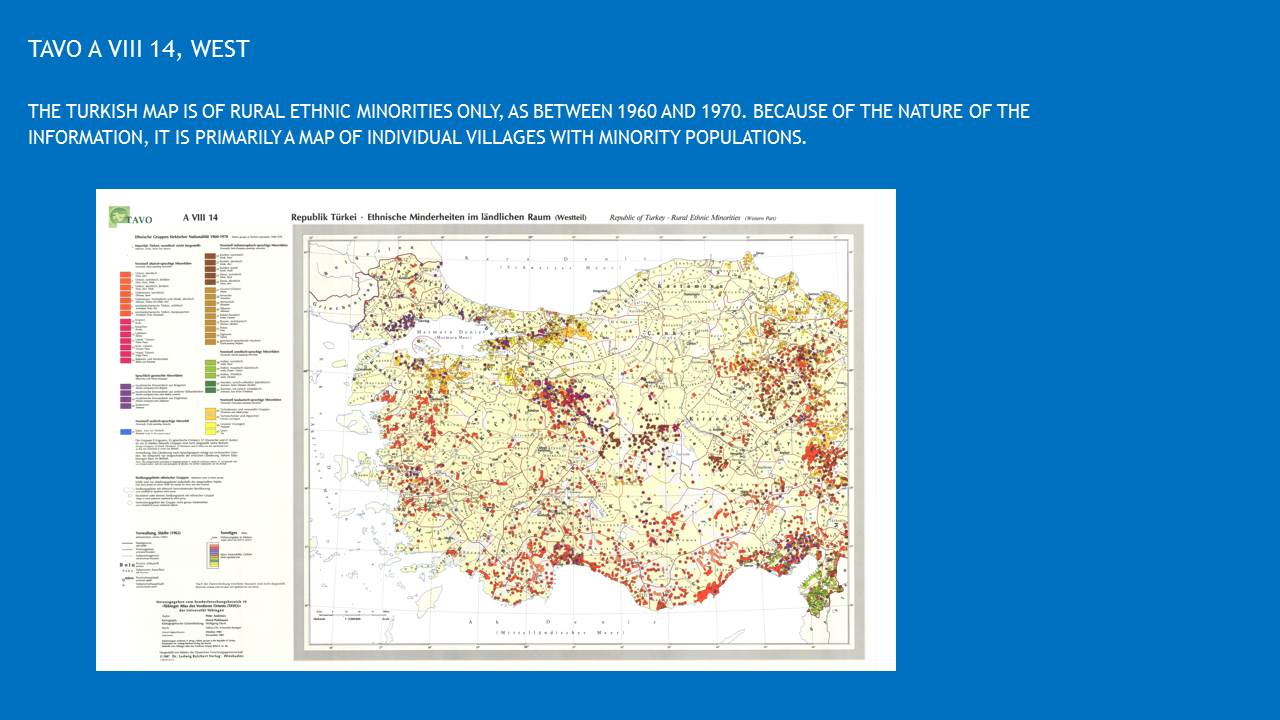
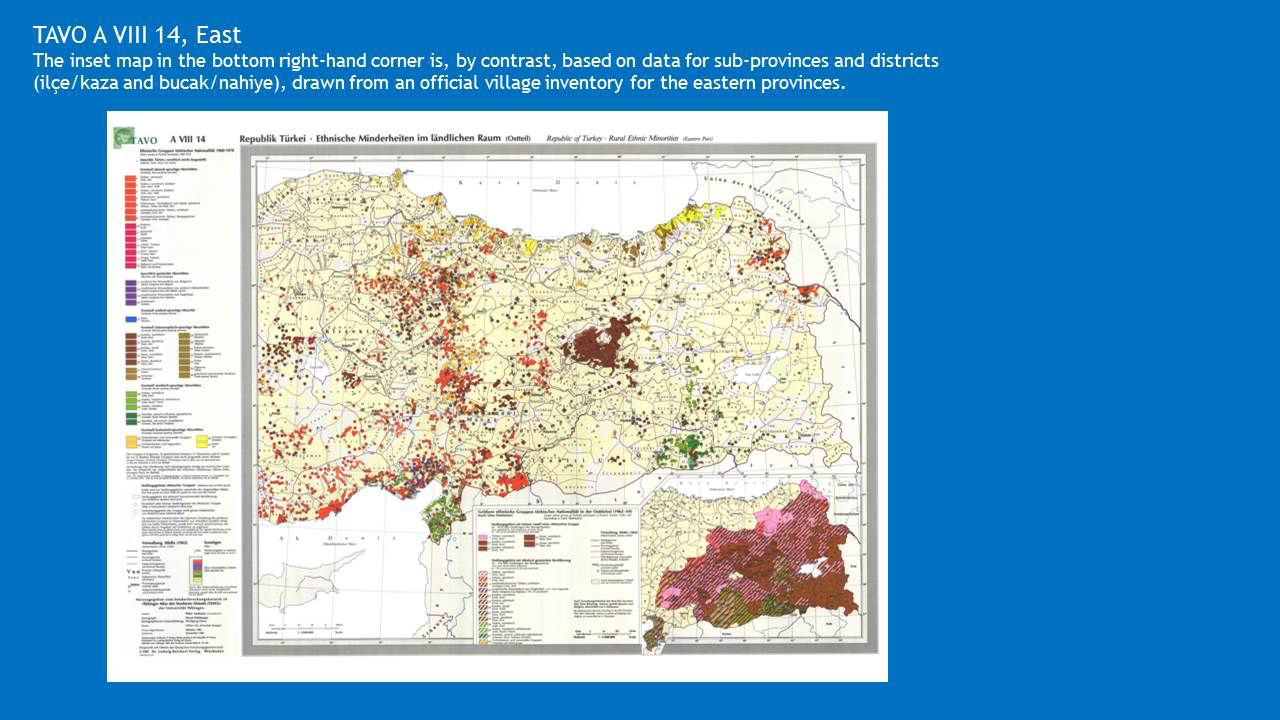
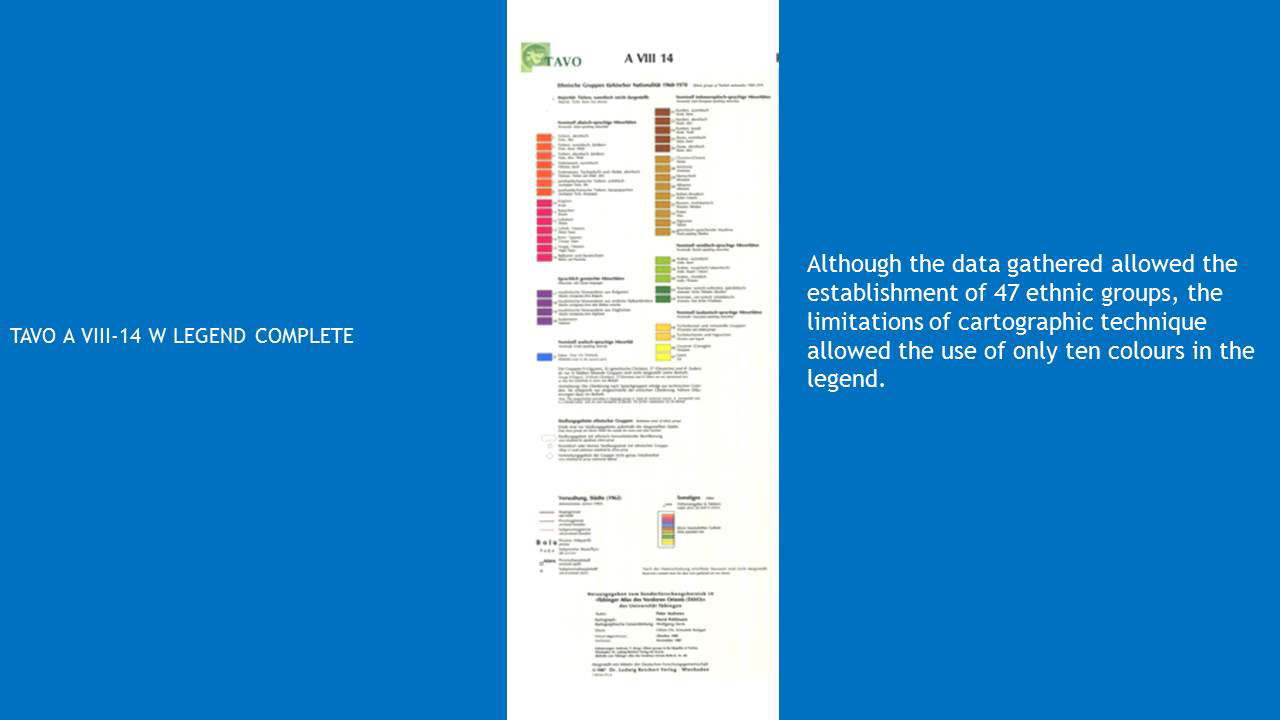
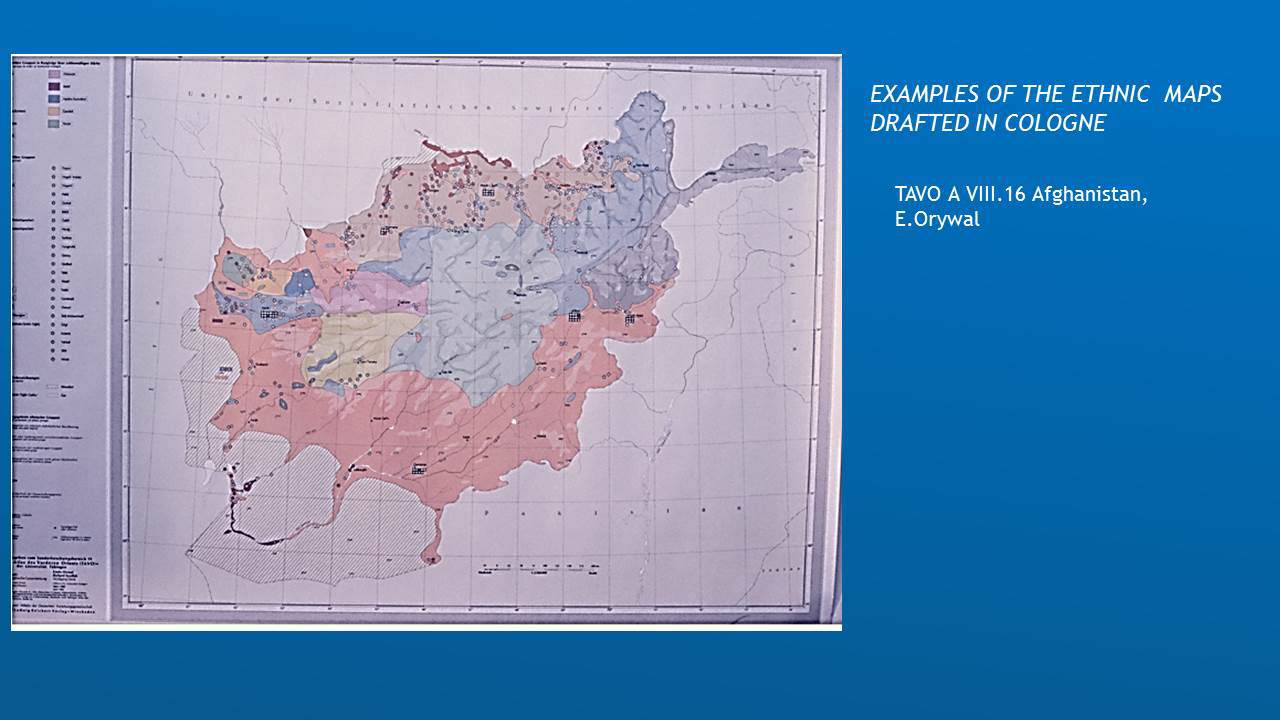
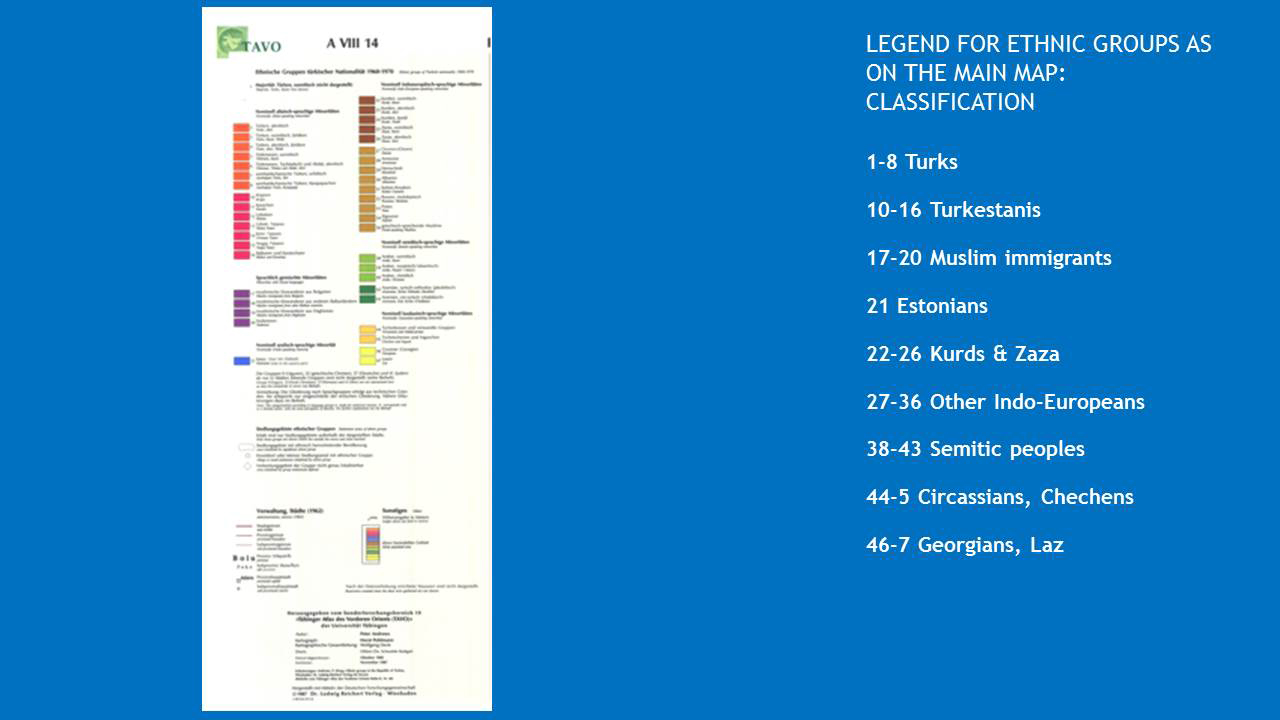
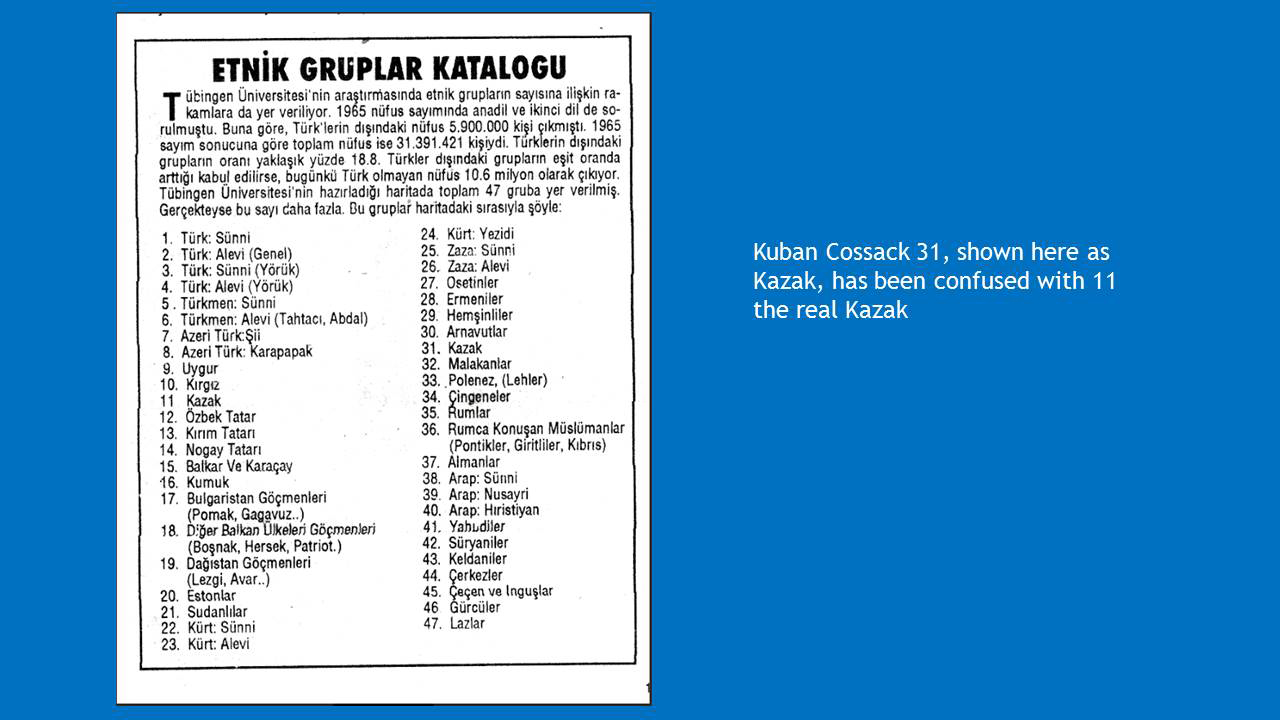
In the event, I was able to establish 47 ethnic groups in Turkey. The means by which these could be shown on the map were constrained by practical considerations. The range of colours used by the Tübingen cartographers was quite limited, so I resorted to a combination of numerals and colours. Colours were therefore used to designate clusters of ethnic groups, based mainly on language, with each group given its own number for identification. So the Sunni Turkish majority is No.1, and the Laz No.47. The numbers are used both on the map and throughout the book. To allow these to be legible, the standard-size map was divided into two sheets, east and west. Most of the information on these is in terms of individual villages, represented by numbered dots.
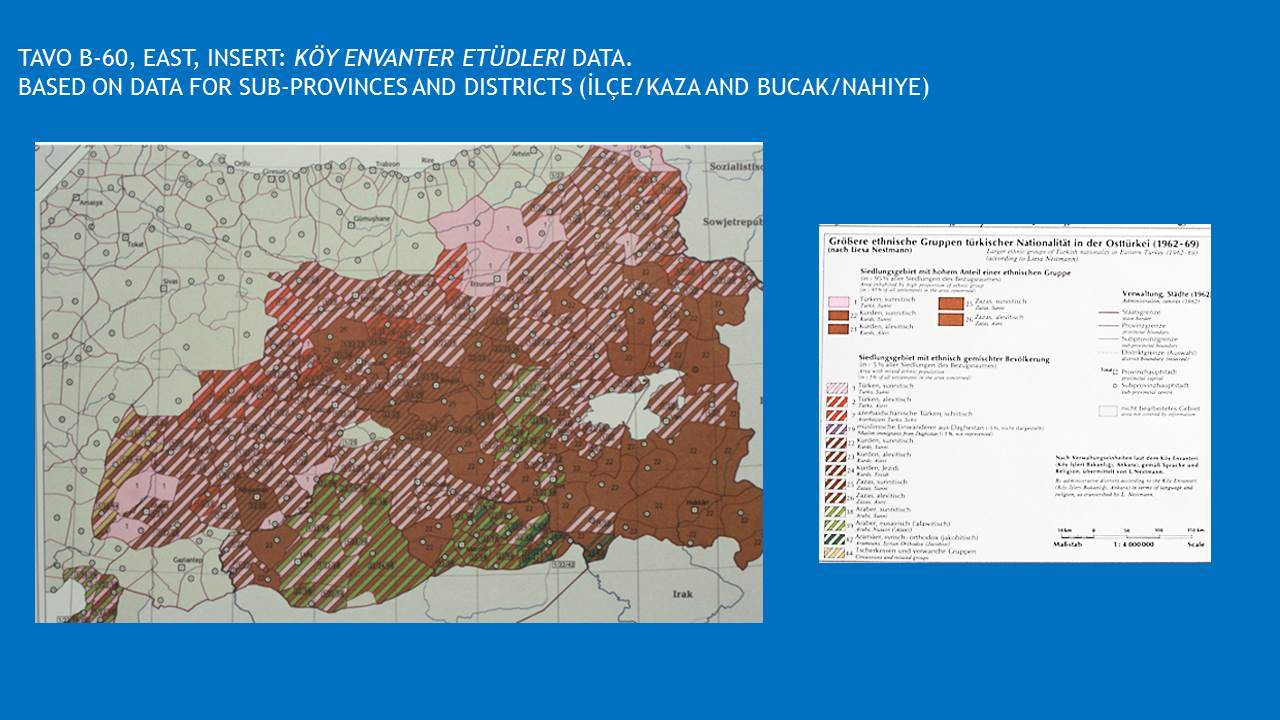
Within the eastern half, there is an inset map. This represents a different kind of information, derived from an official source, but in terms of districts rather than villages. Here the areas occupied by a particular ethnic group are identified by a block of colour, with its number. E.g. No.22 is Sunni Kurd. The striation is used to represent areas with a mixed population. This inset therefore required a separate legend, though the same colours and numbers were used.
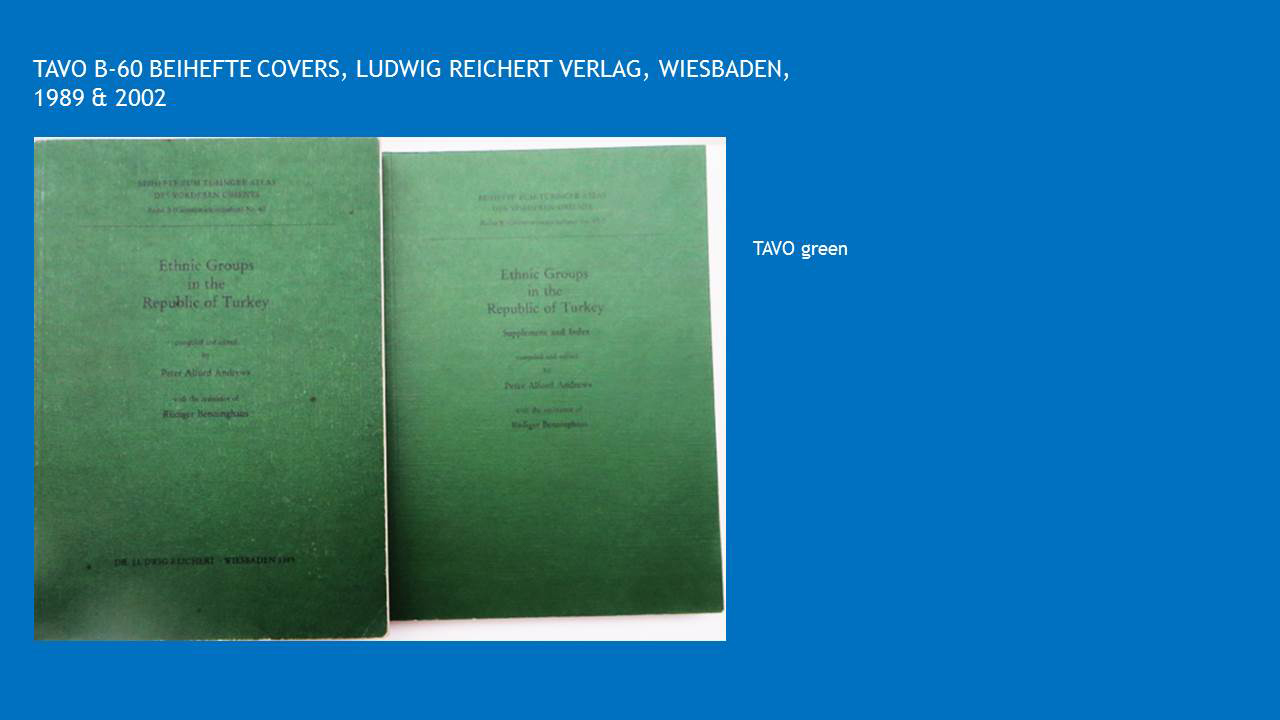
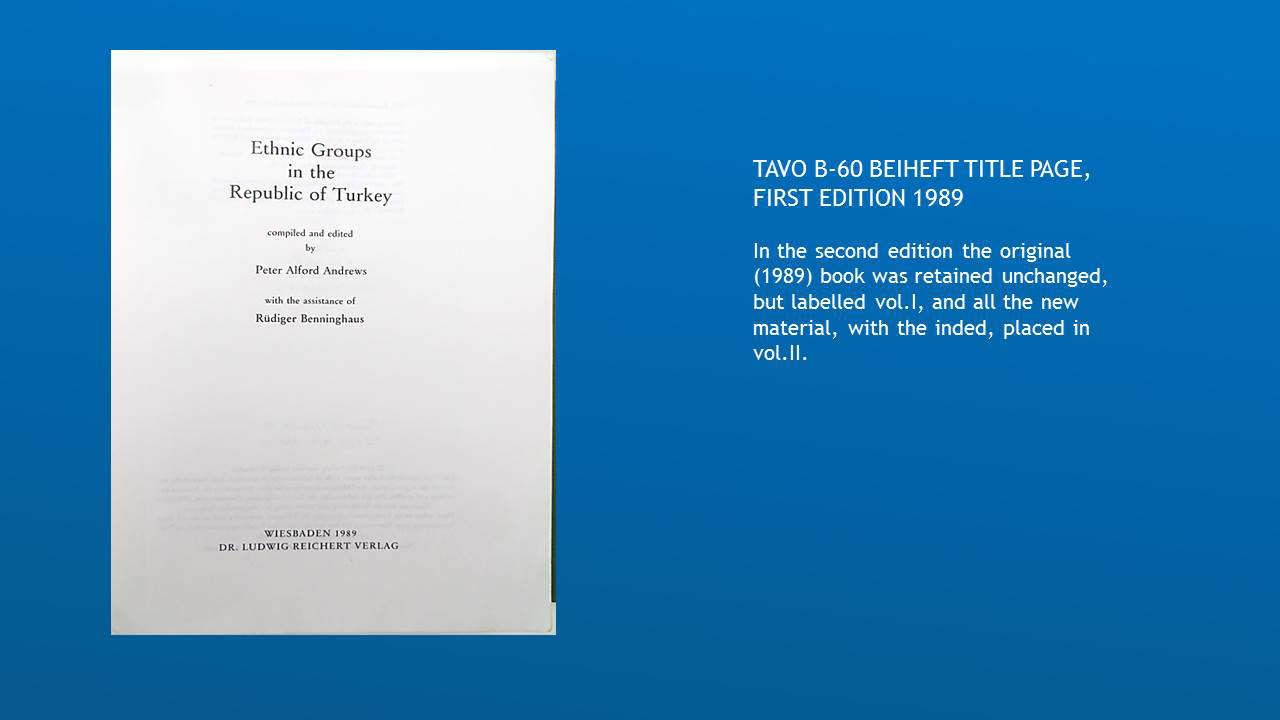
The book was not the primary aim of our work, so it is an irony that mine became more important than the maps it was intended to supplement. At Johansen’s suggestion, it was agreed by the review committee that, since I had gathered so much information, it should be published. Volume II was issued with new information after ten years. Comparable handbooks were published for some, but not all TAVO maps, though mine was unusually substantial.
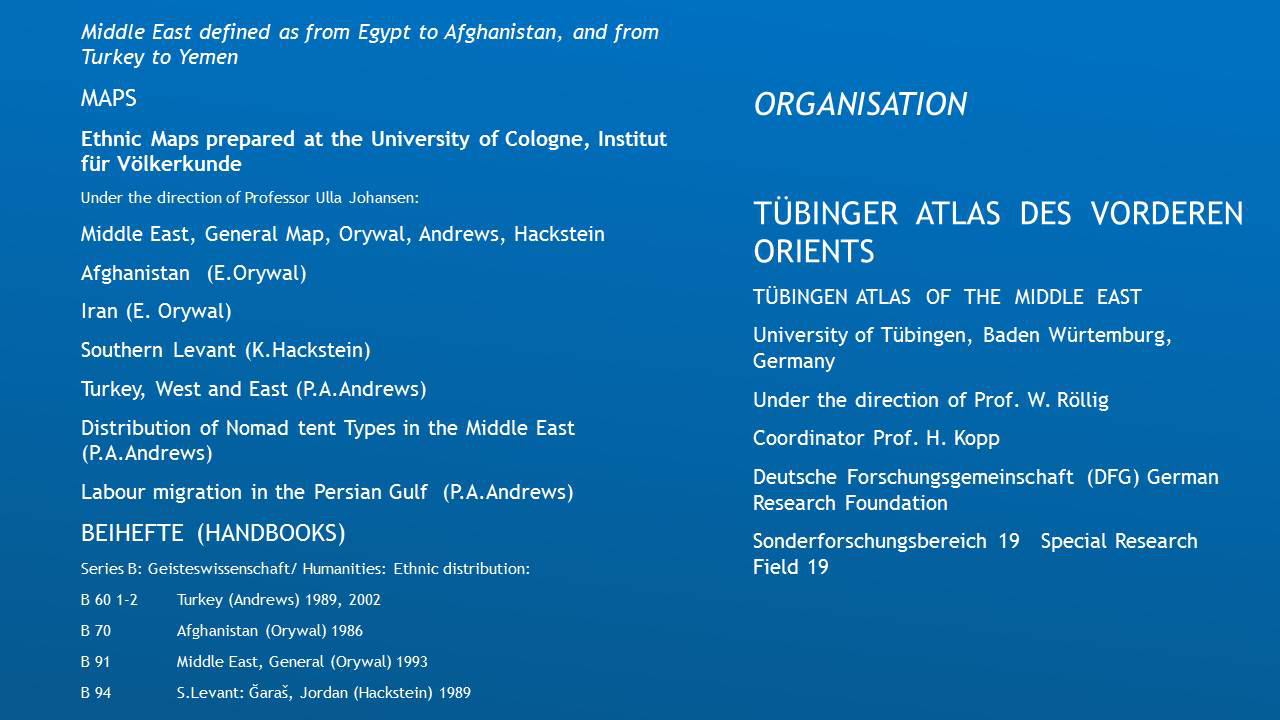
TAVO Organisation
This project would have been impossible without the German research framework within which it was conceived, so I should explain that in some detail.
The Deutsche Forschungsgemeinschaft (German Research Foundation) is an umbrella organisation, semi-governmental, purely academic, and autonomous. It funds both individual projects, sponsored by a professor, and Sonderforschungsbereiche (special research areas), which are more comprehensive, involving more than one researcher, and usually longer-lived. TAVO was Sfb.19, thus one of the earliest. I belonged to two, the other being Frei Otto’s Institut für Leichte Flächentragwerke., Sfb. 230. TAVO lasted, I believe, for up to 14 or even 17 years, continuously funded. The work was not uncontrolled: Begehungen “encounters” were held at Tübingen every two years, when all participants were, in the course of two or three days, expected to present, explain, and justify their work before a committee of a dozen or more prominent academics. This was a daunting procedure before such senior figures. I was fortunate in winning the support of Prof. Wolf-Dieter Hütteroth and Prof. Eugen Wirth, both human geographers. They used to sit side by side at the great table, chain-smoking cigars from a box open in front of them. Privately, we used to speak Turkish with Hütteroth.
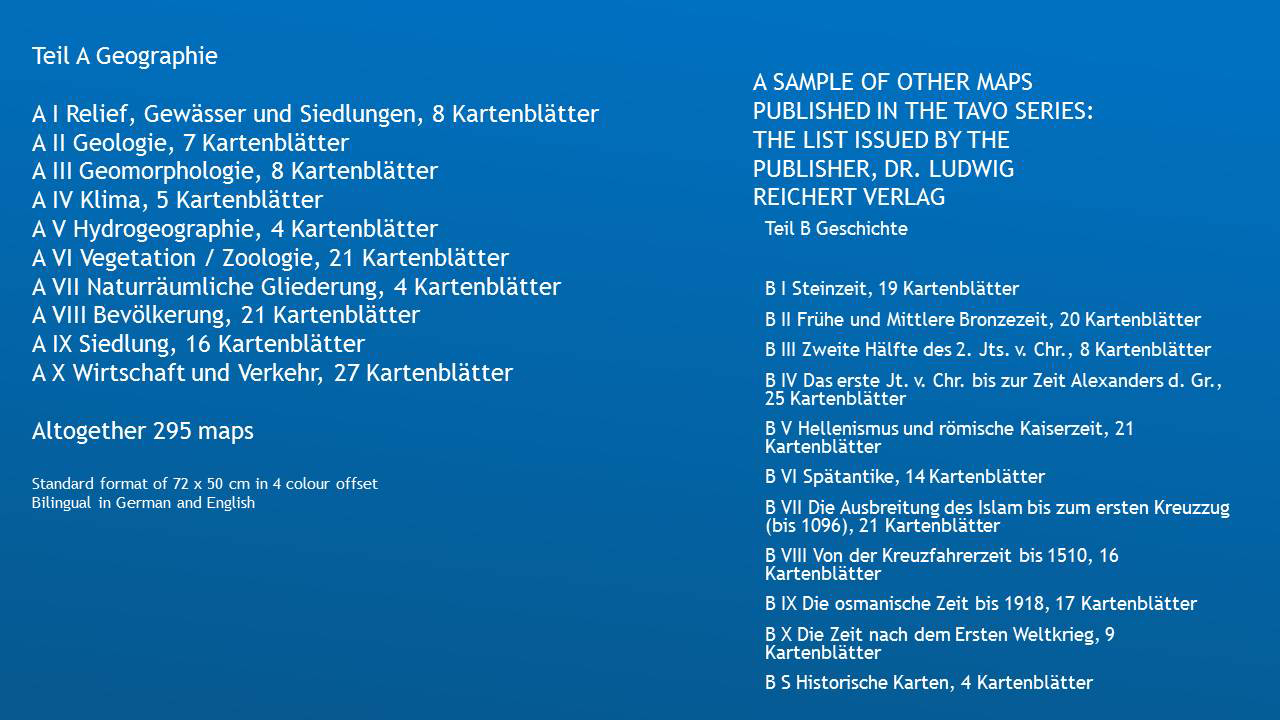
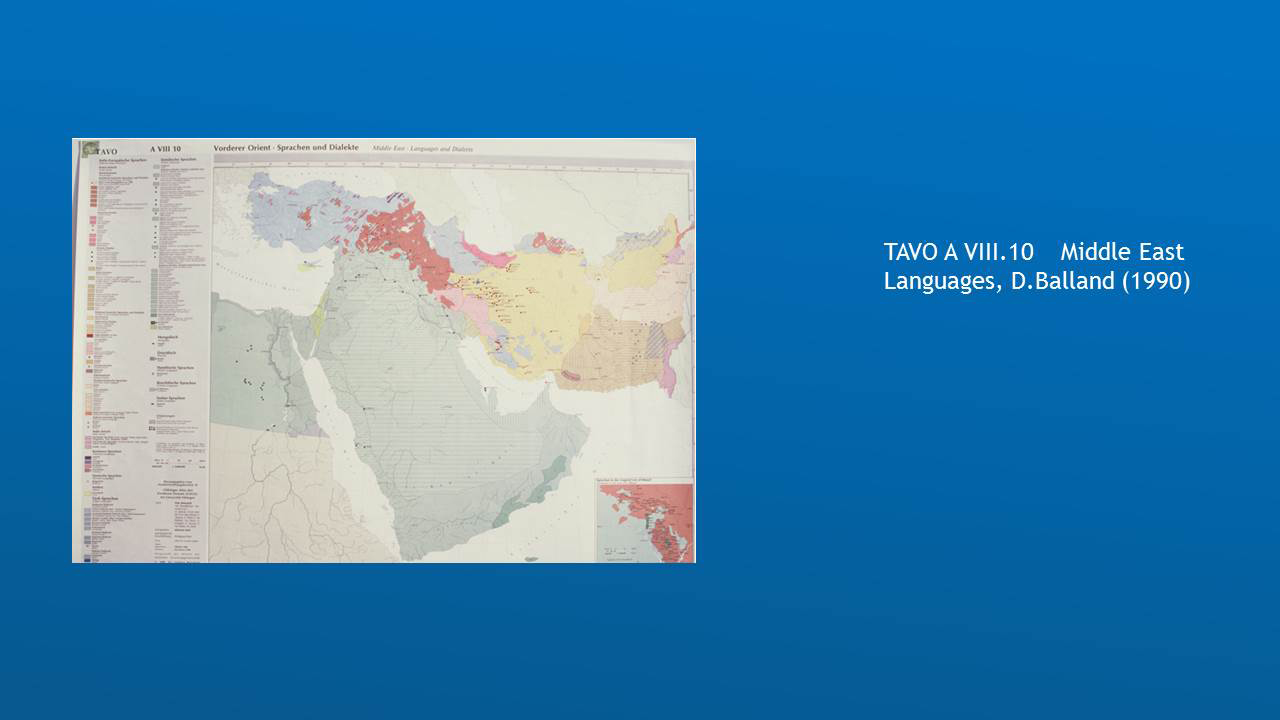
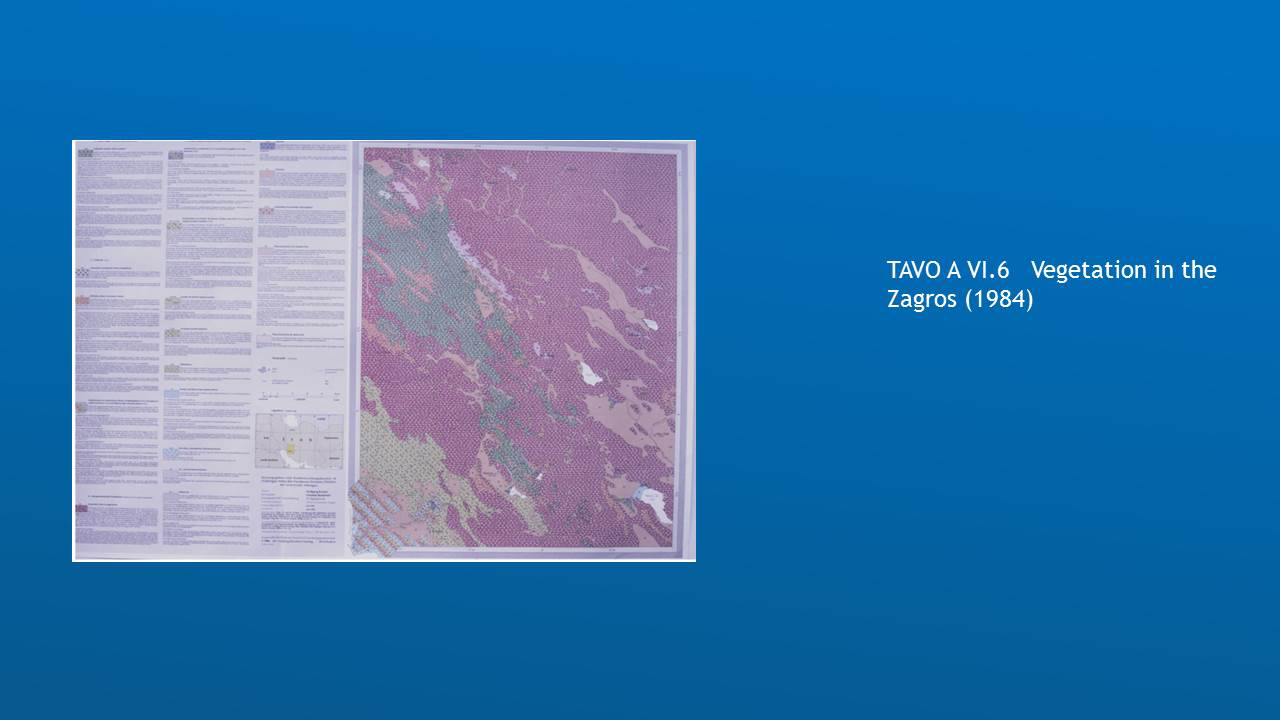
TAVO covered an enormously comprehensive range, from normal geographic disciplines like hydrology and climate to palaeontology, the distribution of scorpion species in Anatolia, or the travels of Evliya Çelebi. The maps are all in a standard size and format, issued in fascicles of a dozen or so. Since Tübingen is a relatively small university, it was not able to answer all these demands, and therefore farmed out some subjects to other universities, some even abroad, as for example the language maps to Daniel Balland. Thus Johansen had secured the ethnological work for her Institut für Völkerkunde (Ethnological Institute) in the University of Cologne.
German academics are civil servants, and paid according to a fixed pay scale depending on qualifications and experience. So although working at Cologne, I was paid by Baden- Würtemberg, where Tübingen is situated, from the DFG funds.
The TAVO Ethnic Maps
Work on Afghanistan was already in progress when I arrived in 1980, so certain criteria had already been established.
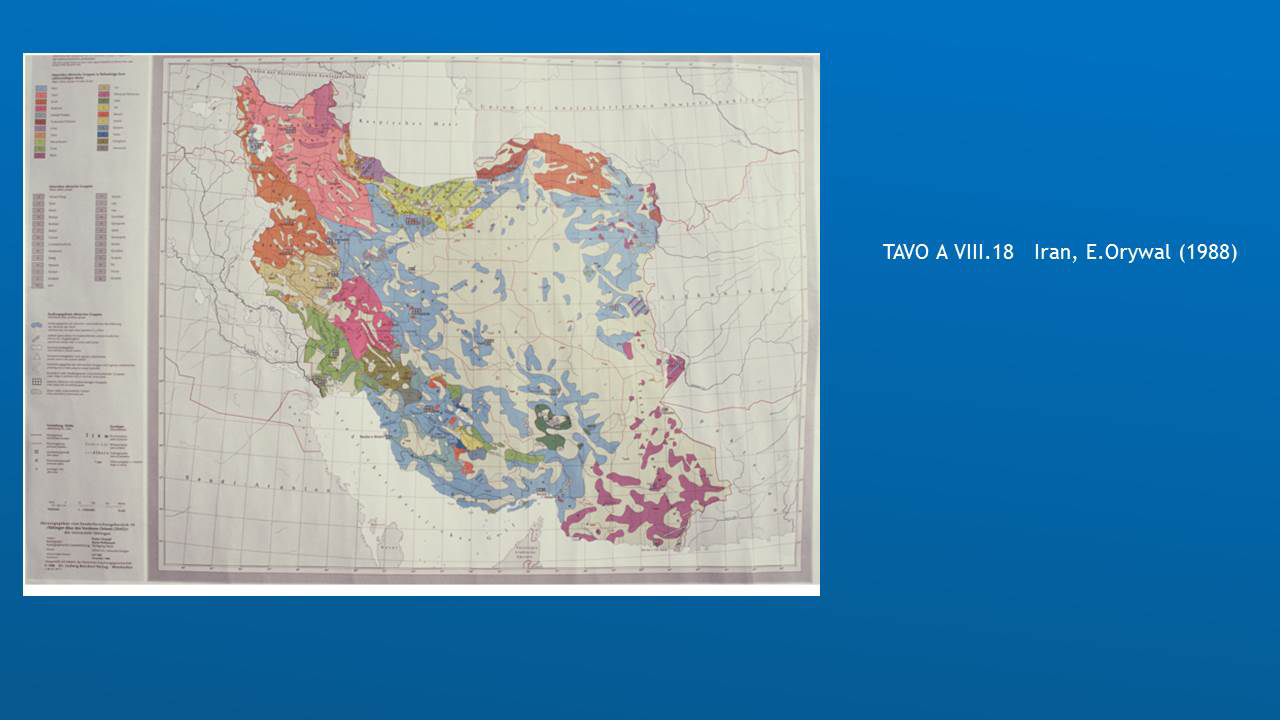
However, in Afghanistan and Iran the rural minorities occupy regions, and can therefore be shown in simple blocks of colour. These countries had also allowed foreign as well as native anthropologists to work unhampered, so that by 1980 adequate information for the ethnic mapping of most regions had been published.
The situation in Turkey was different. The regime was, for historical reasons, reluctant to acknowledge the existence of ethnic divisions within the country, and officially acknowledged only those religious groups recognised in the Treaty of Lausanne: the Jews, the Armenians, the Greek Orthodox, and to a lesser extent the Balkan Orthodox and the Aramaic churches of the east. Only these were classed as azınlık, “minority”, so for all other ethnea this term had to be avoided. As a result little ethnological fieldwork had been allowed, and that primarily in Turkish-speaking groups. Hütteroth’s work on the Kurds was exceptional, and allowed probably because he was a geographer. Furthermore few blocks of ethnic groups existed in the country: most were scattered in villages throughout the land. This made mapping more arduous.
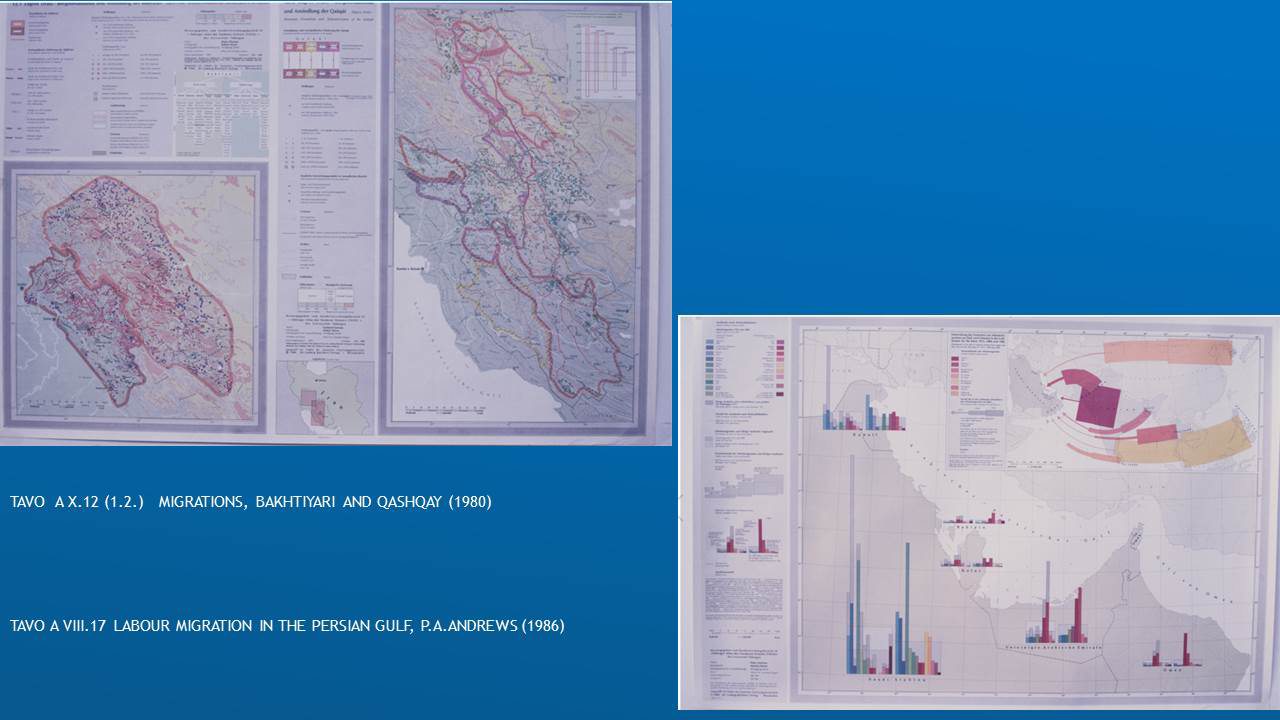
In comparison my map of Labour Migration in the Persian Gulf was relatively easy to compile, as it simply involved collating figures from Durham, Exeter, Hawaii, and Geneva etc.
Personnel
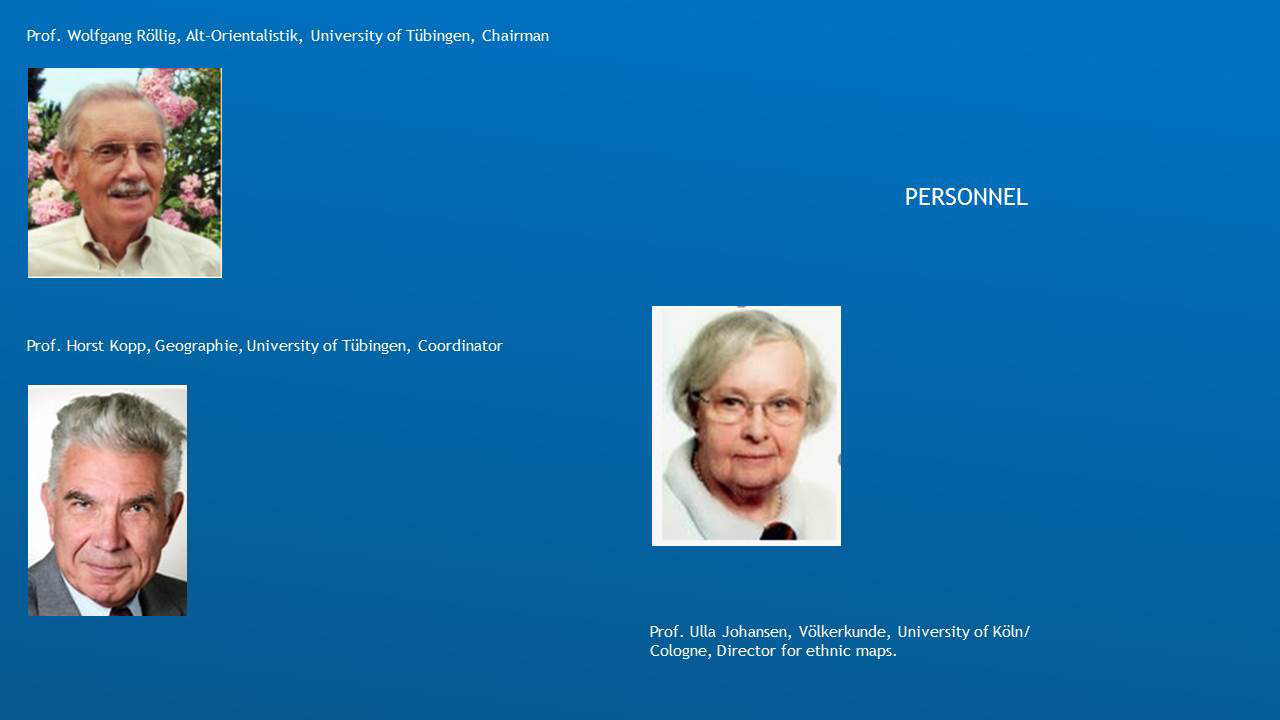
TAVO was led by Prof. Wolfgang Röllig, as Sprecher or speaker, i.e. chairman. He was what the Germans call a Representationsmensch “front man“, a job which he accomplished extraordinarily well, appearing invariably benign and balanced, however difficult the situation. His own discipline was the Ancient Middle East, and he produced a definitive edition of Gilgamesh.
Prof. Horst Kopp, a geographer, was the coordinator, with the very demanding task of managing contributions from perhaps twenty different universities, and leading them through to publication. As Realpolitik emerged when the distribution of limited funding was concerned, we learned to be careful with him. He is now at Erlangen.
Prof. Ulla Johansen had built up the Institut für Völkerkunde at Cologne. She was multi-lingual, and said she could not remember a time at which she spoke less than three languages. She had studied in Moscow, and besides German taught in Estonian, Russian, Turkish and English. Her early fieldwork among the Aydınlı in the 1950s was published in a popular form as 50 Yıl önce Türkiye’de Yörüklerin Yayla Hayatı, and in the same year, 2005, with Doug White, the much more academic Network Analysis and Ethnographic Problems: the latter is unparalleled in tracing genealogies back to the 17th century and analysing them. Her doctoral dissertation was on the Yakut, among whom she came to be regarded as a national heroine. She showed a very high level of personal committment to her work, but was very self-effacing, according to a Prussian code of conduct, somewhat untypically in the Ellenbogengesellschaft (elbow-society) of the 1980s. She too became a loyal supporter and a close friend. She died in 2021. She donated her archive to Koç Üniversitesi.
The TAVO Beihefte (Handbooks)
Dr Ludwig Reichert Verlag was and remains responsible for all publication, both maps and books. As the contributors were salaried through the DFG, we were paid no royalties.
The Ethnic Maps, Frames 17-21
Definitions
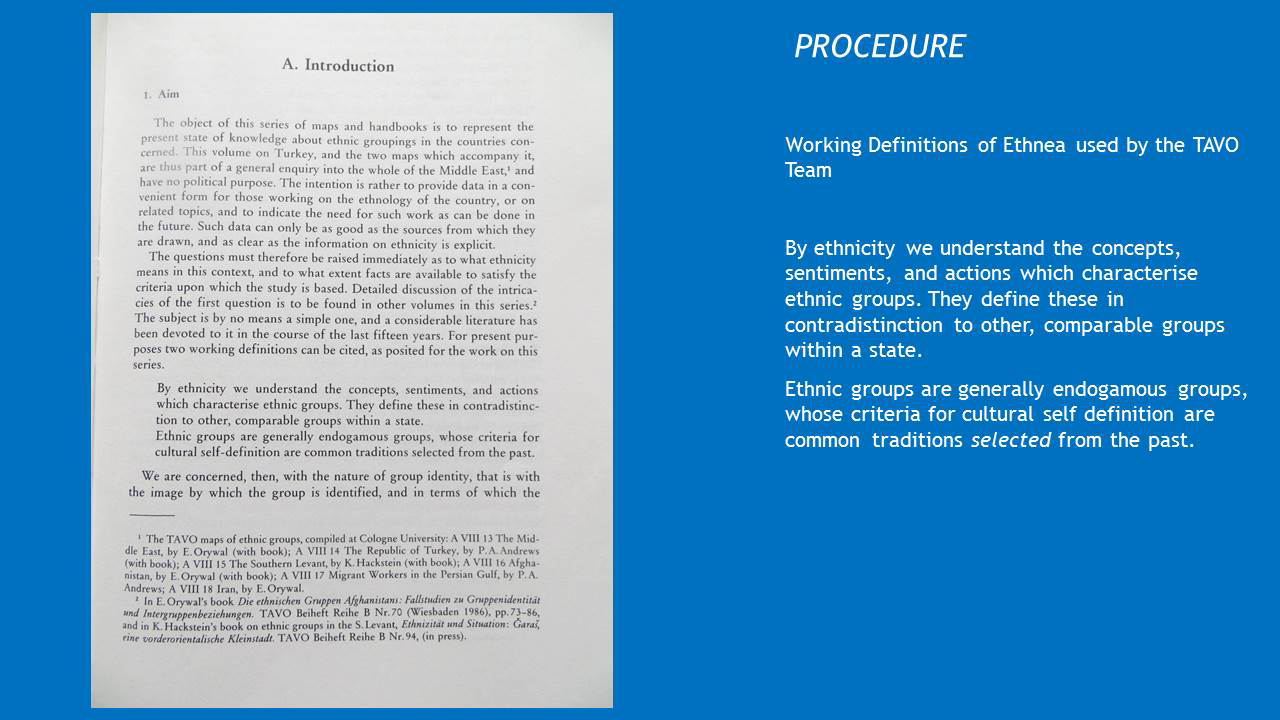
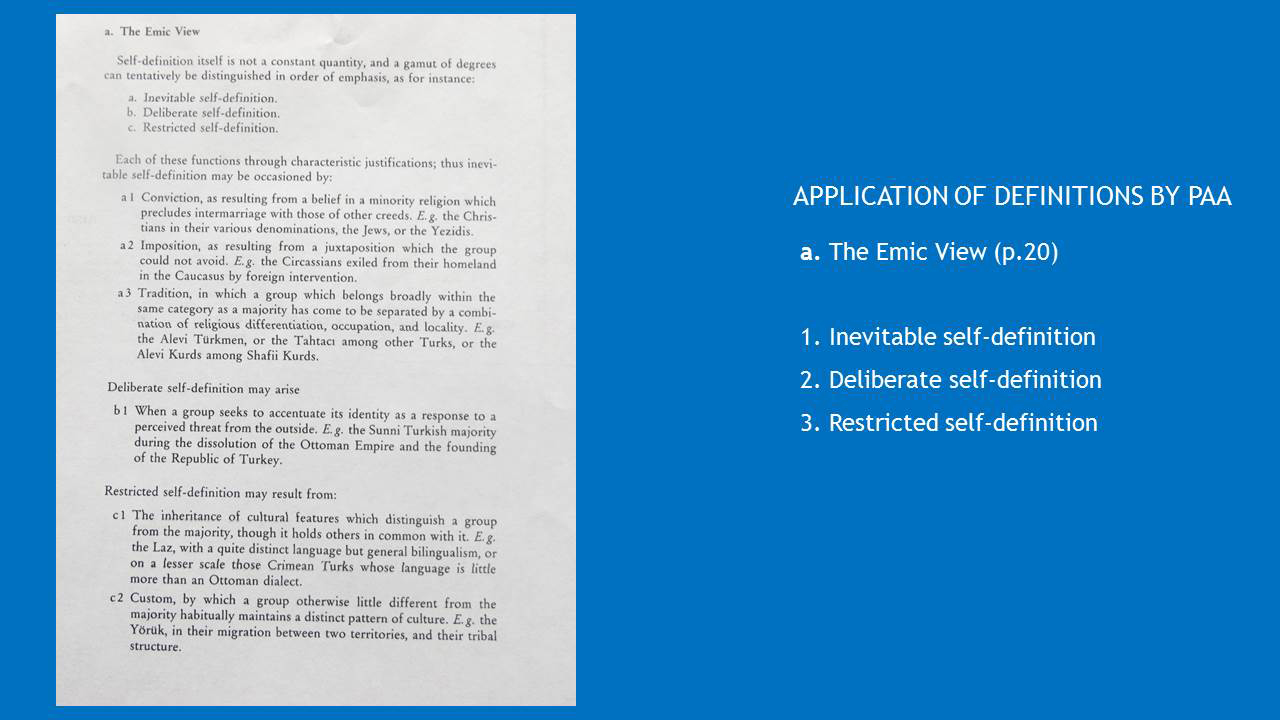
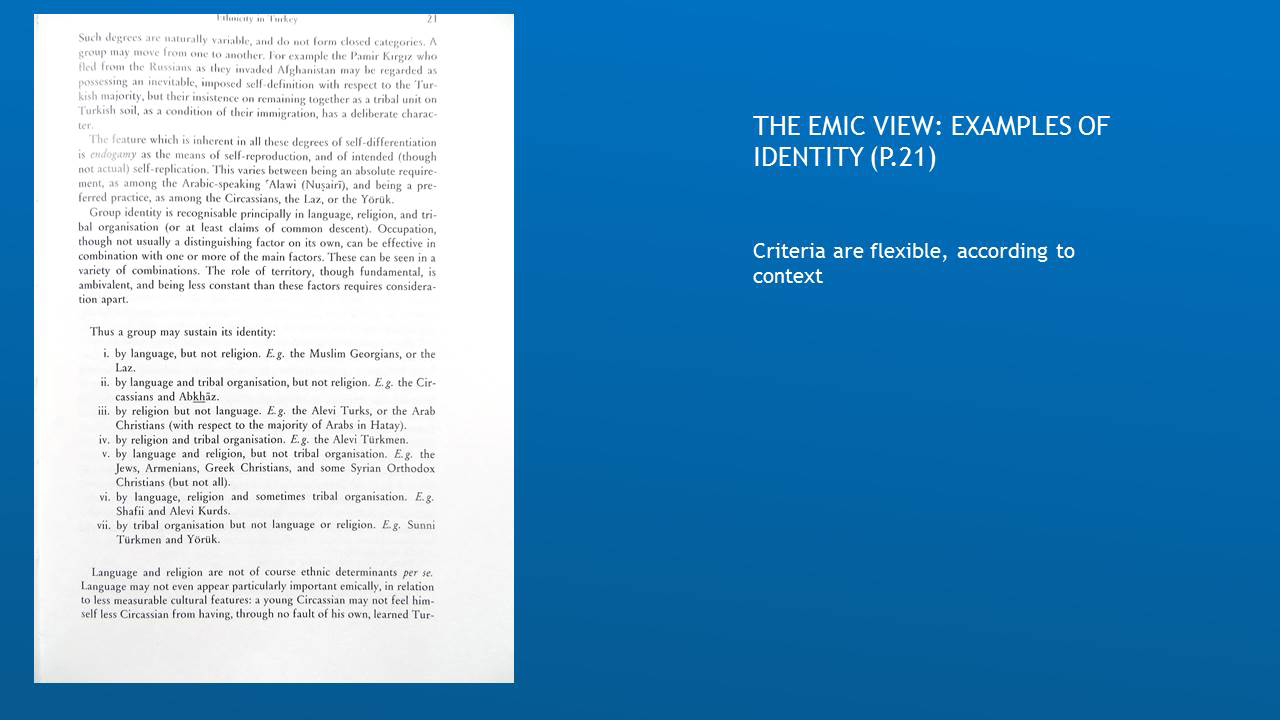
I had to define for myself as much as for the reader what an ethnic group was in the Turkish context, and found it many-facetted. The salient characteristic of ethnicity emerged as flexibility or elasticity. In this respect the popular idea of ethnic distribution as a mosaic cannot be sustained: the edges are not hard.
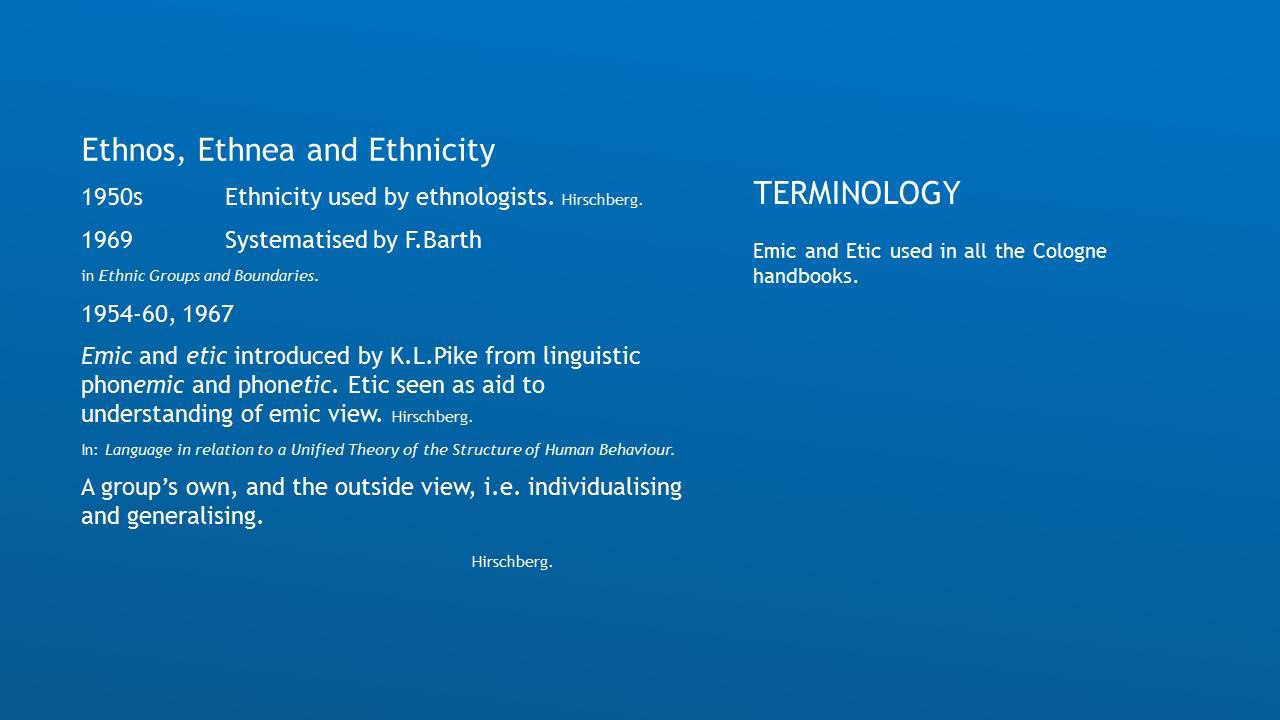
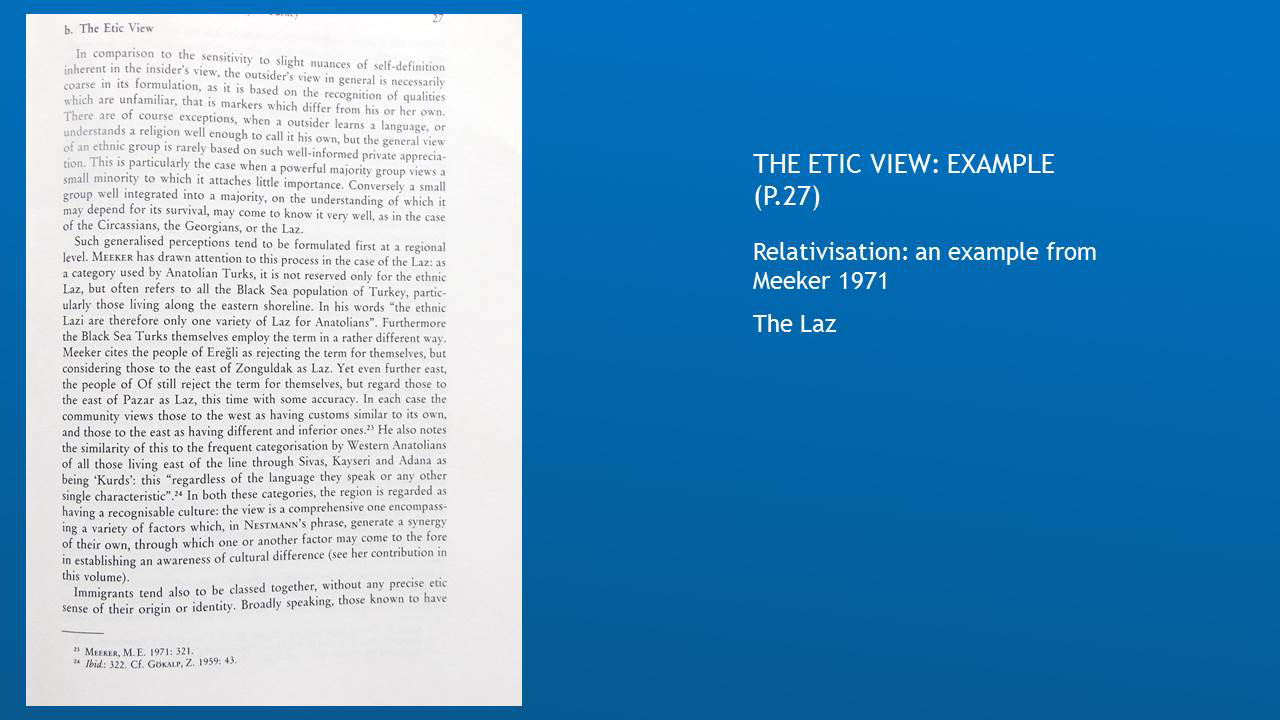
The team accepted that ethnicity had two aspects, the emic and the etic, that is the view from within and the view from without.
Whereas my colleague Dr. Erwin Orywal considered the etic view the anthropologist’s, for me it was the view of the wider population.
Etic has nothing to do with ethics: this leads to confusion in Turkish, where etik means ethics.
The etic view is not, however, without its complications, mainly due to generalised perceptions. Meeker in 1971 gave a striking example from the Pontic coast. He cites Anatolians as tending to consider the Black Sea population in general as Laz, but the people of Ereğli as rejecting the term Laz for themselves, instead using it for anyone living east of Zonguldak. Yet even those still further east in Of reject the term for themselves, but apply it to those east of Pazar, this time correctly. Here, evidently, the assessment of the ethnologist is important.
B. WORK ON TURKEY, Frames 22-30
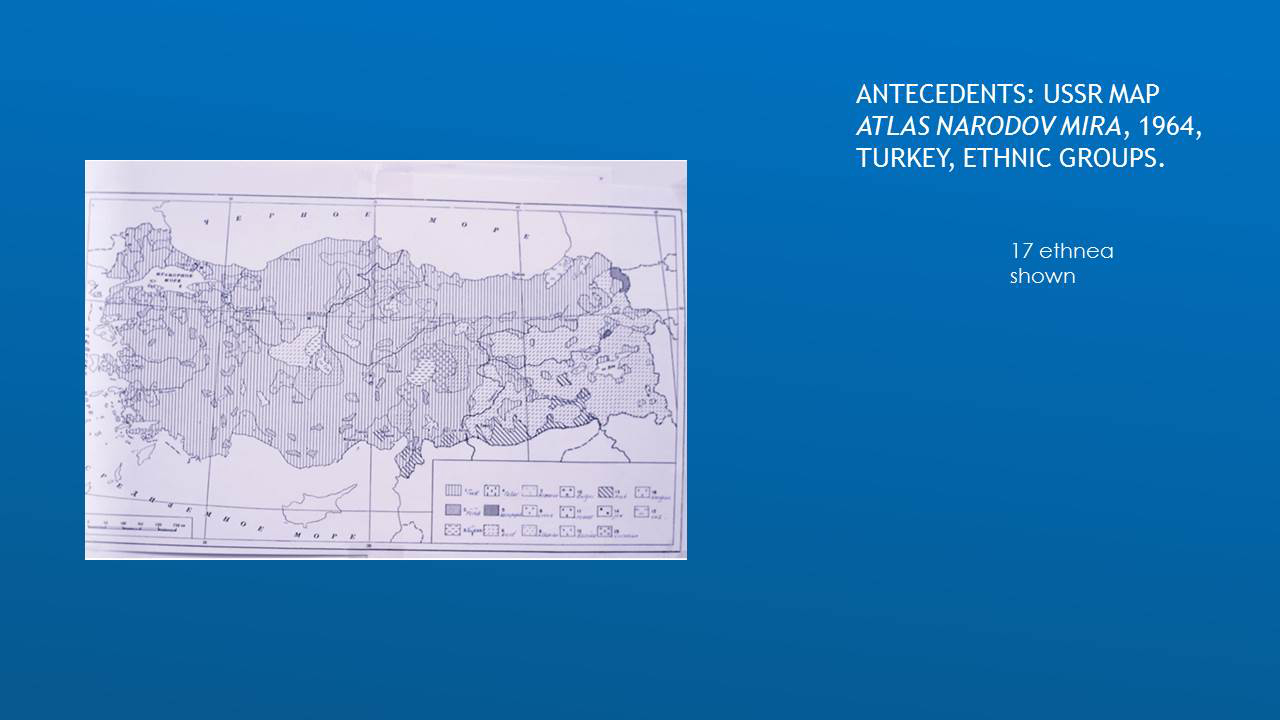
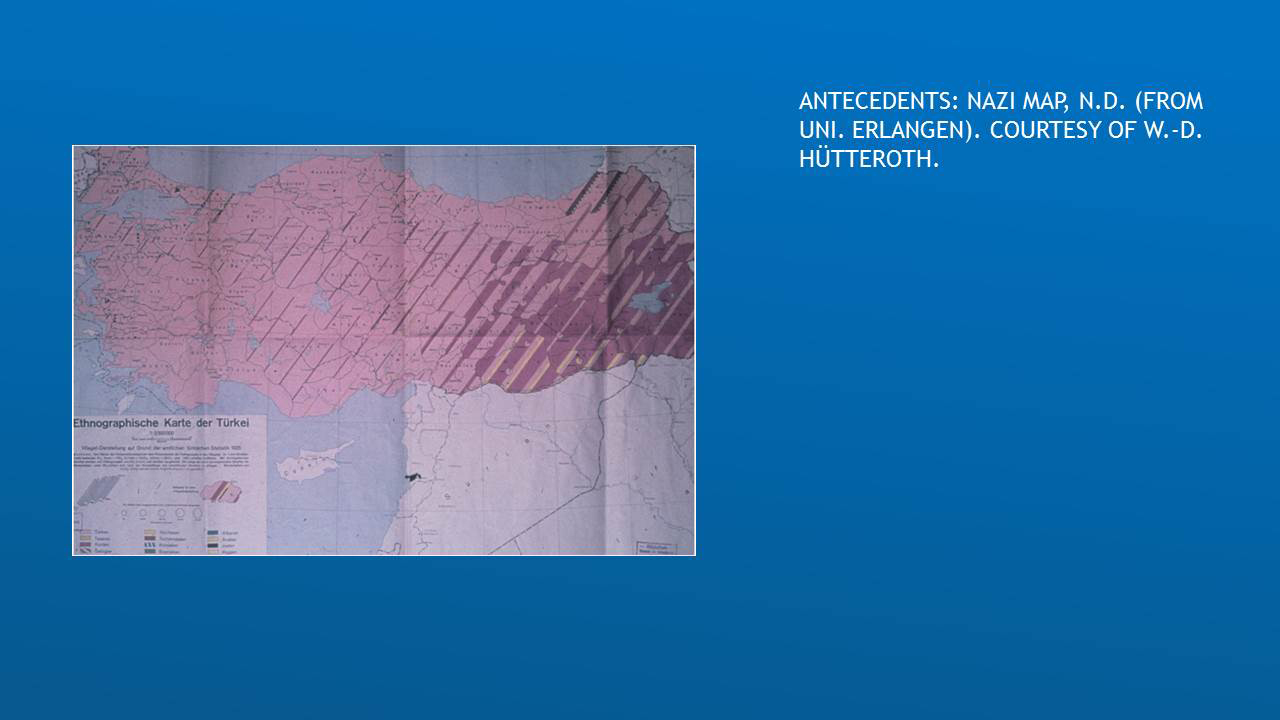
Antecedents
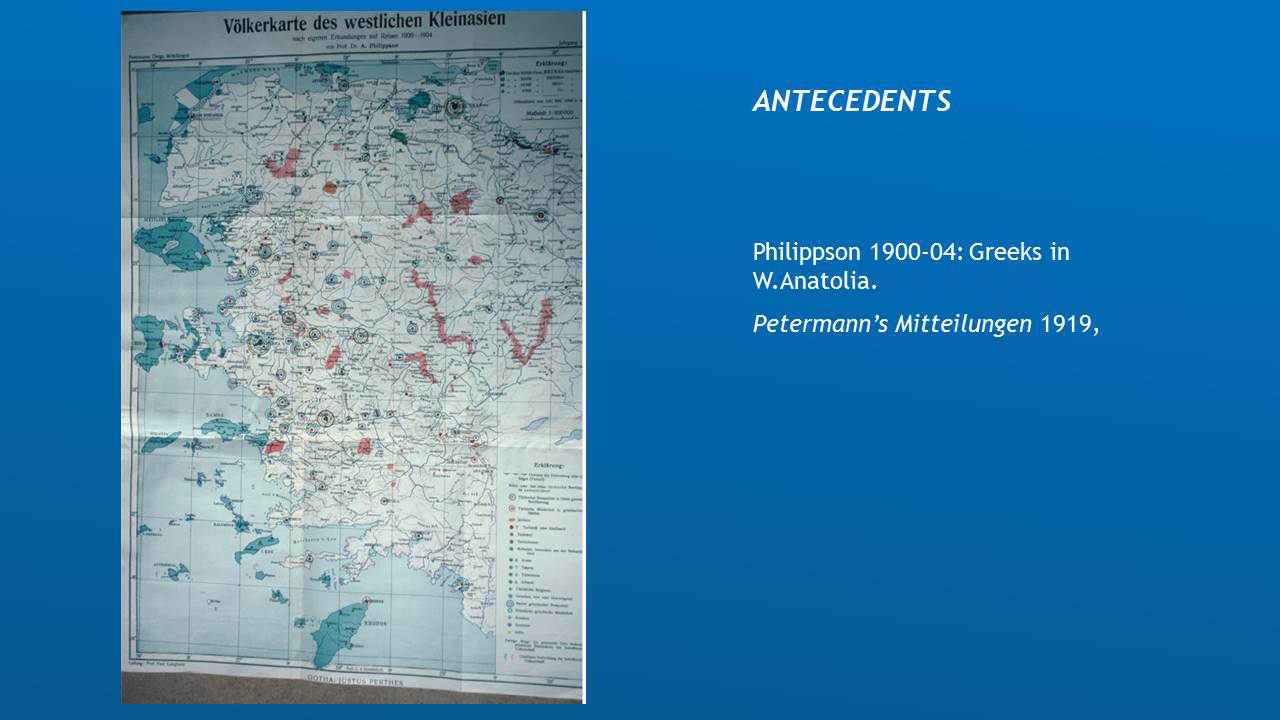
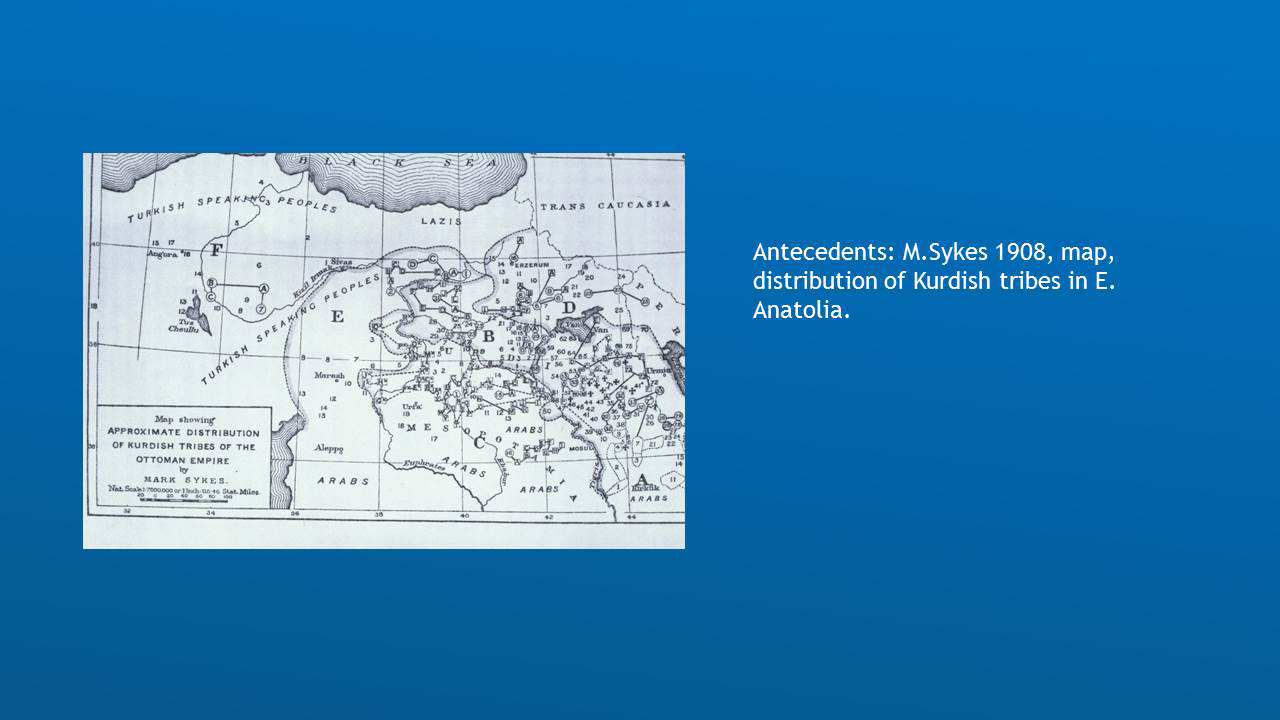
Some mapping of ethnic groups in Turkey had been done in the early 20th century, which, although it is now out of date, is worthy of attention.
Philippson’s record of ethnea in western Anatolia is remarkably competent, both in its scale and his attempt to represent the size of groups. The Greeks who dominate the map are, of course, no longer present.
Mark Sykes (he of the Sykes-Picot Agreement) undertook a map of Kurdish tribes in eastern Anatolia. Considering that he could not speak Ottoman, he made an admirably thorough job of this survey, though the work indicates the problems of determining tribal distribution.
The soviet map published in 1960 in Atlas Narodov Mira is the nearest to a usable model to build on, but a pocket of Avşar is shown to the east of Ankara which, so far as I know, does not exist. It also appears in the Atlas Narodov Perednei Azii.
An undated Nazi map was given me by Hütteroth without any further elucidation: as you can see it is heavily generalised.
C. IMPEDIMENTS, Frames 26-30
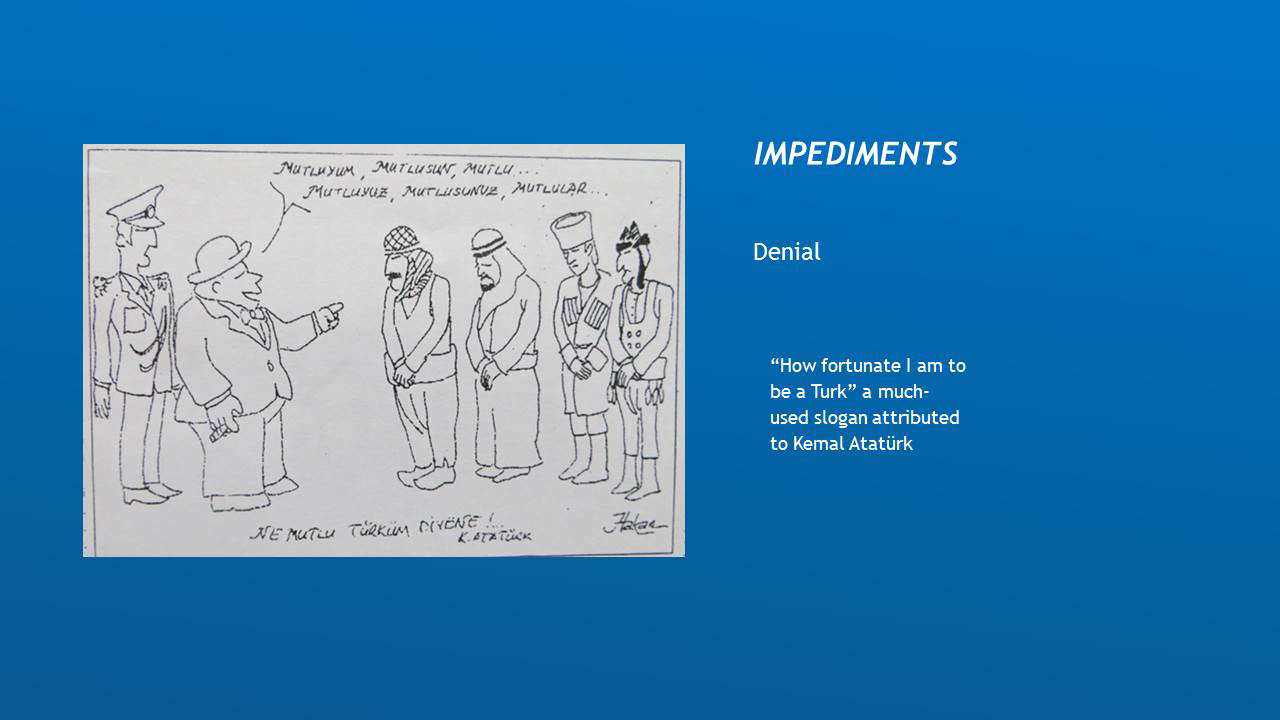
The Government policy of denial
Official fear that any identification of non-Turkic ethnea might result in division of the Republic amounted almost to paranoia. There is not much sign that this has improved, except in the recognition in 2002 of the right to broadcast and publish in Kurdish and the right for it to be taught.
As to the legally recognised minorities, azınlık, some falsification was accepted. In order for a minority to qualify for its privileges it had to be of a minimum size of 25,000. The exodus of Jews following the establishment of the state of Israel had depleted the number remaining below this level, but by a tacit agreement this was officially ignored.
Ordinary Turks, especially the rural population, were and are fully aware of ethnic difference, and even within a single village, different ethnea often do not intermarry. They can usually identify several surrounding villages as populated by different ethnea. In contrast, those who consider themselves indigenous call themselves yerli (local) or manav (market-gardeners).
Many urban Turks have never travelled east of Sivas. When they do, they find the ethnic differences striking. My wife Mügül, when I first took her to Muş, listened to the talk around her and the songs on the bus-driver’s cassette, and said “I might as well be in China”.
Some administrators deliberately denied access to ethnic groups even when their existence was obvious. When in 1972 I had asked permission of the Governor of Ağrı to visit Kurdish nomads in his area, he replied “You come from a civilised country: I do not want to show our lack of civilisation to you” (bizim medeniyetsizliğimizi size göstermek istemiyorum). He lacked the perspective to realise that his own refusal did precisely that.
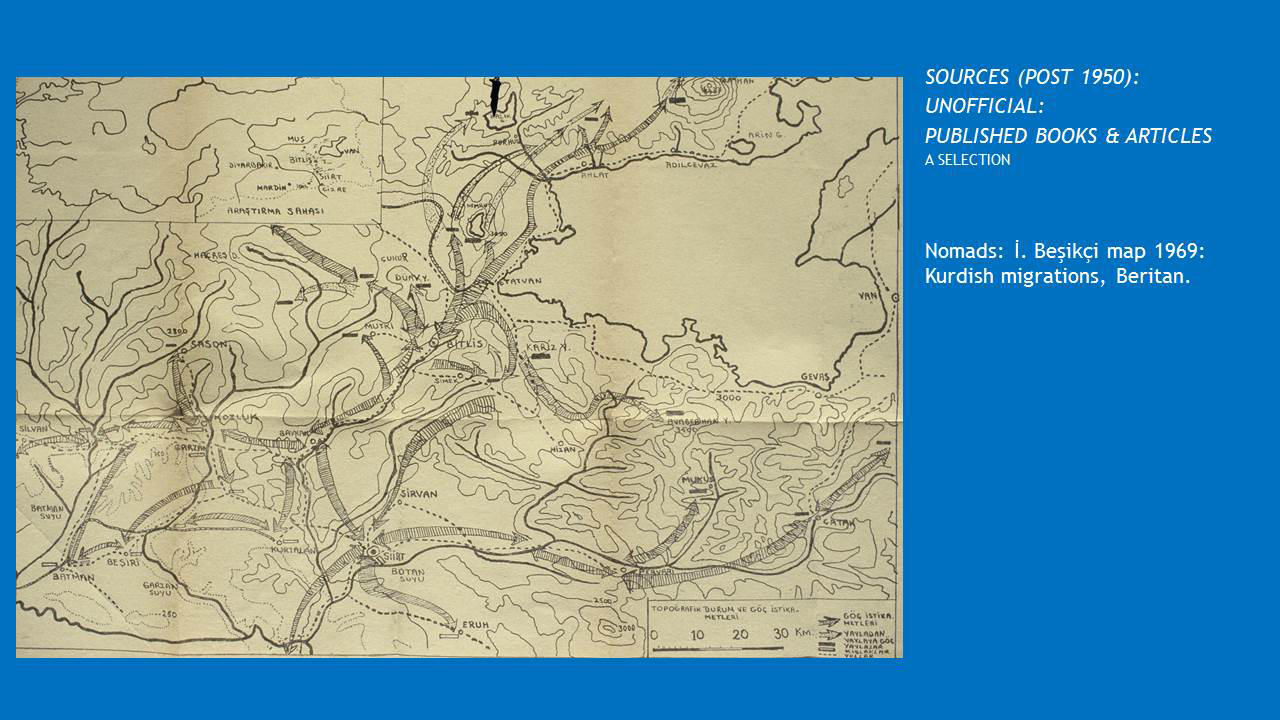
There is no doubt that by the 1980s the official denials inspired real fear among those who might be construed as ethnic activists. We visited Şerefettin Terim in connection with his book Abhazlar ve Çerkez Mefhumu. He kept our interview as short as possible, but as we left, thrust a dozen copies of the book into my hands, all too happy to be rid of them. İsmail Beşikçi, who in 1969 had dared publish a book on the Alıkan Kurds in the Nemrut Dağı region, was sentenced to 13 years in prison for his pains, though he was fortunate to be released under an amnesty. His fingers were said to have been broken by way of encouragement. He could never again find employment in a Turkish university.
Changing of village names
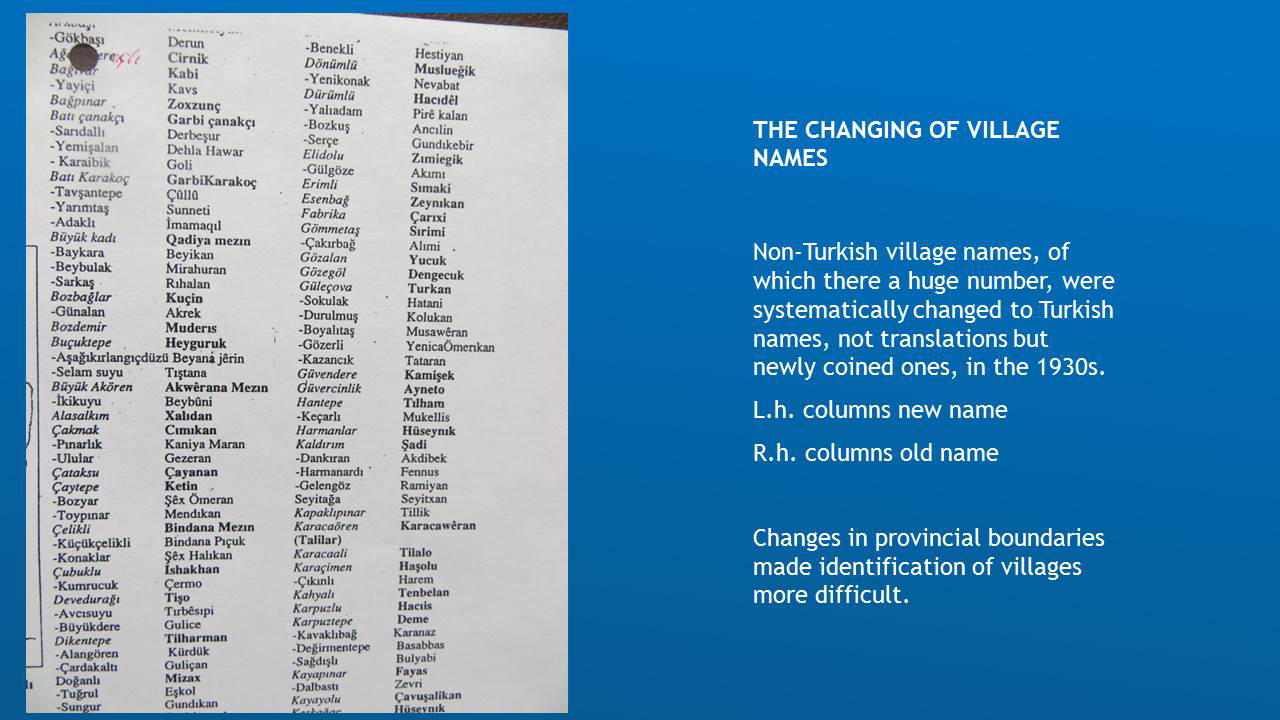
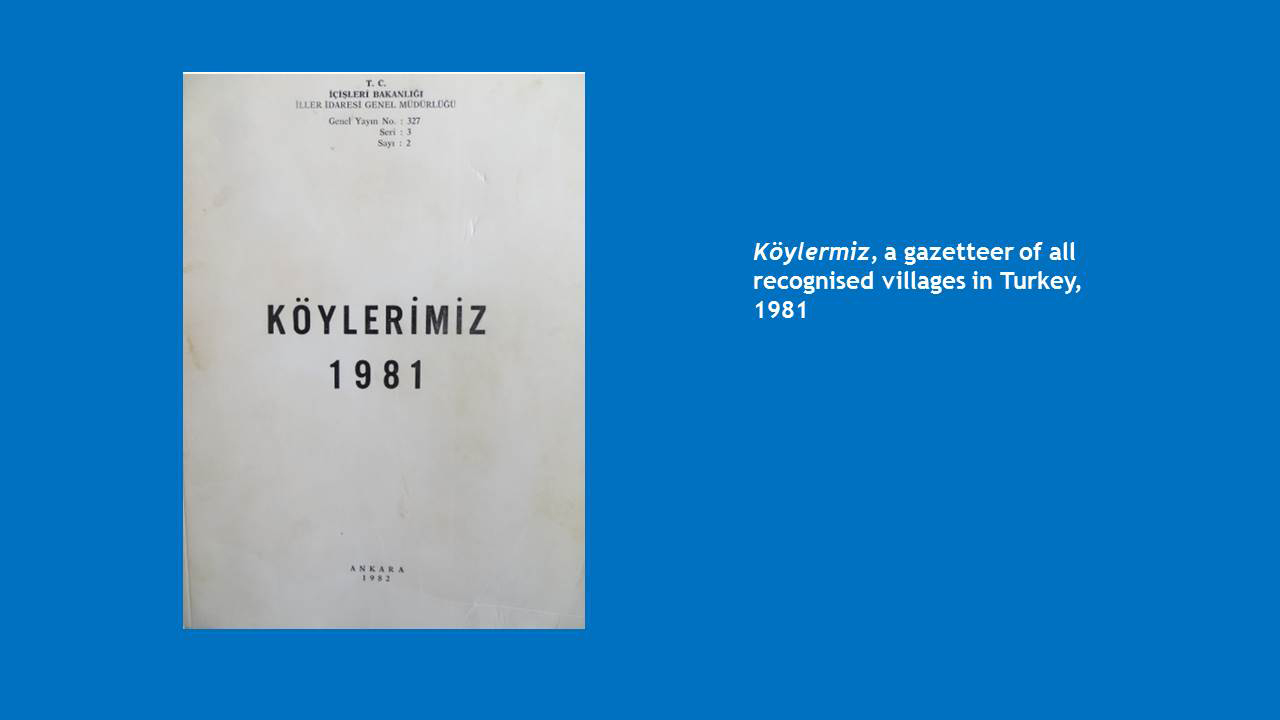
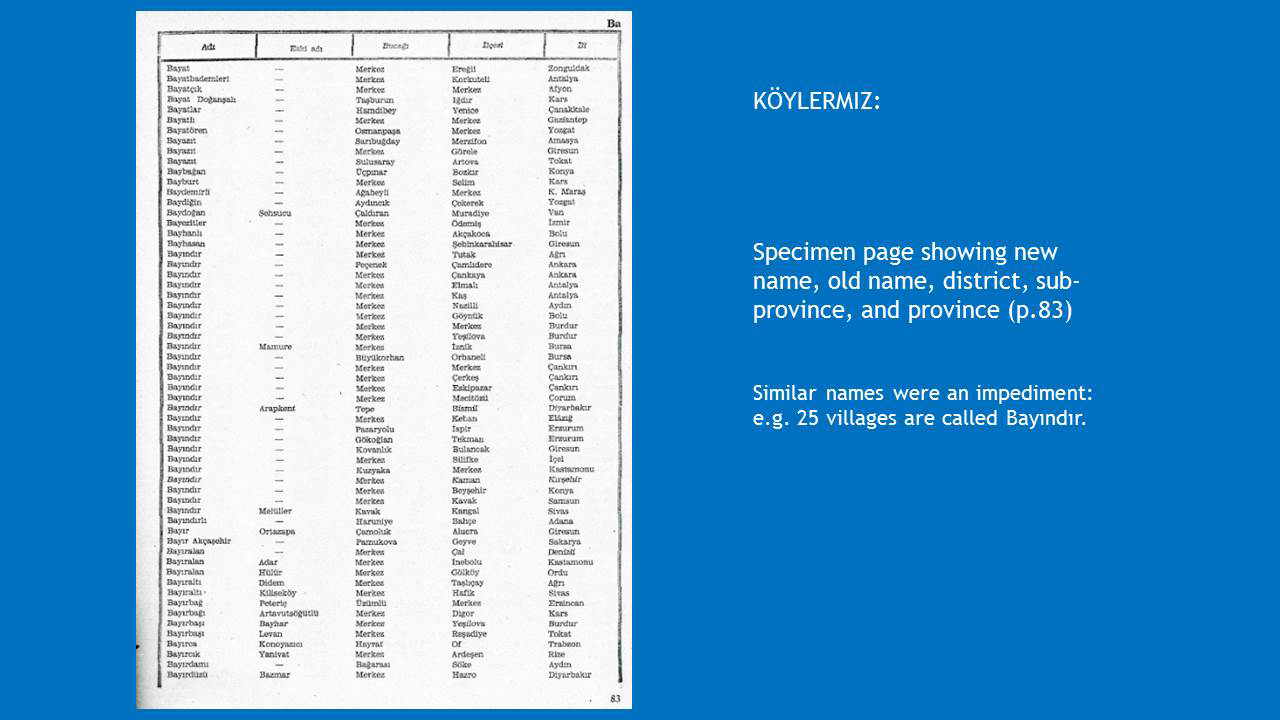
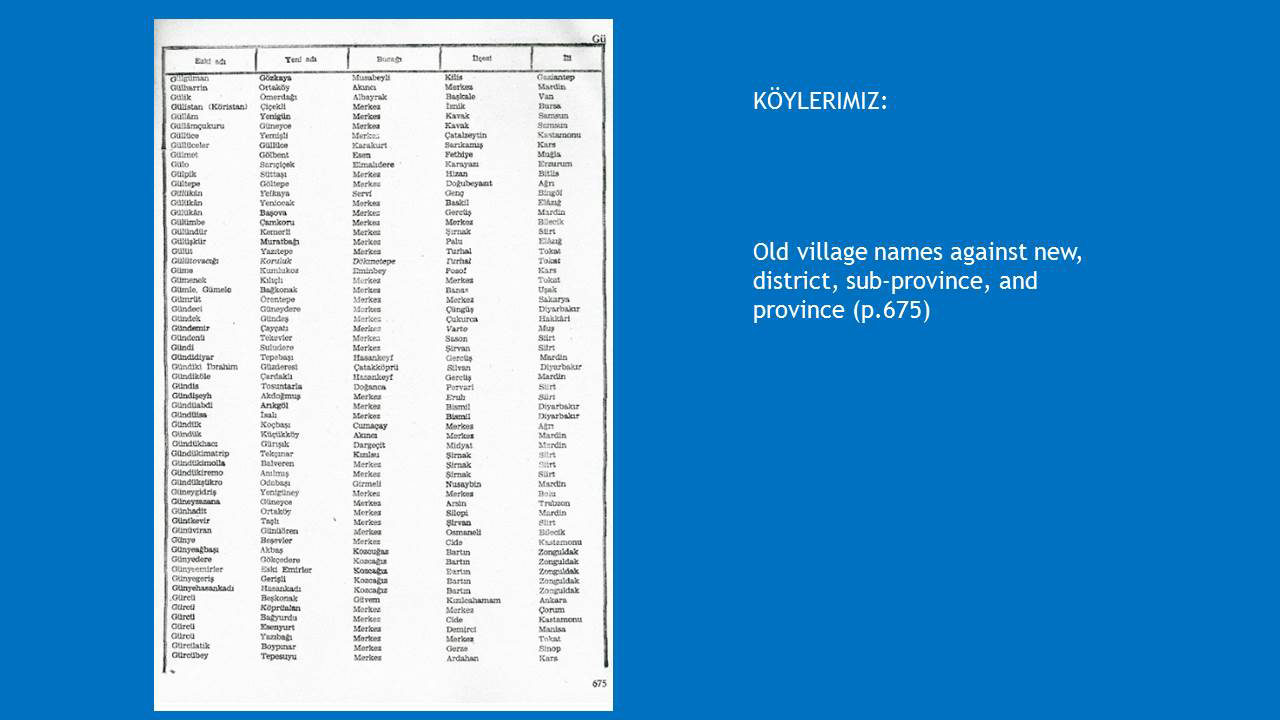
Part of the official obfuscation was through the changing of village names whenever these suggested an ethnic origin other than Turkish. The 1982 edition of Köylerimiz (Our Villages), a gazetteer listing all recognised villages in the country, makes this very plain. In the first part, all villages are listed under their new names followed by the old ones, and in the second, amounting to a quarter of the book, they appear under the old names, followed by the new. Names in Kurdish, Dimli, Lazuri, Georgian, Circassian and Aramaic were all sacrificed to the dogma of ethnic unity. The new names bore no relation to the old, and were often quite arbitrary. A student study gave the example of a civil servant who renamed a village Karanfil (Carnation) after the brand of cigarette which the headman happened to be smoking.
A list of village names from Diyarbakır illustrates the extent of the changes from the original Kurdish.
As village populations obstinately prefer to use the old name, the changes often made identification difficult.
Changes in the names of towns were more difficult to identify, as they do not appear in Köylerimiz. In some cases even the names of provinces were changed.
Changes in provincial boundaries, or the creation of new provinces, was also a hindrance to identification..
Official information concealed
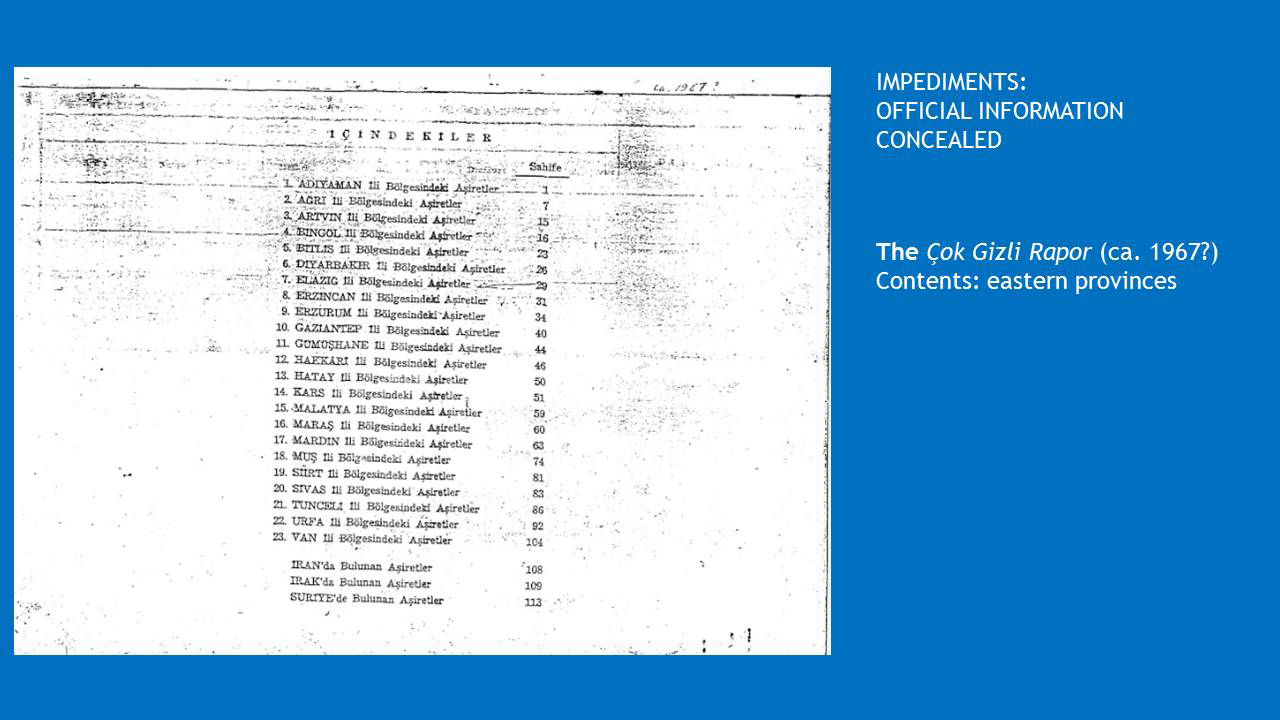
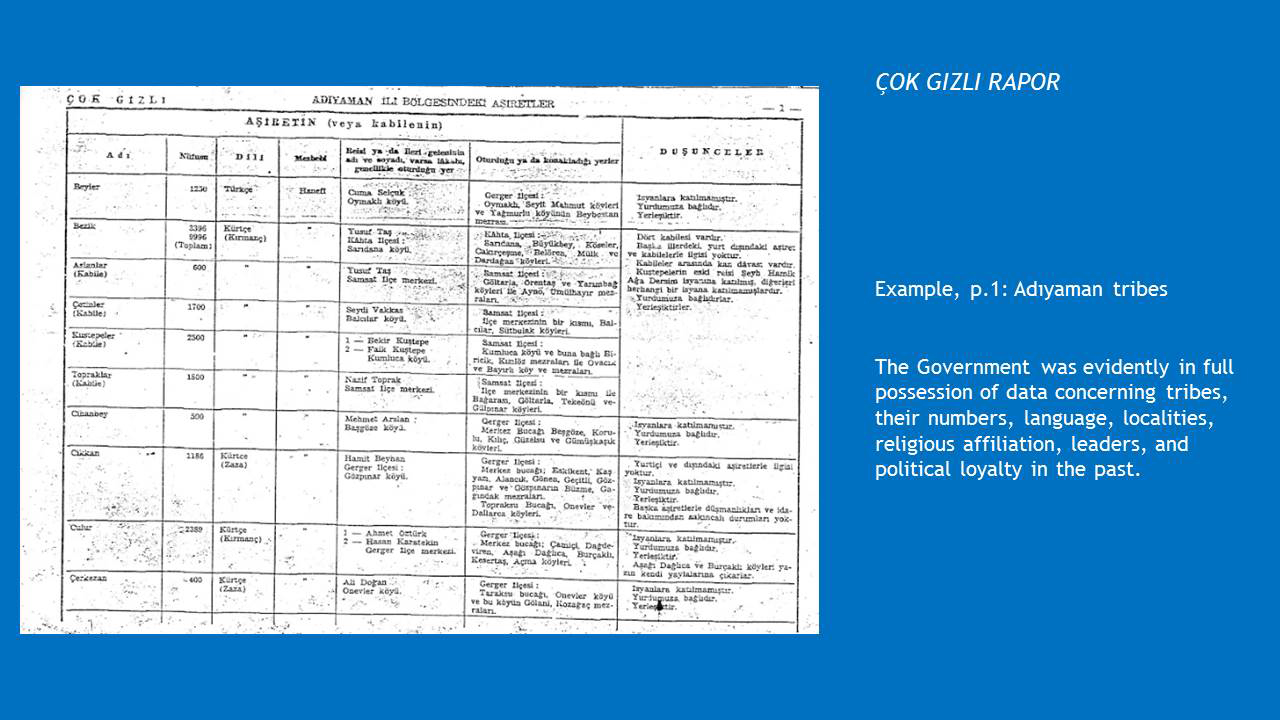
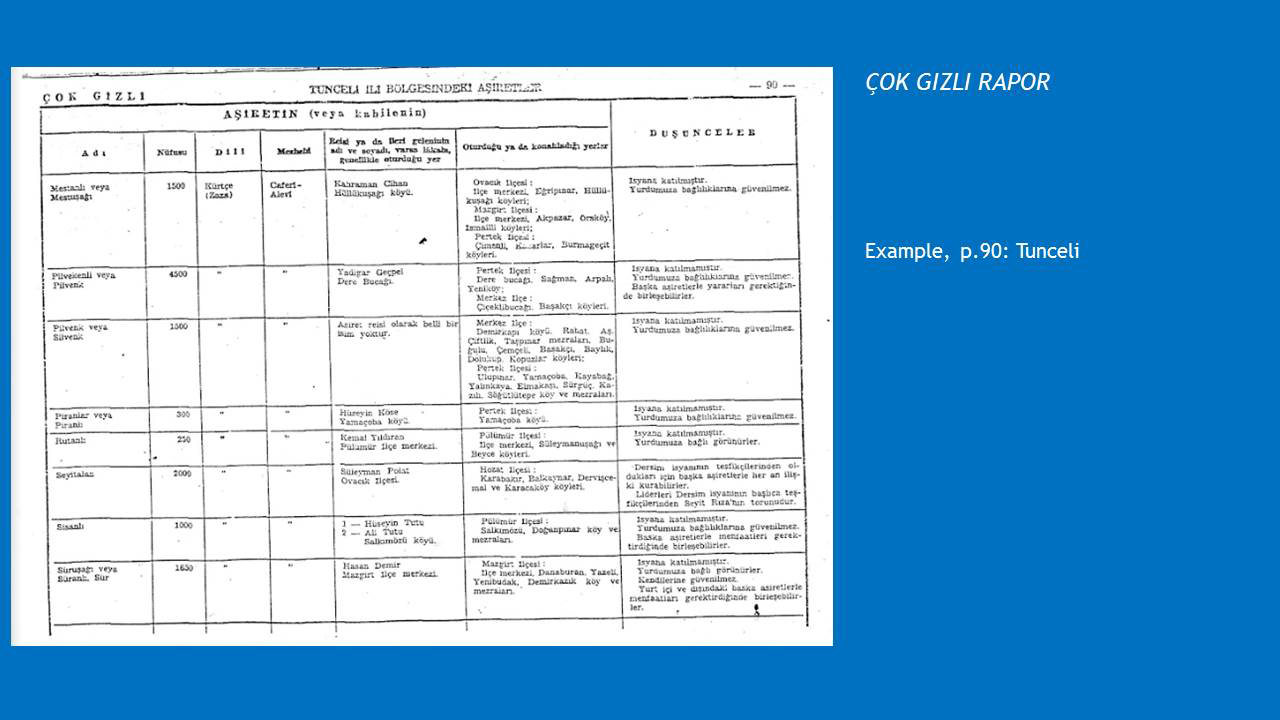
In Cologne, we obtained a copy of a different gazetteer, which, as the title page was missing, we knew as the Çok Gizli Rapor (Top Secret Report), apparently compiled in ca. 1967. This lists tribes in the eastern provinces with their numbers, language, religion, leadership, position, and political loyalties. Its chief use to us was in identifying whether the groups spoke Kurdish (Kırmanç) or Zaza (Dimli). The fact that we obtained it illustrates the near-impossibility of maintaining the secrecy of material.
In the case of Tunceli (Dersim), for example, we have a tribe, the Mestanlı, recorded as insurgents. Tunceli, historically a refuge area which harbours the early Zaza immigrants, was described by van Bruinessen as “the biggest Karakol in Turkey” and for many years was quite inaccessible for enquiries.
There was another restricted report, the Doğu ve Güneydoğu-Anadolu’nun Genel Durumu (Mesleki Rehber), Ankara 1972, a 543 pp. professional guide for officials working in the eastern and south-eastern provinces. I used figures from that for non-Turkish-speaking populations in Vol.II.
D. SOURCES, Frames 31-46
Assistance
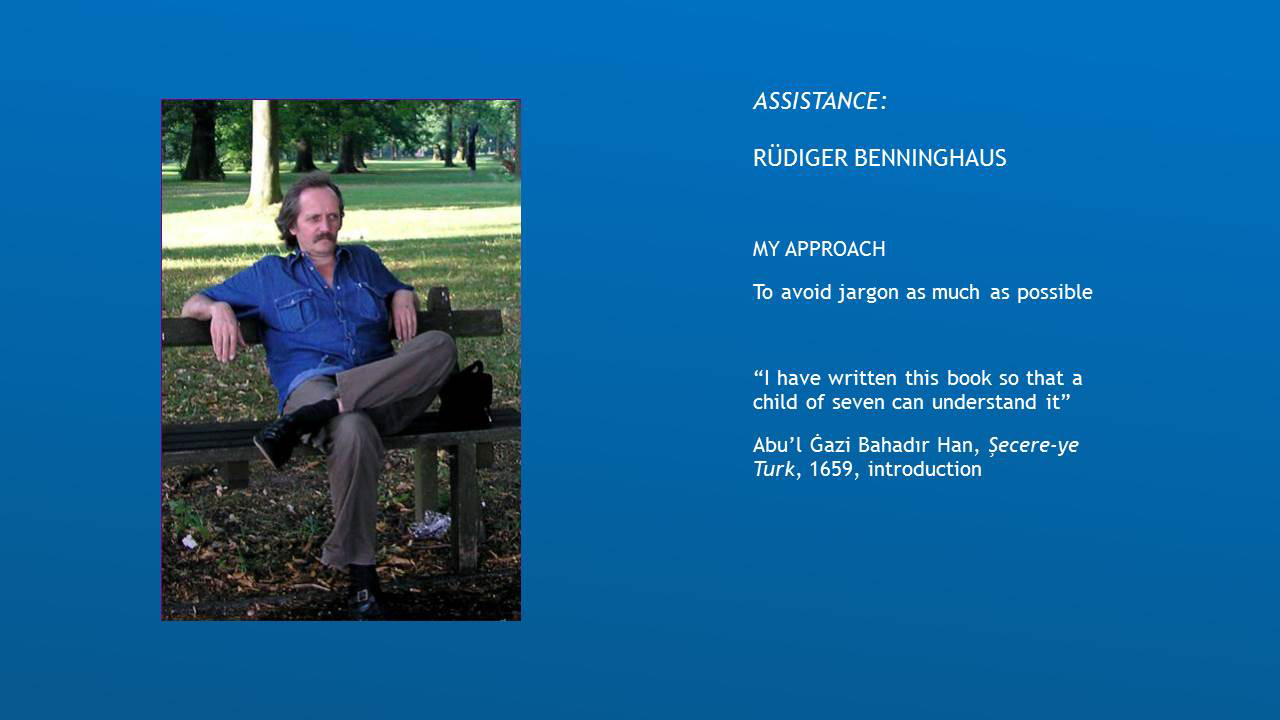
Shortly after I began work, Rüdiger Benninghaus, a local Sauerländer, appeared in my room and presented himself as someone who had been collecting information on ethnic groups in Turkey for several years. He had conducted his own surveys in Cologne, and to some extent in Turkey itself. He did this out of his own strong sense of justice, and therefore loathed the forces in the regime which concealed the truth. While at school he had been strongly influence by Lessing’s Nathan der Weise. Although a senior student, with considerable ability, and speaking fluent Turkish, he repeatedly refused to write a thesis, mainly because he could not get along with Johansen. He had mastered eastern Anatolian dances so well that he taught them to Turks in Cologne. He seemed to identify strongly with the Laz.
His help was invaluable, and he made a major contribution to the books. He had a remarkable ability to winkle out information, and went around the çayhane of Cologne with a copy of the census, pencilling in information against the villages listed.
I managed to get him paid by the DFG as my assistant (and Johansen must have cooperated in this), though because of his lack of qualification, this was not as generous as it should have been. I had no disagreements with him, and we agreed on a general strategy. Tact was not his strong point. He was arrested more than once in Turkey, and told the police they were behaving like “nineteenth-century derebeyler”.
I must emphasise that we were never expected to conduct fieldwork. For the reasons I have given, it would in any case have been impossible to obtain permission for this from the authorities, but, as Hütteroth pointed out at a Begehung, Turkey is such a large country that, if I started to collect data at one end, that would be out of date by the time I got to the other!
The team was working on data from later than 1950. For practical reasons, I decided to limit the scope of the Turkish maps to 1960-70. Firstly the last official figures available for language and religion were from 1965; secondly student work on ethnic groups had stopped in 1970; thirdly extensive urban migration had taken place in the 1970s, emptying many villages (mapped separately by Greif on TAVO A VIII 5.1); fourthly the official data on language and religion in the eastern provinces had been gathered in 1960-68; finally the influx of refugees had largely ended with the arrival of those expelled from Bulgaria in 1950-54, and the Altay Kazak in 1952-69.
Official Sources
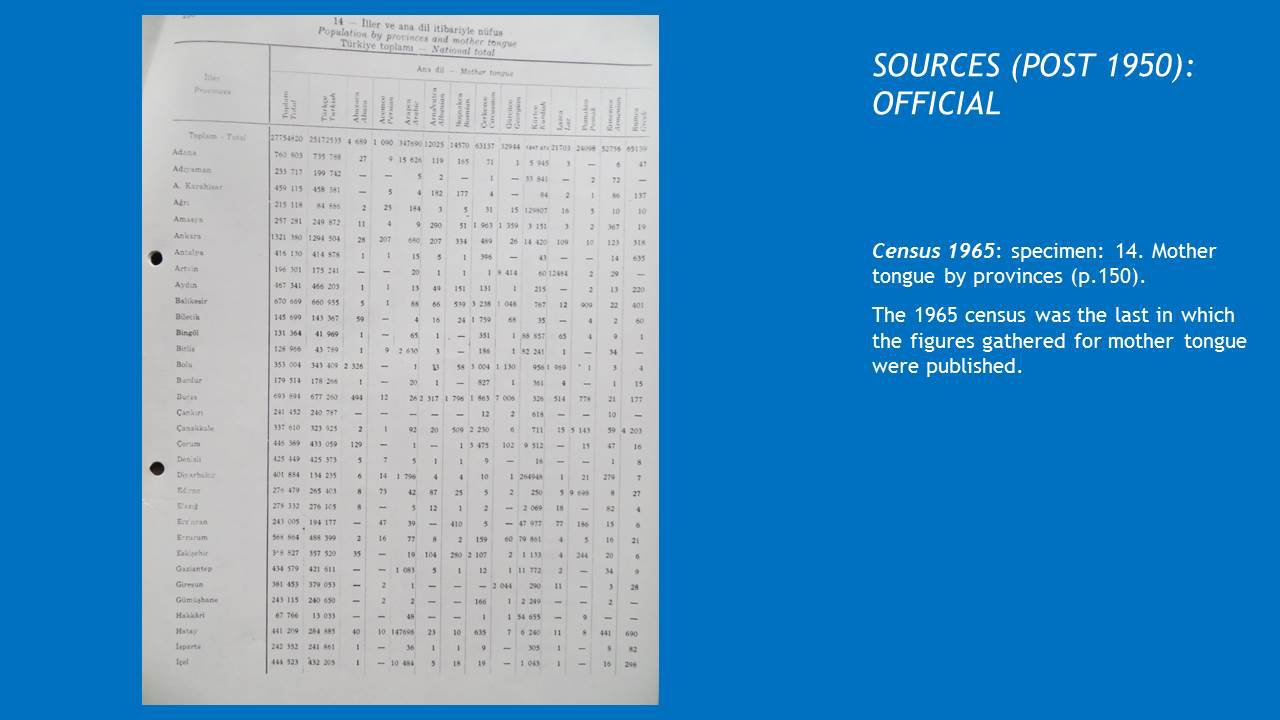
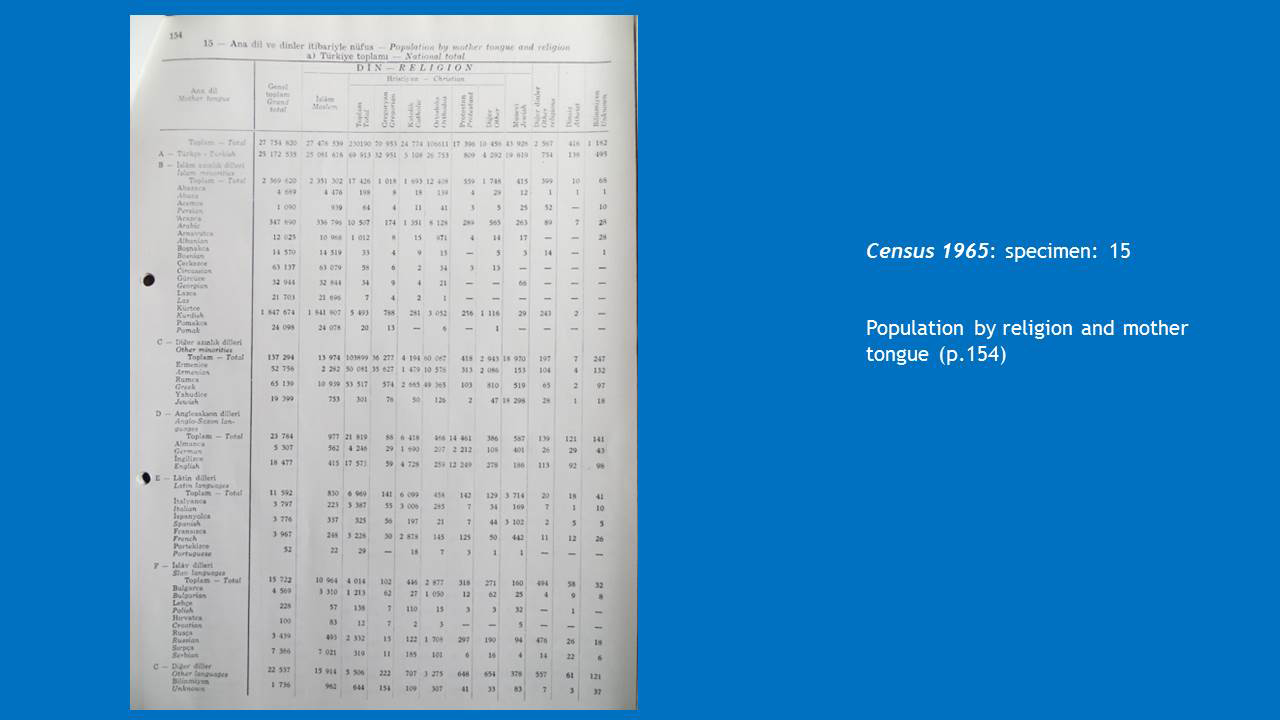
The primary source was of course the census, the Genel Nüfüs Sayımı (GNS). However, the figures on language (mother tongue) were suppressed after the 1960 issue. Fortunately this brought it just within our parameters of 1960-70. A debate arose over the listing of “second language”.
I have already mentioned the gazetteer Köylerimiz, which served as a key in interpreting data we were given.
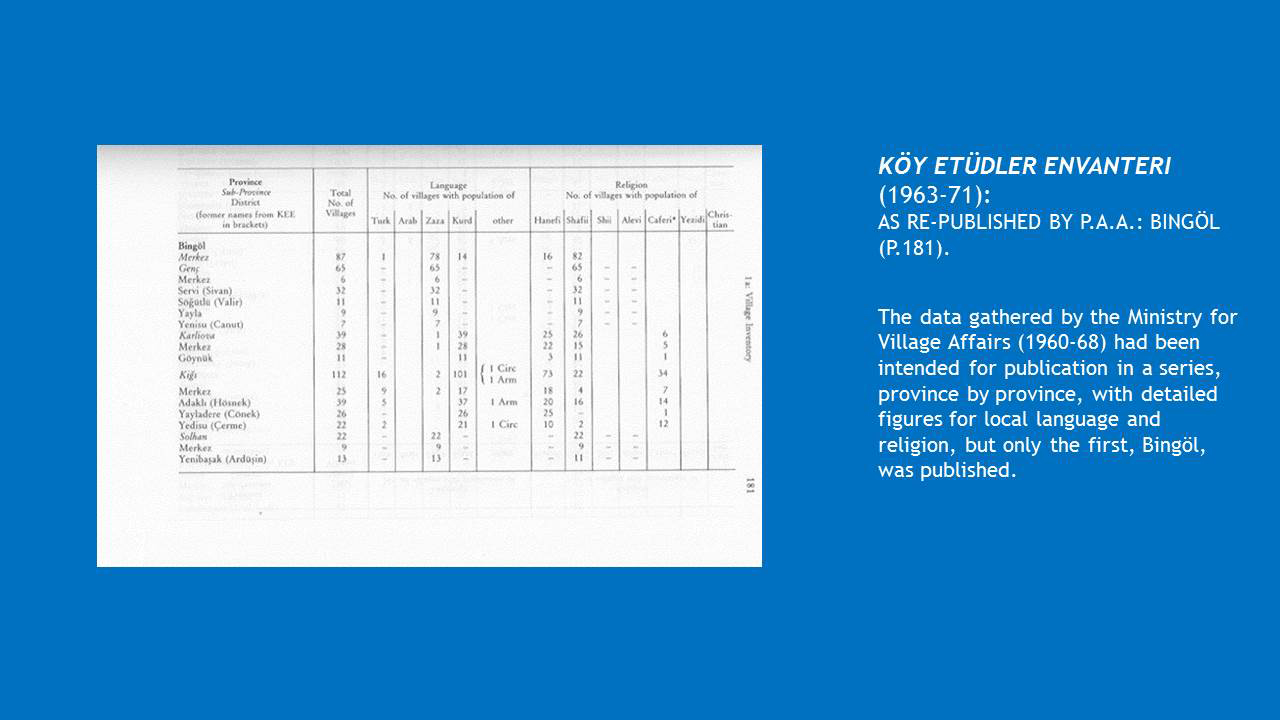
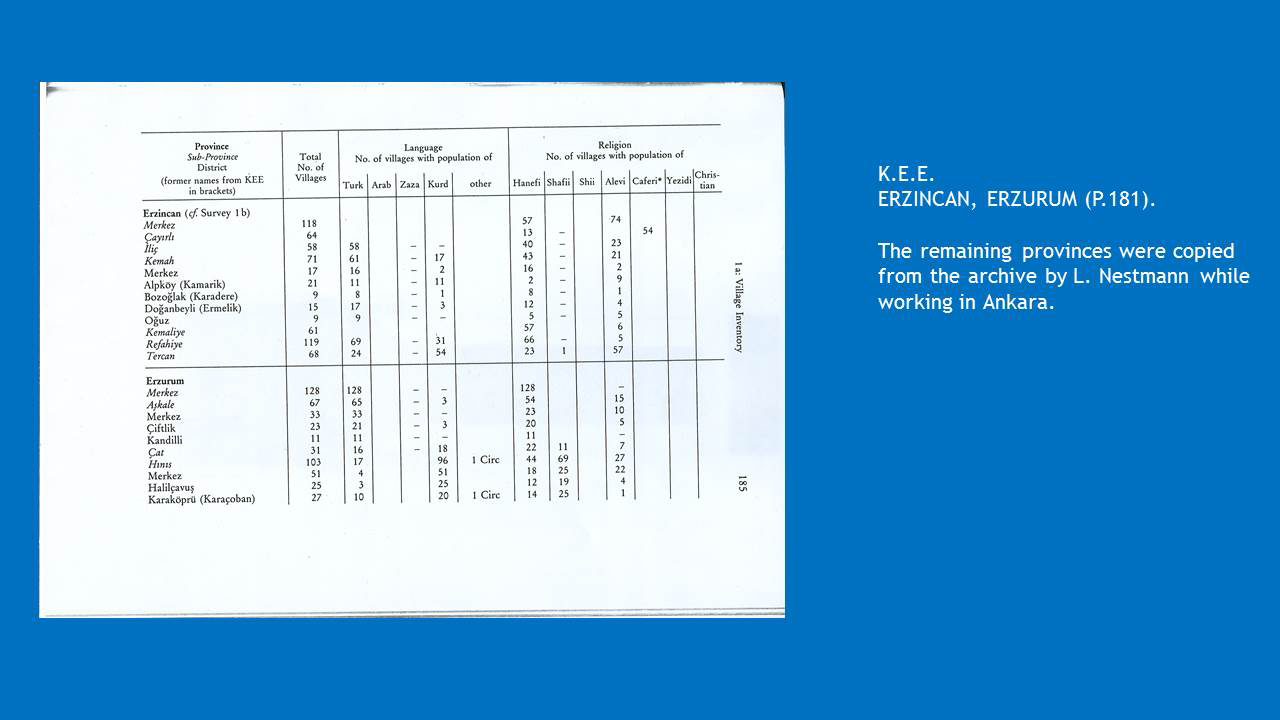
The Köy Etüdleri Envanteri (KEE), a survey of the eastern provinces conducted from 1960-68 by the Ministry for Village Affairs, came out in fascicles for each province. Again, the data on language and religion were suppressed after the appearance of Bingöl. Apparently other government departments found this information unacceptable. So the data remained in a card index in Ankara. It was later reported to have been lost in a flood, though Ankara is at high altitude. Fortunately Prof. Liesa Nestmann, who in the 1960s was teaching in Ankara, became the friend of the wife of the director of the survey, and through her obtained access to it. She managed, surreptitiously, to make a copy by hand, which she gave me.
Unofficial Sources
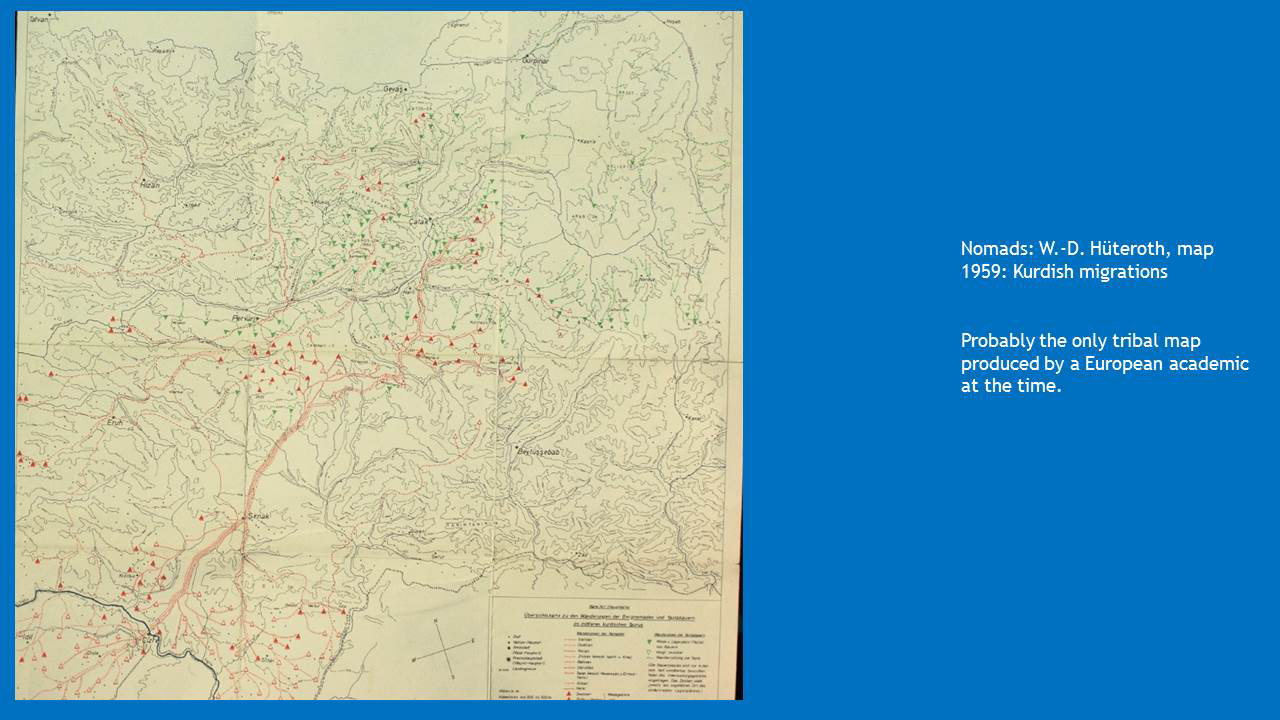
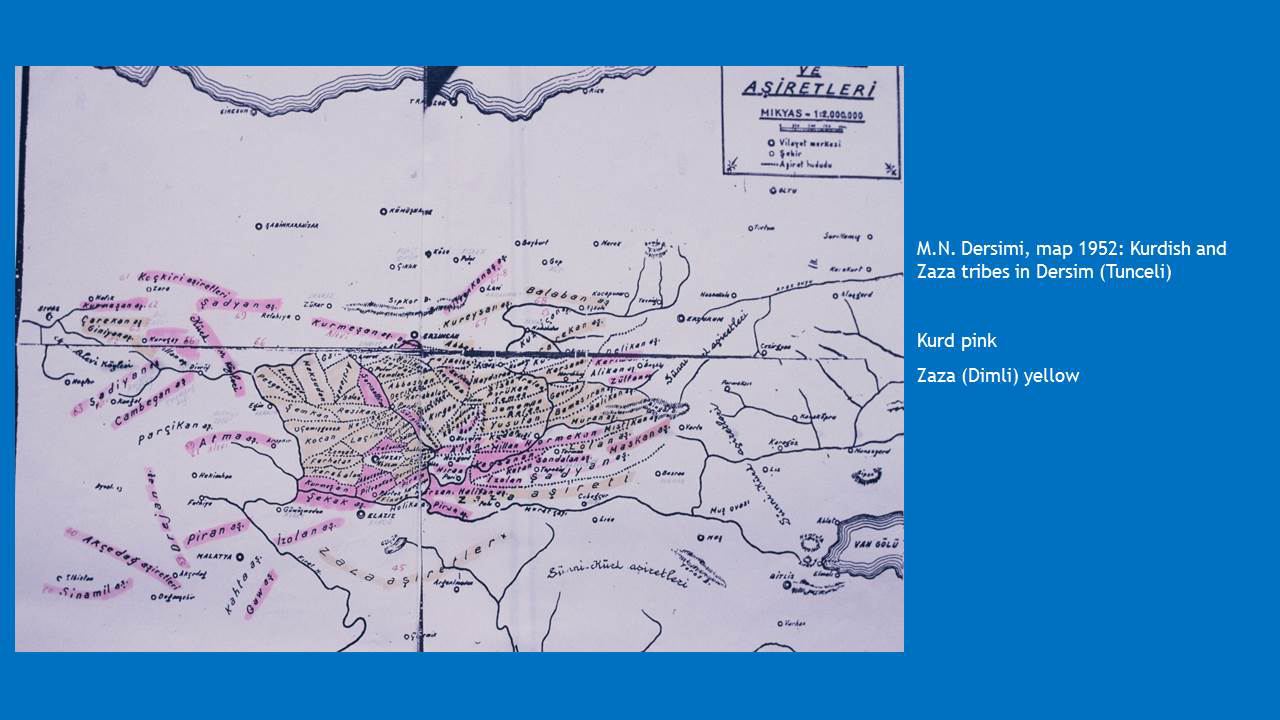
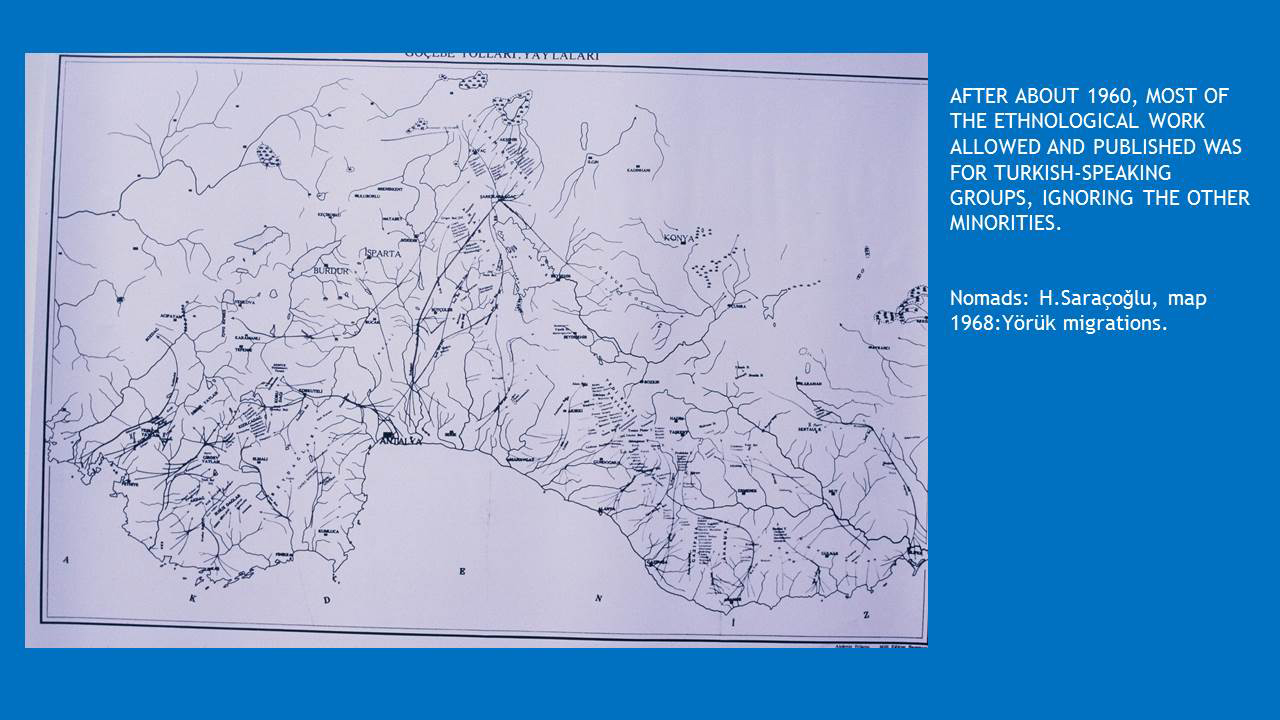
There were quite a large number of maps published by anthropologists and geographers, though most of them related to Turkish-speaking groups. As examples I can show:
Hütteroth (1959) documented and mapped the Kurds before it became impossible to do so. He later collaborated with Nejat Göyünç in editing the Tahrir Defterleri.
Dersimli’s material (1952) was potentially incendiary: it was published in Aleppo.
Saraçoğlu’s (1968) map of Yörük migration routes in southern Anatolia. It is by no means sure that all these migration routes are still active: radical changes have taken place in Yörük life, with the use of tractors and polythene tent cloth, terylene ropes and other moves away from their traditional self-sufficiency. The government remains intent on settling them, unsympathetic to tradition or to their ecologically sustainable life. For urban Turks, we found that etic perceptions are so crude that Yörük are often confused with Gypsies.
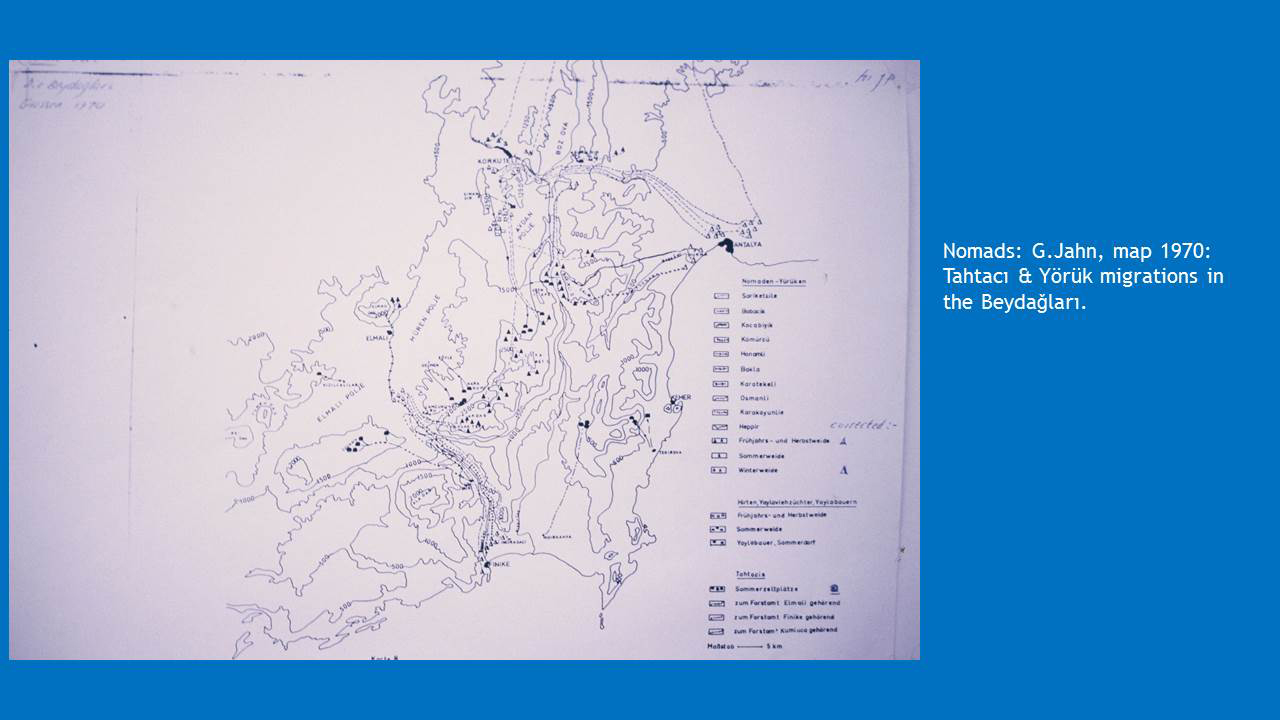
Jahn (1970) and Özbayrı’s (1972) documentation of the Tahtacı adds to earlier material from Güngör. The Tahtacı are still very shy of contact with outsiders: in our experience they are the only group whose children run away.
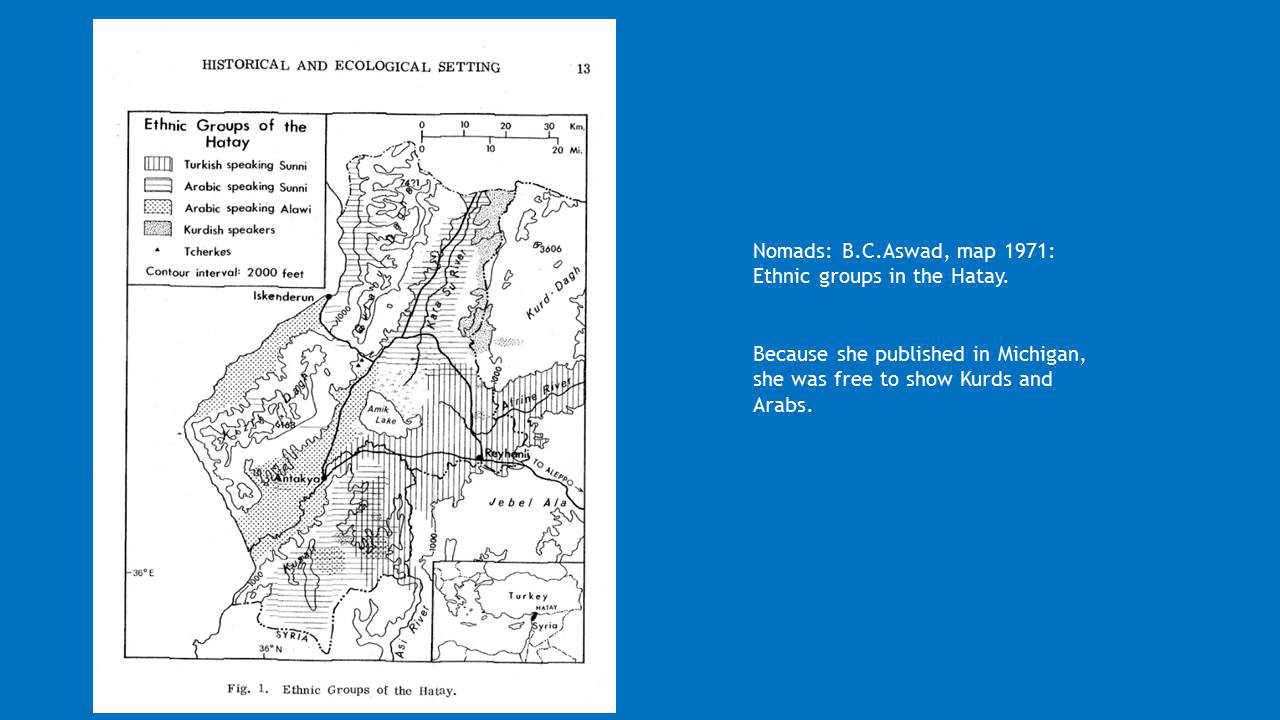
Aswad’s map of the Hatay (1971). The ҅Alawiyya have a highly exclusive form of religion quite different from that of the Alevi in the rest of Turkey, which they deprecate as “blind”. Yet the difference has gone largely unnoticed in Turkey, perhaps because Hatay is remote and entered the Republic late.
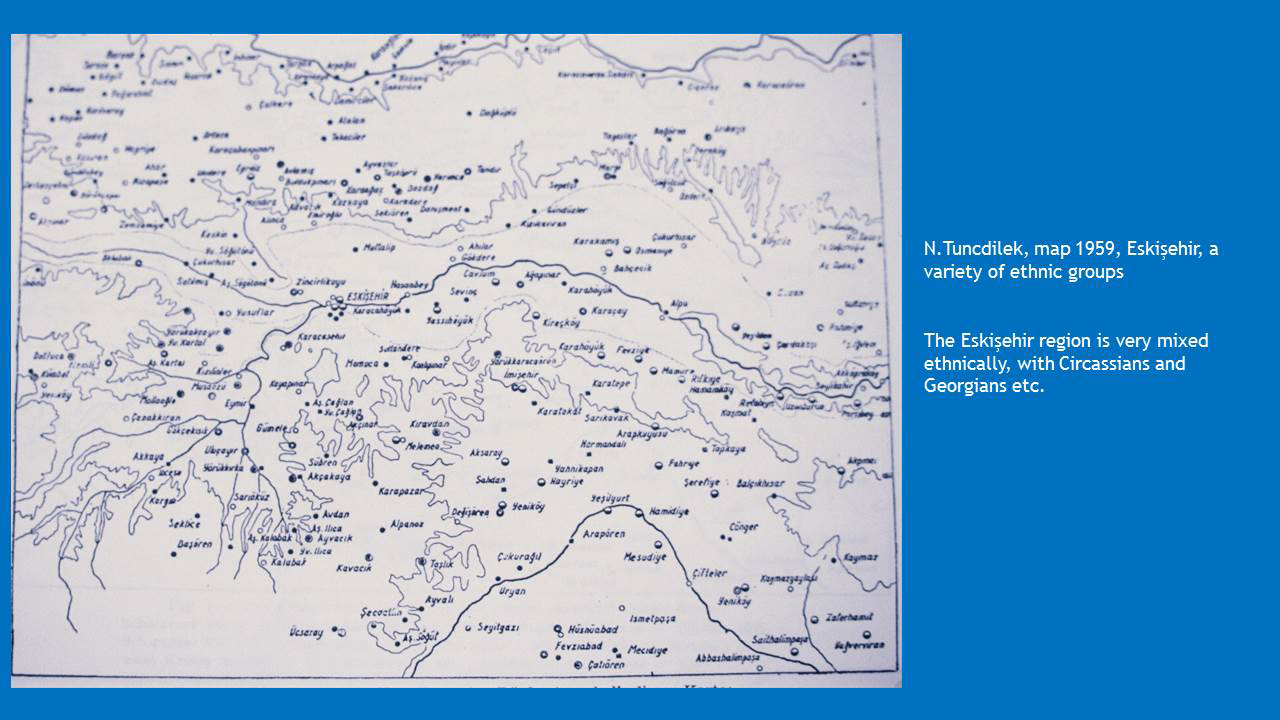
Tuncdilek (1959) made a thorough survey of the different groups in Eskişehir, showing the extraordinary scatter pattern of ethnea resulting from Government settlement policy. They are denoted here by circles of various kinds for Circassians, Georgians, Laz and Yörük. These are all well-integrated with the Sunni Turkish population.
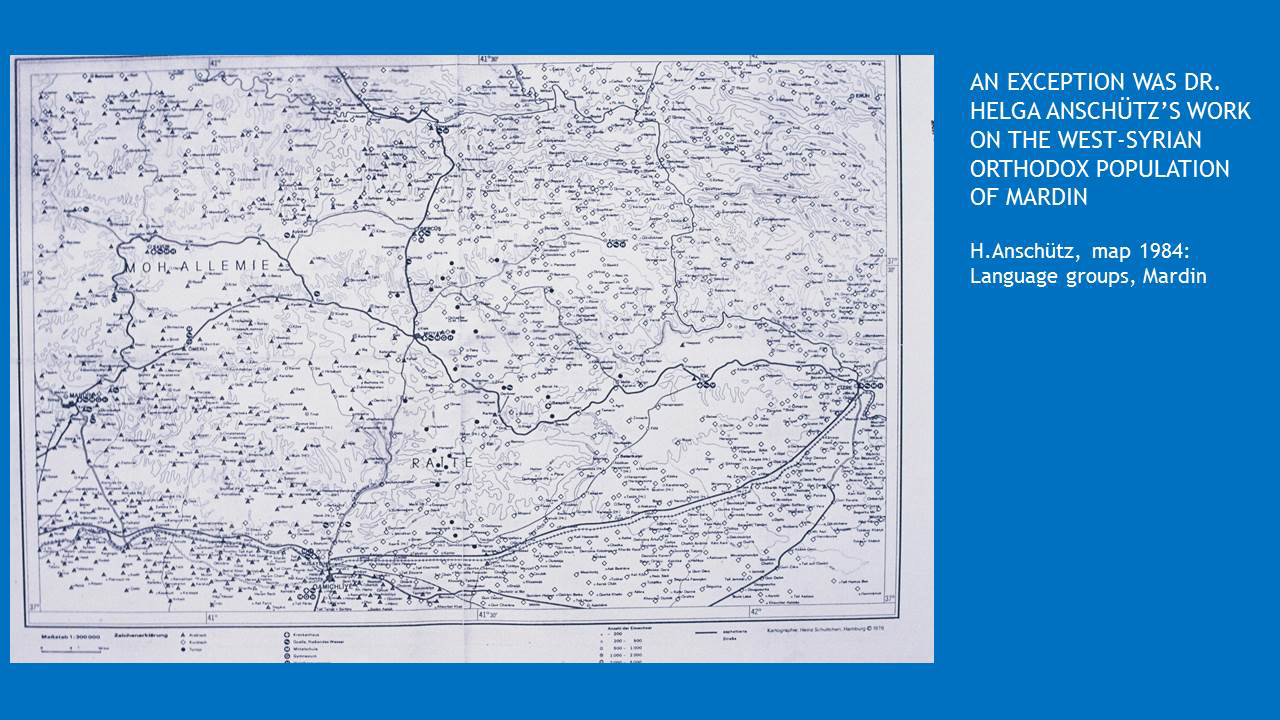
Anschütz (1984), who was married to a Syrian Orthodox pastor, was deeply committed to their culture, and did her best to record the entire province of Mardin, not only for religion, but for language. She was one of the first academics to note the Mhallami as distinct.
Unofficial studies by ethnology students at Turkish universities
The anthropology departments at İstanbul and Ankara had required their students to conduct fieldwork and write it up as small theses to qualify for their degrees. In about 1970, a tacit agreement had been reached with the departments that no studies of groups other than Turkish Sunni ones was to be undertaken. Before then, some useful work had been done, mostly on individual villages, but also on groups such as the Ertuş Kurds, or immigrants from Bulgaria and East Turkistan. I was allowed access to these.
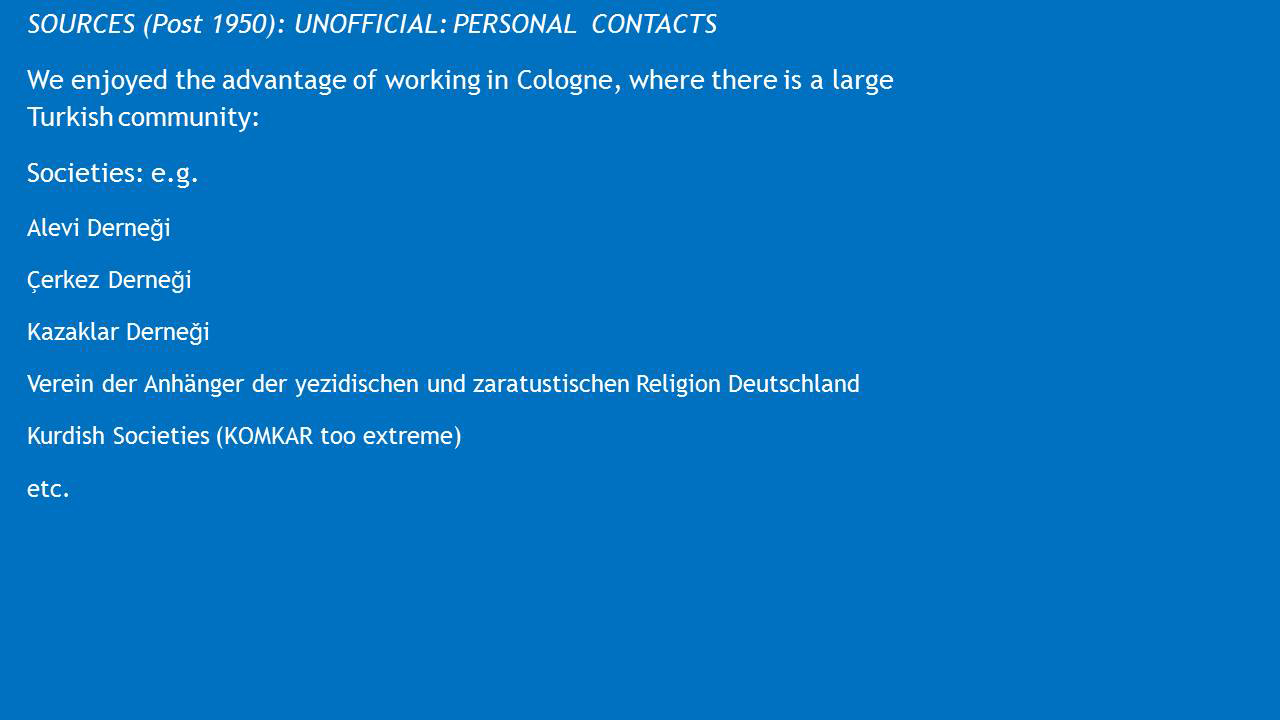
Personal contacts: societies and individuals
The motivation of these people was often to ensure that their own group was secure for the future. In other cases information was collected as a by-product of studies on language or religion.
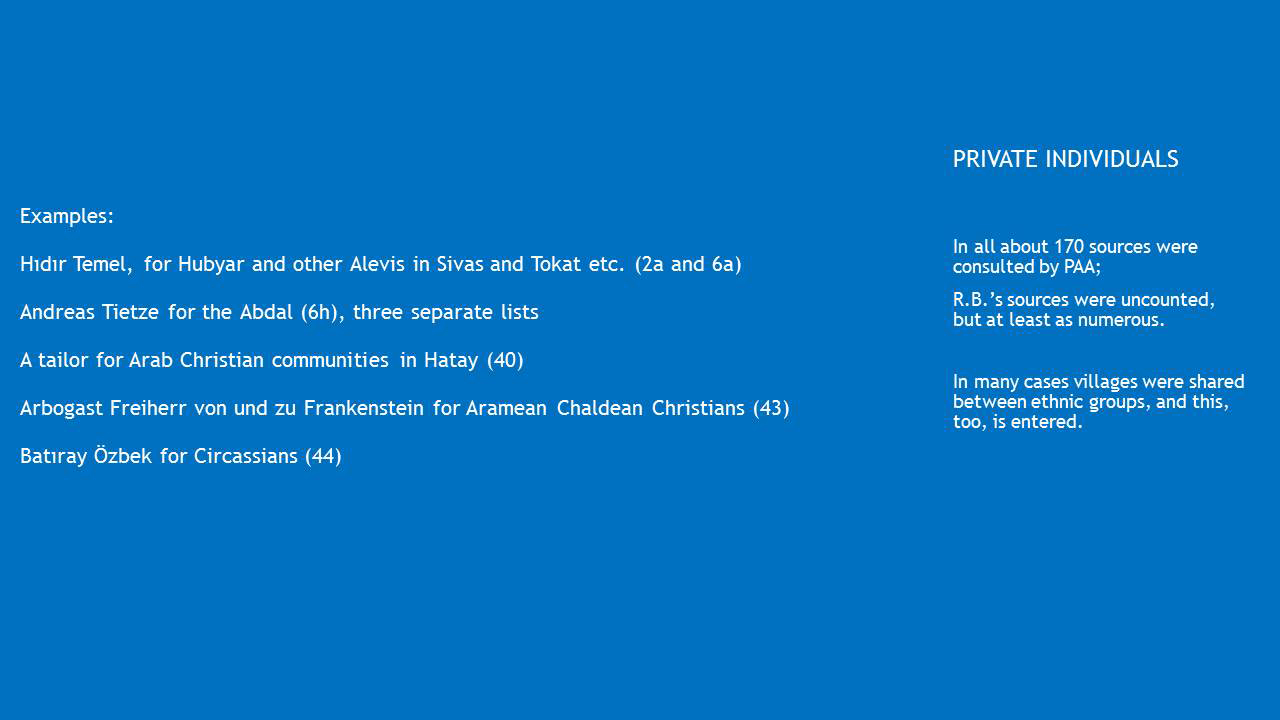
Private individuals: examples
Prof. Andreas Tietze (1914-2003), part of whose wide-ranging interests was folklore, gave his attention to the Abdal as conveyors of popular tradition.
Prof. Otto Jastrow (1942), a brilliant linguist, has the reputation that if you set him down in a village he will speak their language better than they do within a week. He had conducted research on the Arabic dialects of SE Turkey until stopped by the Government.
Hıdır Temel, whose grandfather was the last Dede of the Hubyar ocak (order) of Alevi in Tokat, had compiled material from his own extensive personal experience. We later went on to publish articles together on the ocak in BJMES. [One remains to be published, as it needs an Ottomanist translator].
Wherever possible information from one source was of course cross-checked against another, and these were entered as in the book as abbreviations in the village lists.
In many cases villages were shared between ethnic groups, and this, too, is entered.
E. PROCEDURE, Frames 47-56
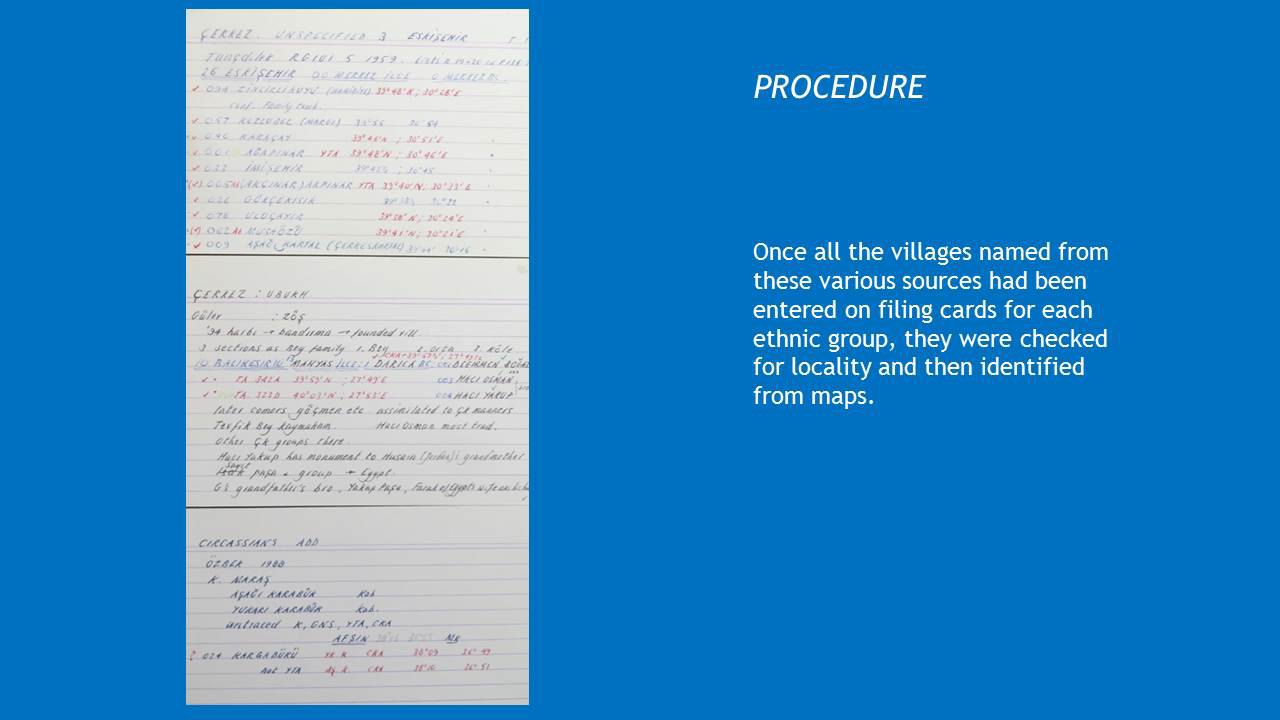
As the information came in, it was entered on filing cards under the name of the ethnos, and then the geographical area. Filing cards may seem primitive now, but computers were not available at that stage: the first had only just been acquired by the department, and was regarded with some awe. Ten years later, for Vol.II, we could use computers.
Some information on the cards was surplus to our present requirements, such as the classification of Circassian subgroups.
The Circassian case illustrates the complexity of classification through language: two principal dialect groups are Upper Circassian, including Kabardey and Besleney, and Lower Circassian, including Bjedukh, Temirgoy, Şapsug, and Abadzekh: these two had status as separate languages in the USSR. Abkhaz and Ubıkh are distinct, but Ubıkh is no longer spoken in the Caucasus, and only one speaker survived in Turkey, carefully studied by Dumézil. Descent groups and language are closely associated. When we had data on the dialect of a group, we entered it as potentially useful to other researchers.
Classification
Language was chosen as a convenient criterion for sorting the groups in the legend, even if not in practice the only one, and the sequence was determined by the language families, in blocks of the same colour, starting with Turkish and the Turkic languages, and ending with the Kartvelian languages, Georgian and Lazuri.
Tools
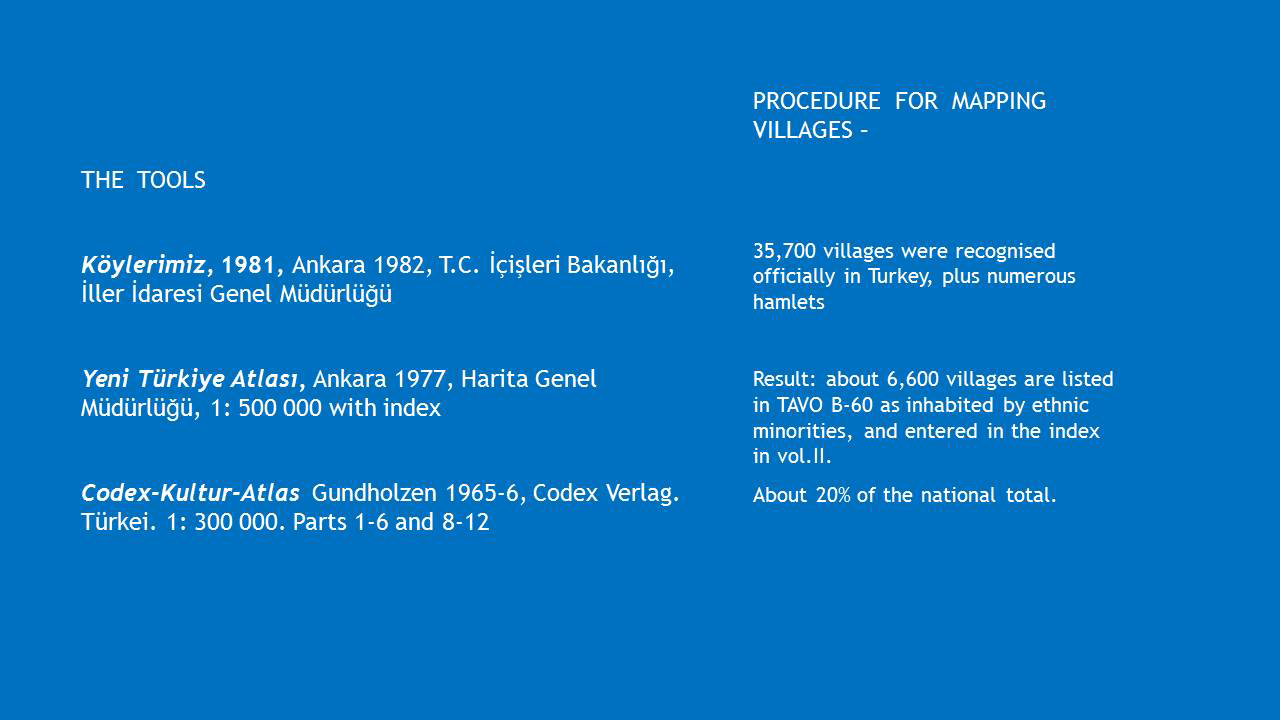
For mapping, we had to determine the exact geographical position of each group we heard of, and this entailed both its administrative classification and its coordinates.
The Turkish Government had until recently suppressed the scale of large-scale maps, and the İl Haritaları series was not yet available, though we could use it, in part, for vol.II.
It was fortunate that a new edition of Köylerimiz had appeared just at the right time in 1982, so that when we were uncertain about the position of a village, we could establish it by province, sub-province, and district (İl/Vilayet, ilçe/kaza, and bucak/nahiye). We could then cross check this against the census lists.
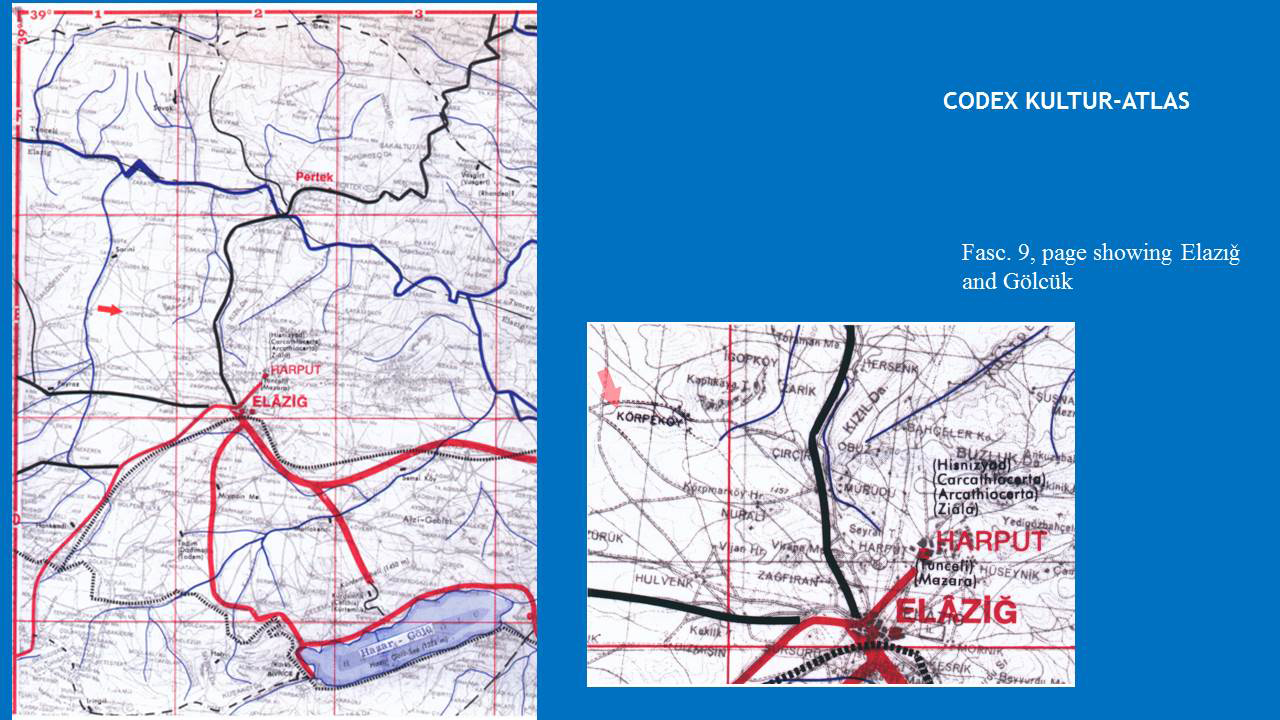
For the coordinates, we first consulted the official Yeni Türkiye Atlası (1977) which listed them in the index. It showed only the larger villages, however, so that we needed a more inclusive map.
I found this Codex-Kultur-Atlas (1965-6), an older large-scale map which had been overprinted in Germany to illustrate archaeological sites. I found it, in eleven fascicles, in the Archaeological Institute at Cologne. The grey script made the Codex impossible to photocopy. I had to use a magnifying glass, and measure off the coordinates with a graduated strip of paper: Benninghaus used to joke about the primitive tools used by the poor German academic.
Caution was required as some provincial boundaries had been changed, so I had to refer to the old boundaries of 1965 from the census.
Cartography
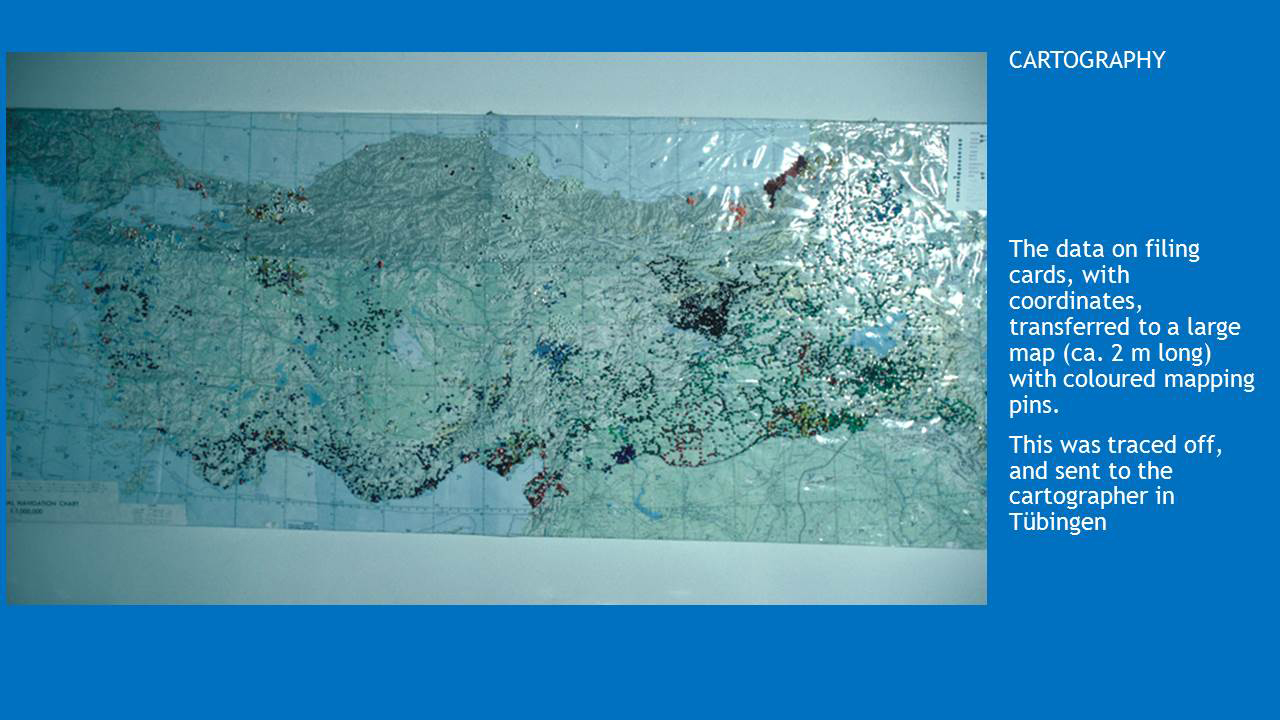
Once the considerable bulk of cards had been built up, the data were used to place pins in a large-scale NATO map I had obtained, and mounted, about 2 m long.
With the coordinates entered on the cards for each village, the ethnos could be placed on the map as a pin of a particular colour for that group. There were more colours for pins than for the cartography, so the two did not correspond entirely.
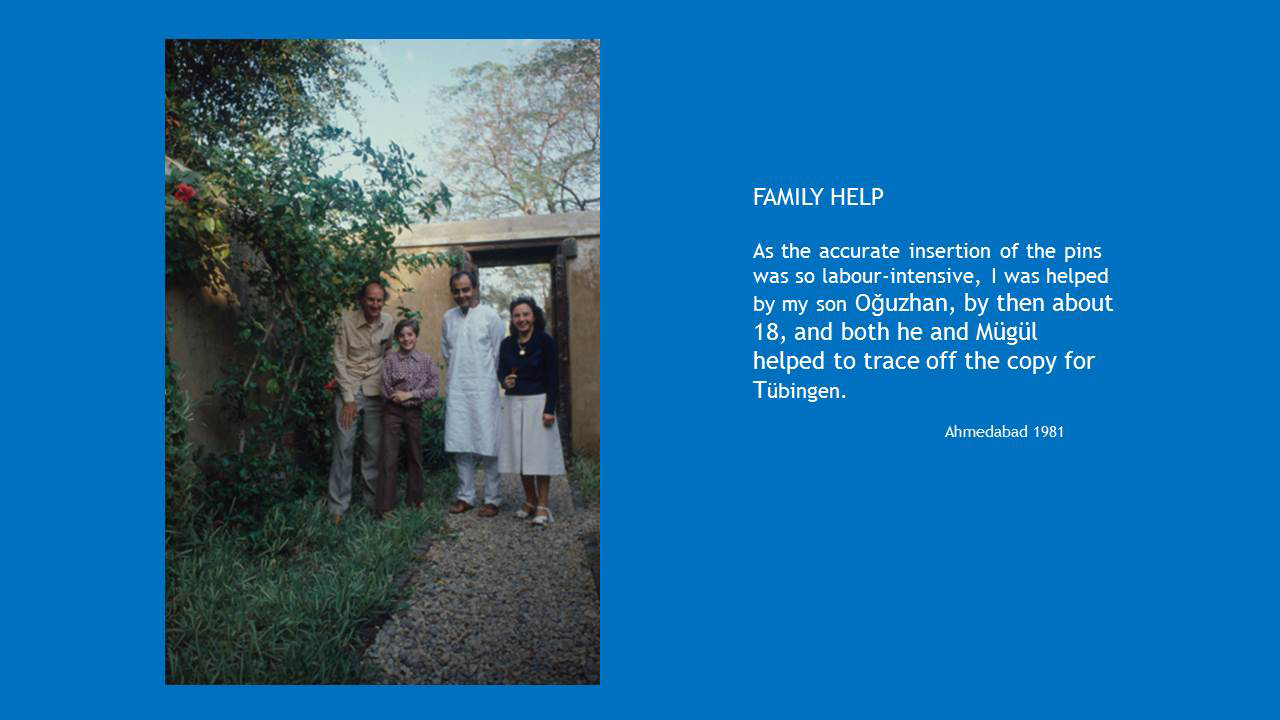
This large map was graduated, but even so the placing of the pins was very time consuming, and as the deadline was imminent, my wife and elder son, by then 18, helped to place them, working late into the night: my colleagues accused me of being a slave-driver.
For the KEE data, applying to areas rather than villages, we simply outlined the districts with pins of the right colour.
Once these thousands of pins had been located, we traced them off onto paper, inserting the appropriate numbers, so that the cartographer in Tübingen could work the data up into the finished maps. This was submitted to me as a chromaline for proof-reading before the final print. I must say the draughtsman, Horst Pohlmann, was remarkably accurate in his interpretation.
F. TEXT Frames 58-67
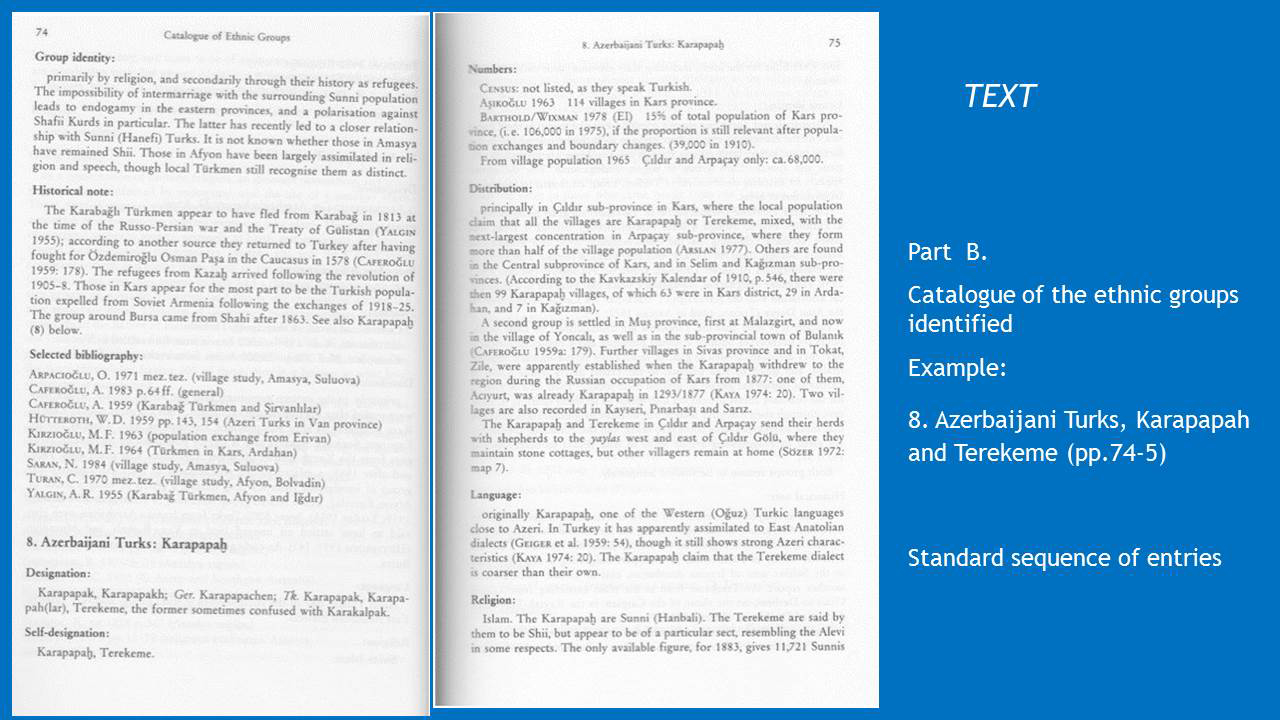
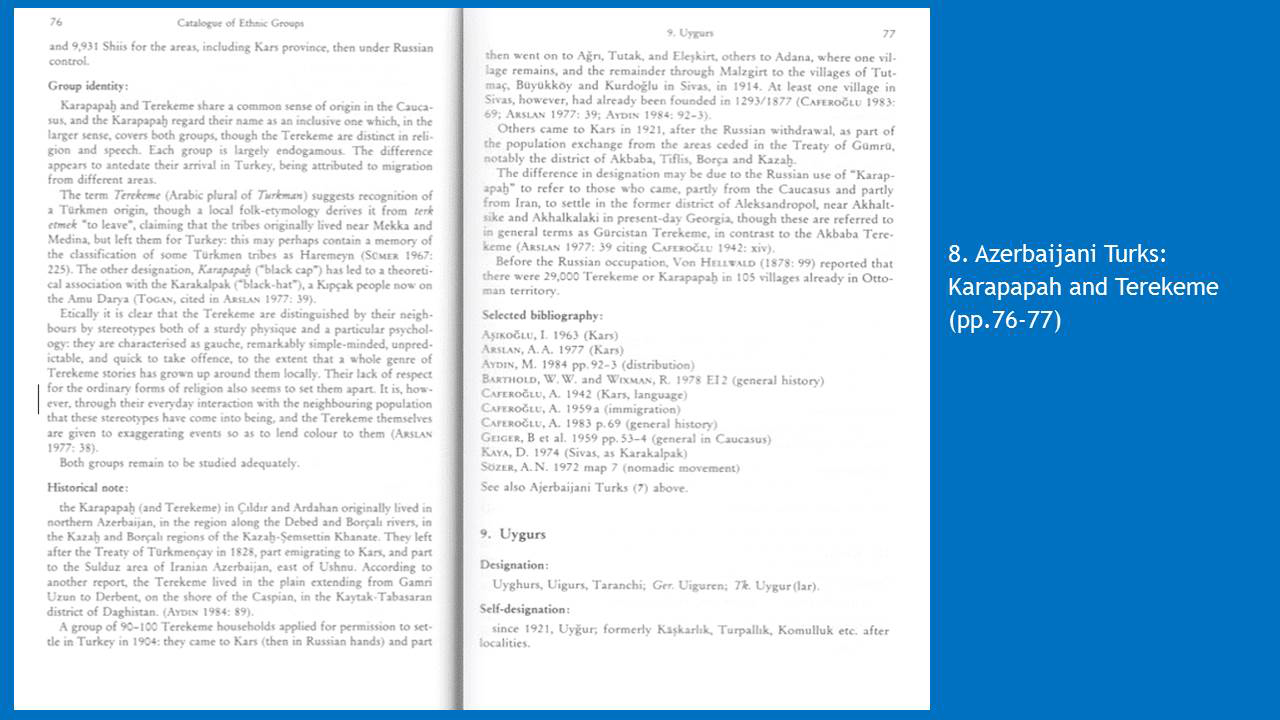
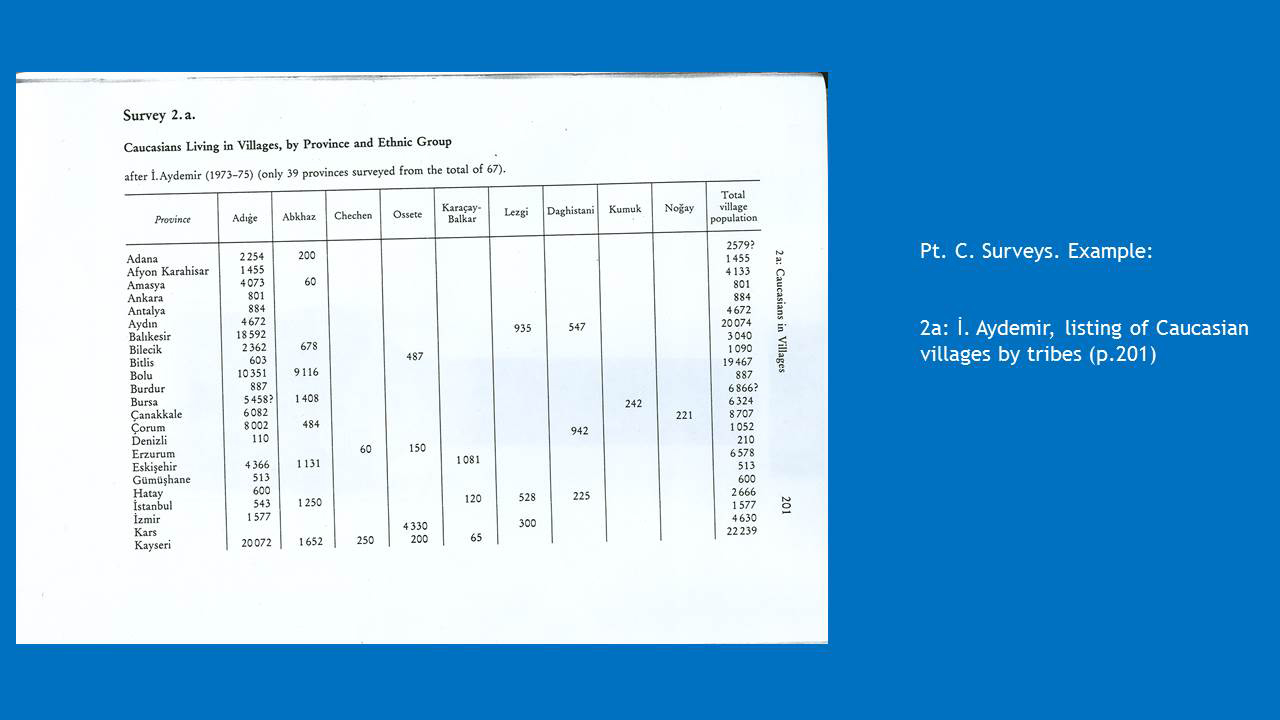
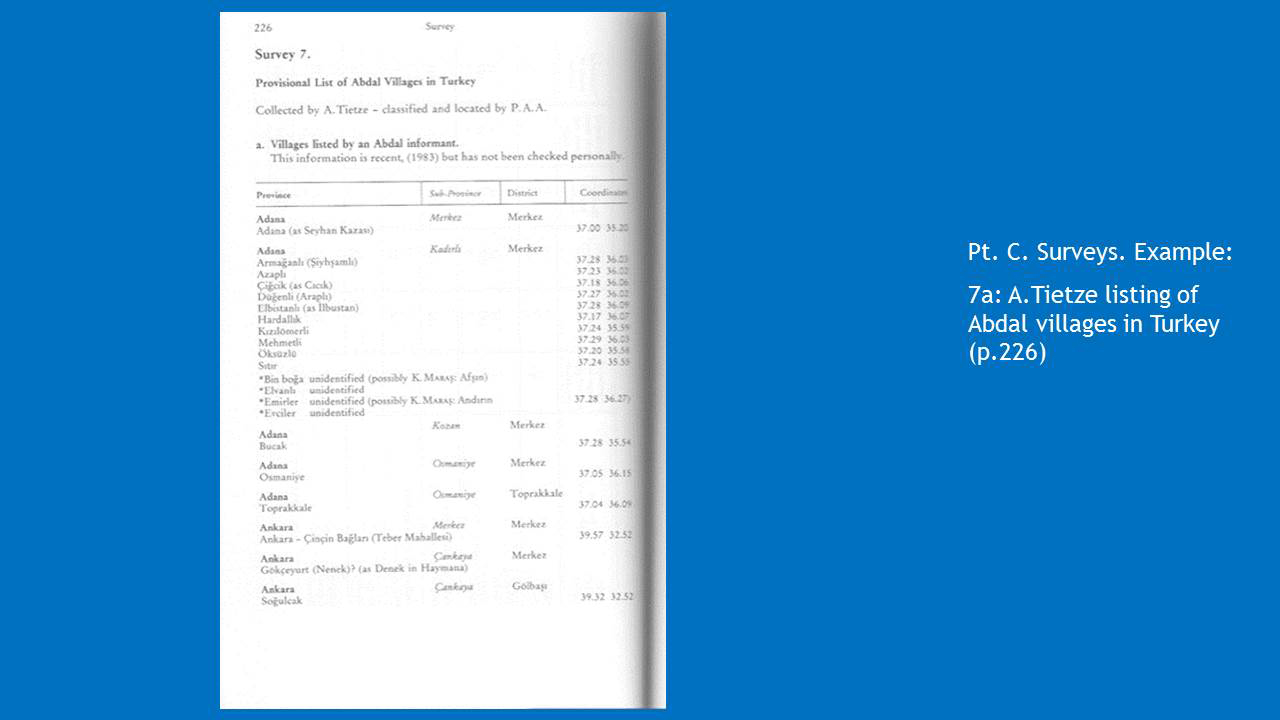
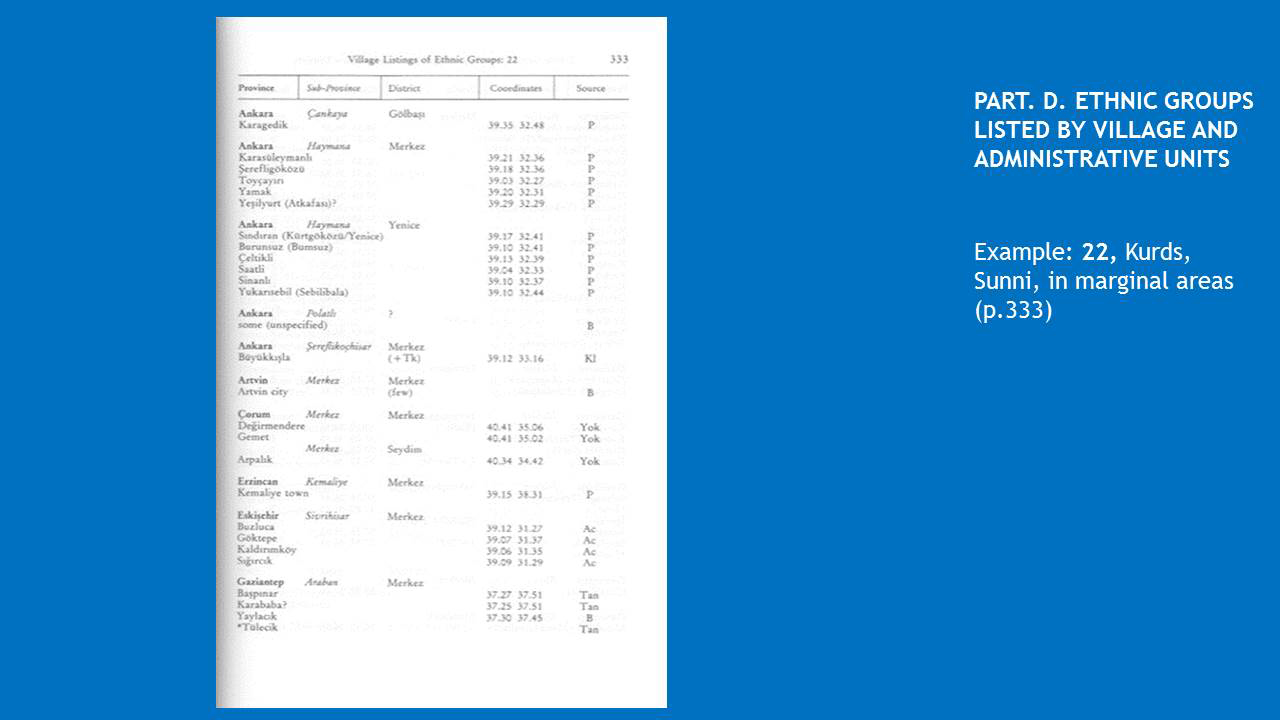
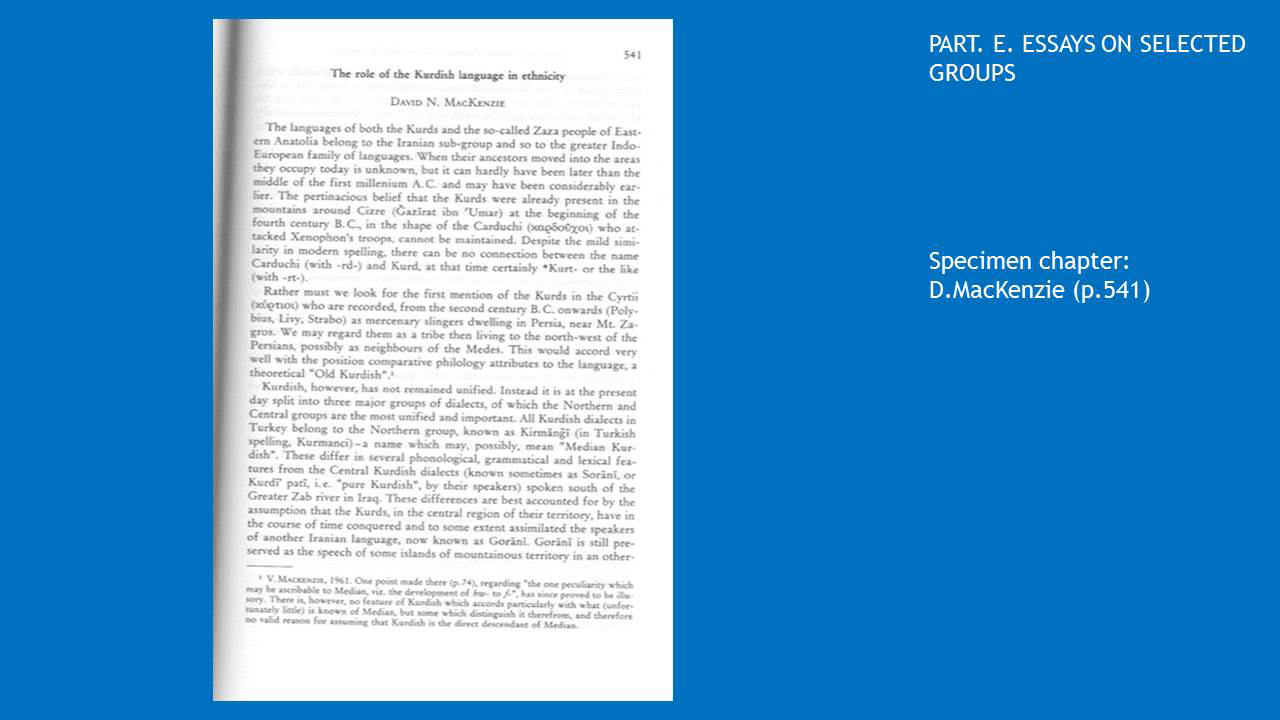
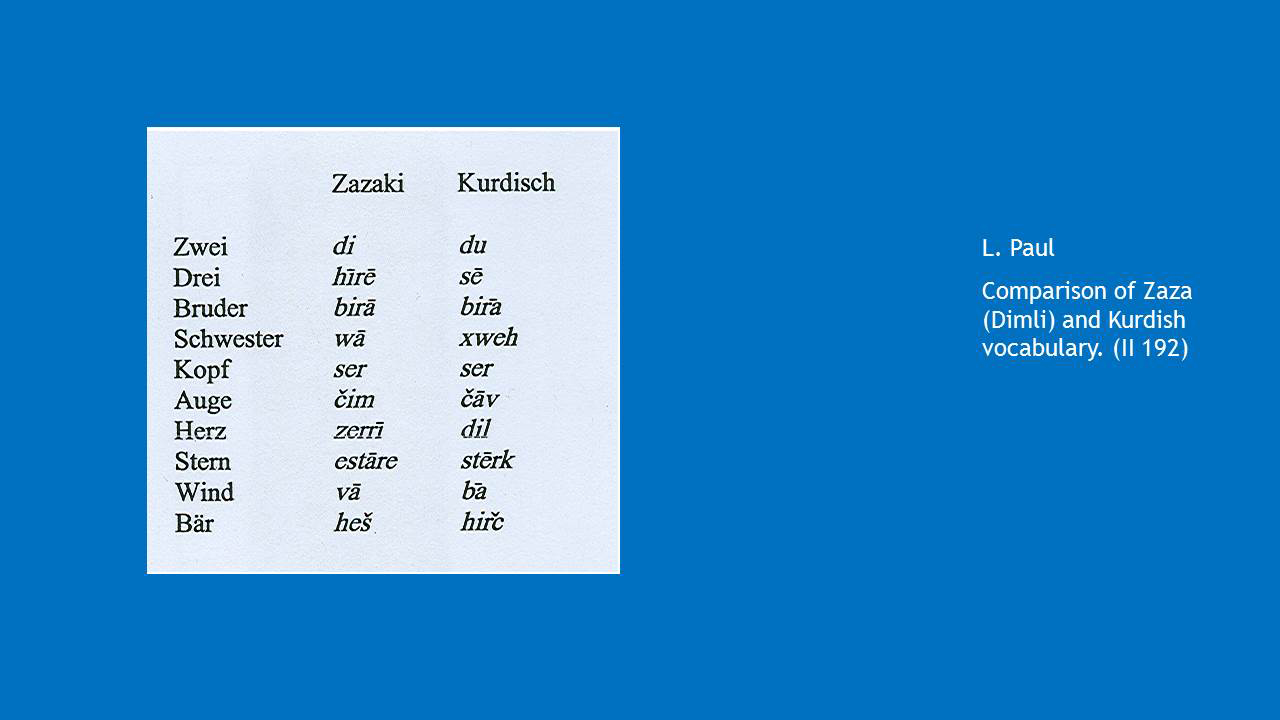
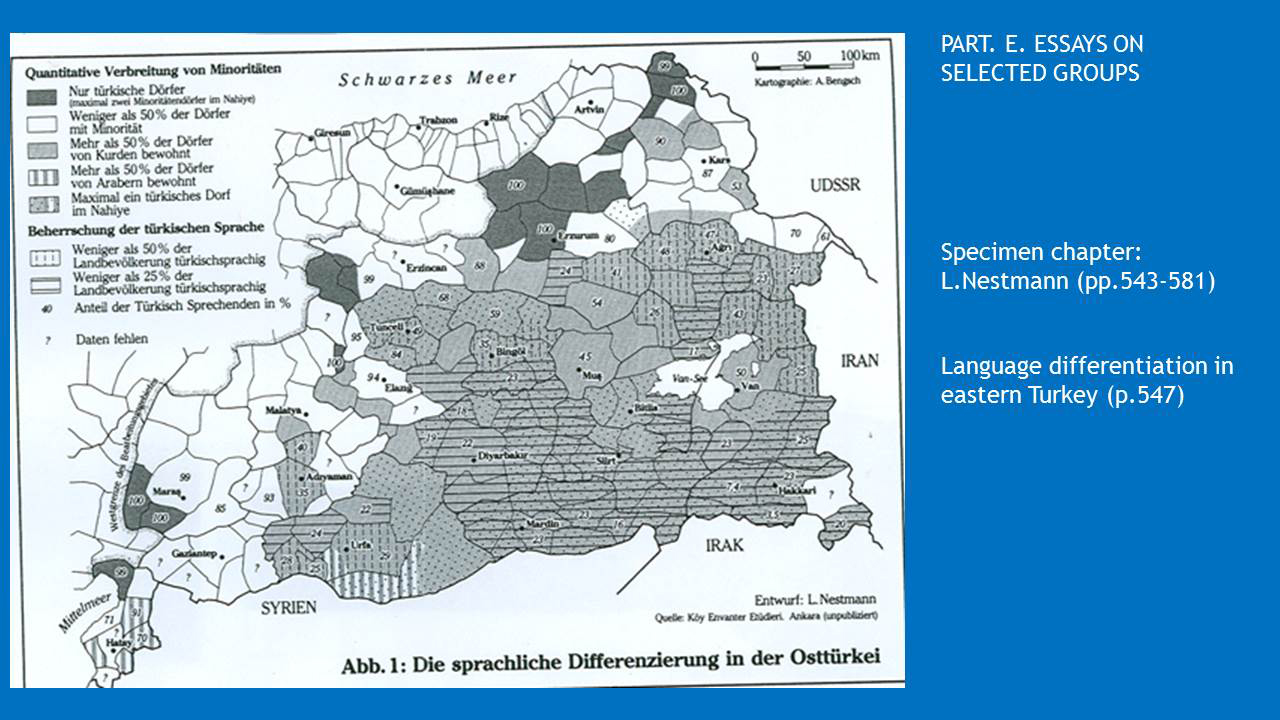
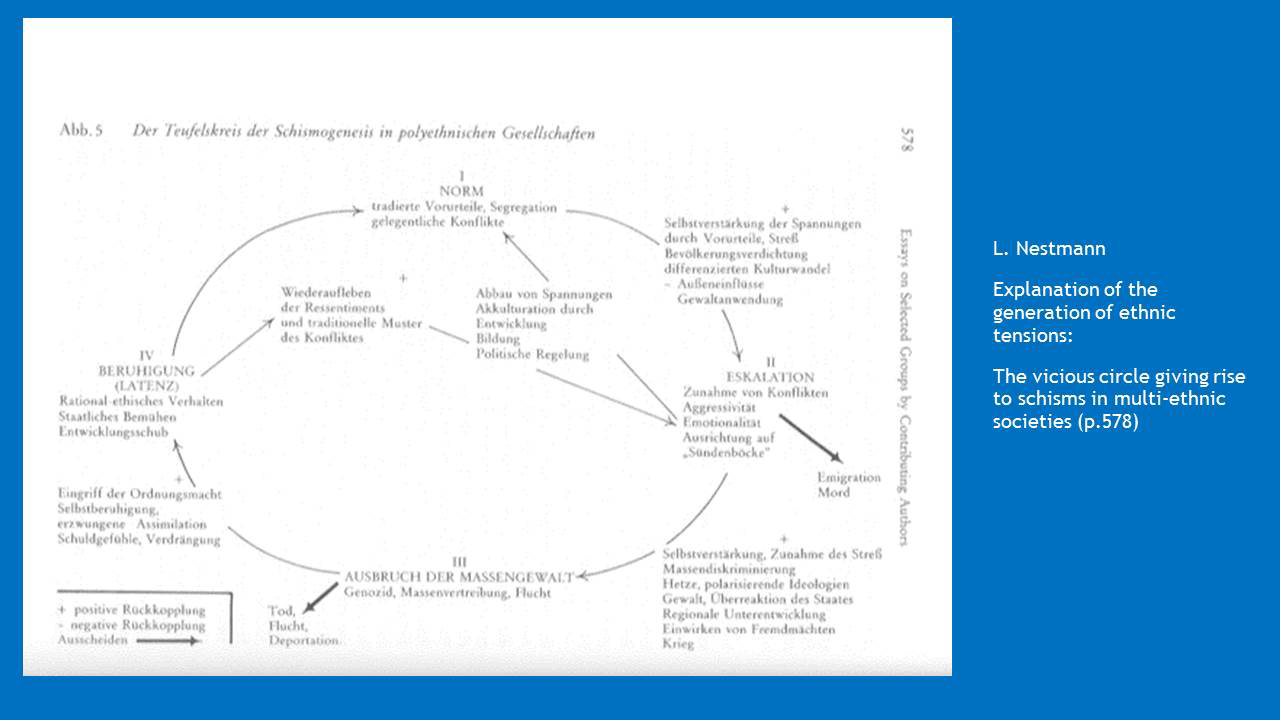
The nature of the material required the book to be divided into a set of distinct sections, coordinated by the ethnic numeration. The text is in English, German and French.
a. Introduction. A fairly long introduction was needed, to explain the circumstances and restraints I have just outlined.
b. Catalogue of ethnic groups. The core of the book was the catalogue of 47 ethnic groups, explaining their nature and distribution, and why they should be considered distinct: this entailed a brief history.
As an example I show No. 8, the Karapapah, a subdivision of Azerbaijani Turks living around the Çıldır Gölü. For each ethnos there is a standard sequence of entries, ending in a selected bibliography for the principal sources.
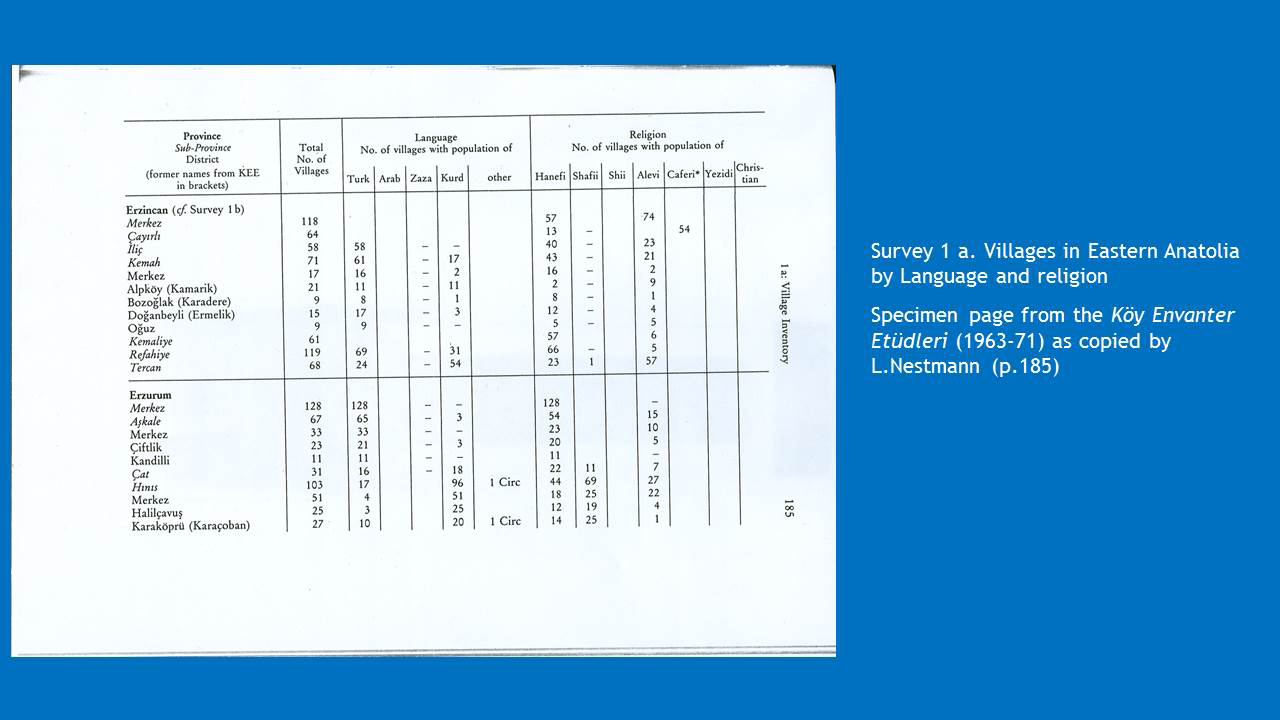
c. The Surveys presented information from individual sources in a tabulated form where this was appropriate. The most important of these (1) was Liesa Nestmann’s transcription of the Köy Envanteri. The restricted circumstances in which she had taken her notes had resulted in some rather confused figures, which I had to sort out. Fortunately the most confused province, Erzincan, had also been studied and published by Boynukalın.
2a shows the Caucasians, including the Circassians (Adige) according to the data published by Aydemir. These were published in a series of ten articles in Kafkasya Dergisi from 1973-75. These Çerkes were the most resolute of the ethnic groups in asserting their identity by peaceful means.
d. The Village lists documented all the villages entered on the map, with their administrative status and coordinates, and abbreviations for the sources from which the information was derived. This is essentially the set of data on the cards.
As an example I show No. 22, the Sunni Kurds living in marginal areas that is beyond what is normally considered the Kurdish region. In this case we have the Kurds of Haymana, a group often overlooked, despite their proximity to the capital.
e. Essays. Where I thought that the identification of an ethnic group required justification, or when someone appeared with particular knowledge, I invited specialists to define groups. I had encountered Prof. MacKenzie at SOAS. He later went to Göttingen. He was able to elucidate the nature of Kurdishness. I also asked Prof. Ludwig Paul to clarify of the difference between Kırmanç and Dimli. This was necessitated by Kurdish nationalist claims appropriating the Zaza to swell their numbers. From the little table shown it can be seen that the languages are distinct, and that Kurdish is plainly closer to Farsi than Dimli, with the one exception, the word for star, sitāreh in Persian.
I also show the essay contributed by Nestmann, as it was exceptional in dealing not with a group, but a situation. Her interests lay in the discipline of human ecology, so had a different emphasis. Interestingly she showed how there was a buffer zone of Alevis between the major Kurdish areas and the Sunni Turks. In her diagram of the vicious circle of polarisation she shows the progression from the norm to increasing tensions due to prejudice, stress as population increases, exacerbated by cultural contrasts and the intrusion of external influences, leading to the outbreak of violence, escalation and the search for scapegoats, and thence to discrimination, polarised ideologies, and overreaction of the state in the use of outright force, and even genocide, large-scale expulsion and flight. These are all too familiar, but the diagram represents a lesson still to be learned.
G. LEGITIMATION, Frames 68-72
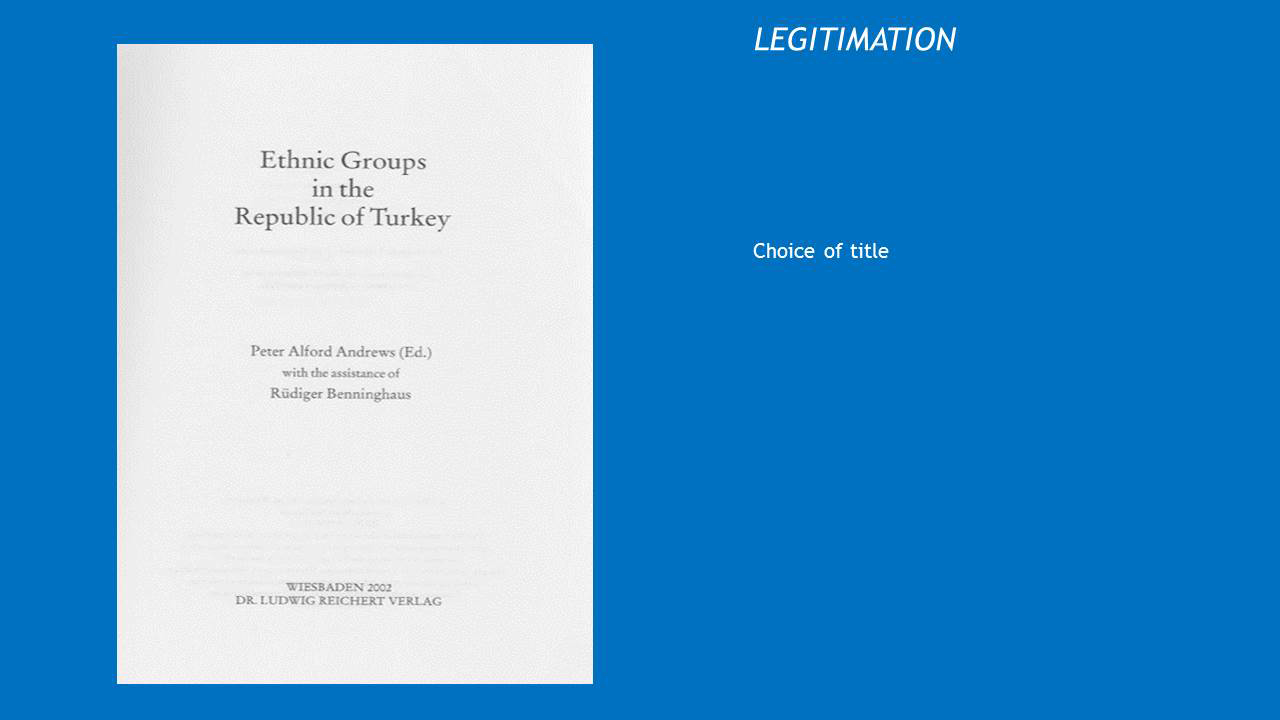
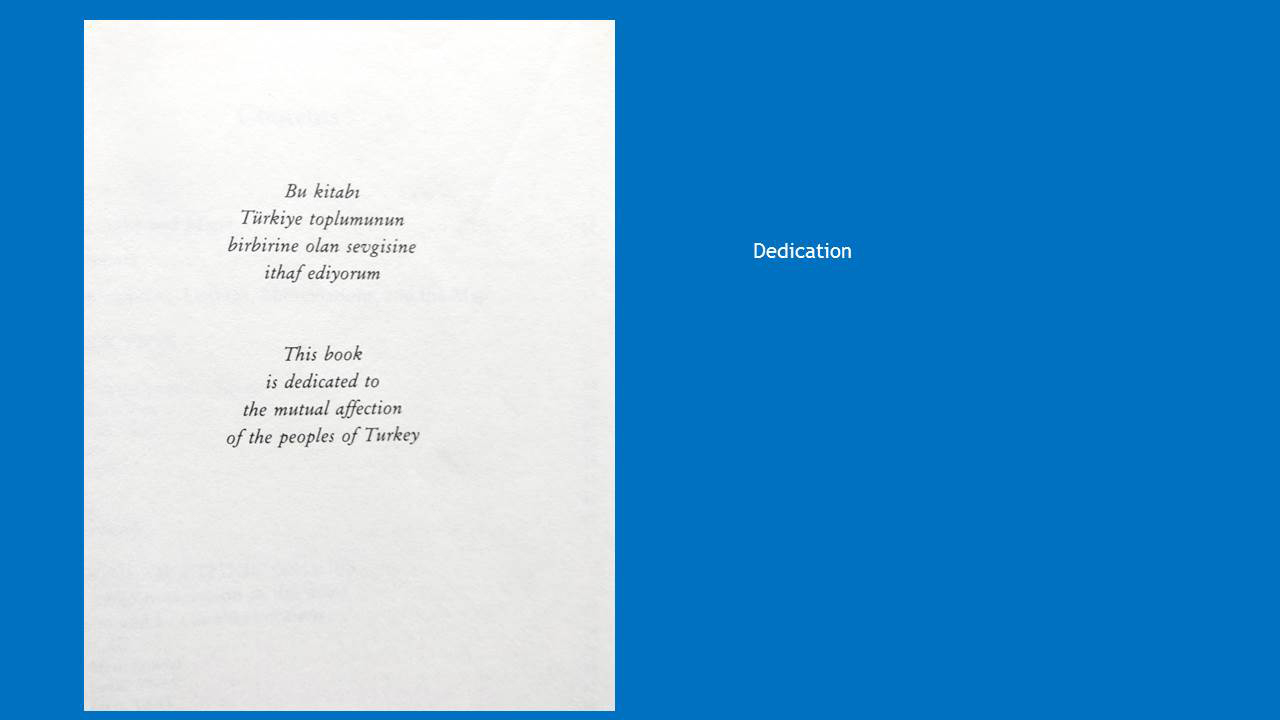
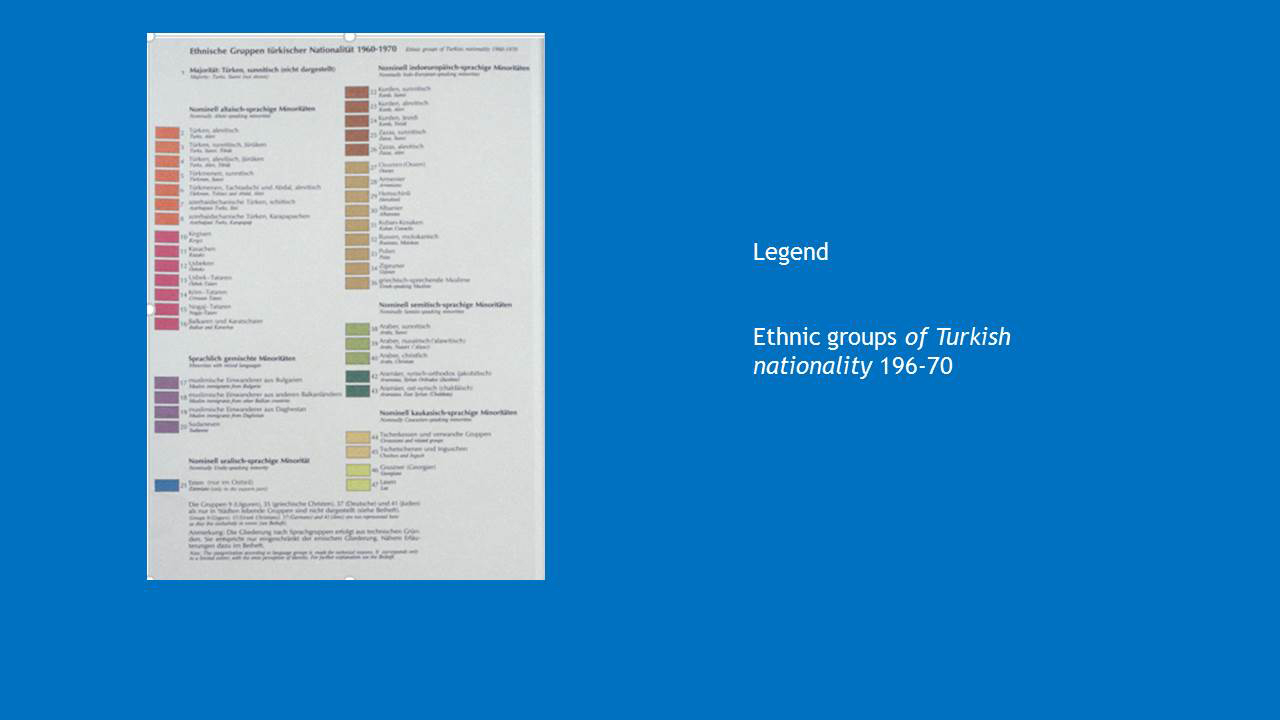
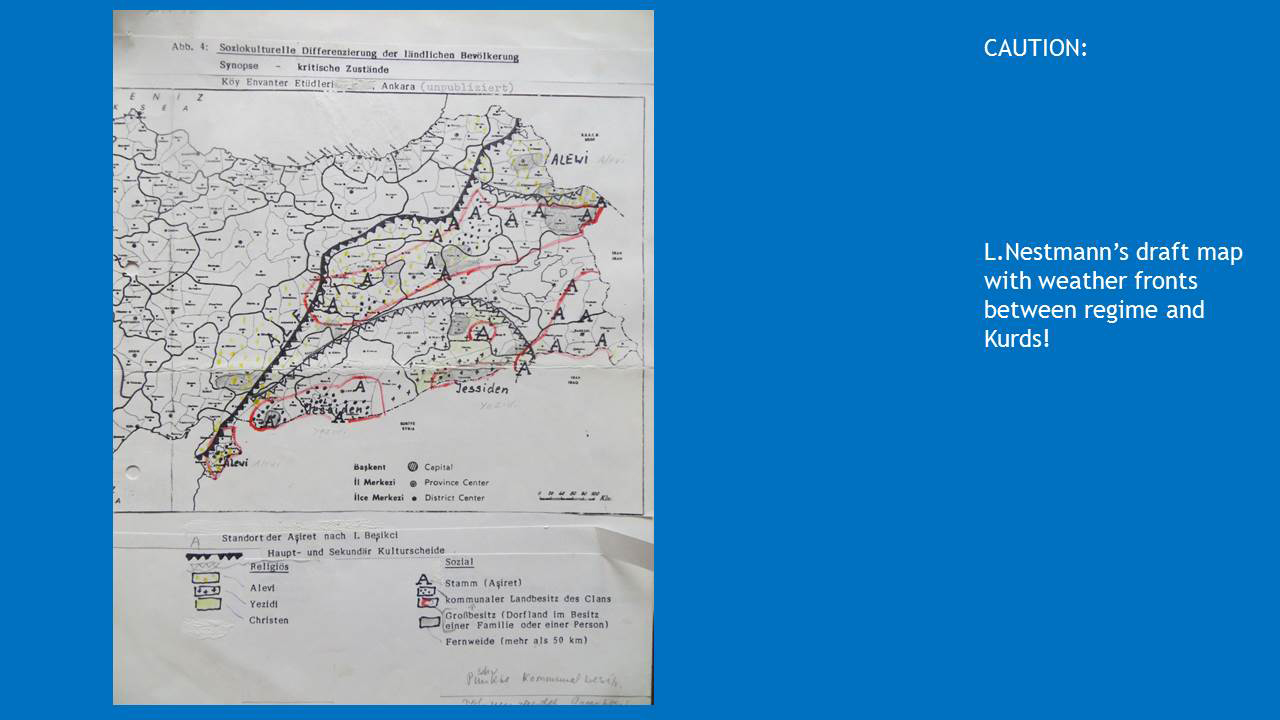
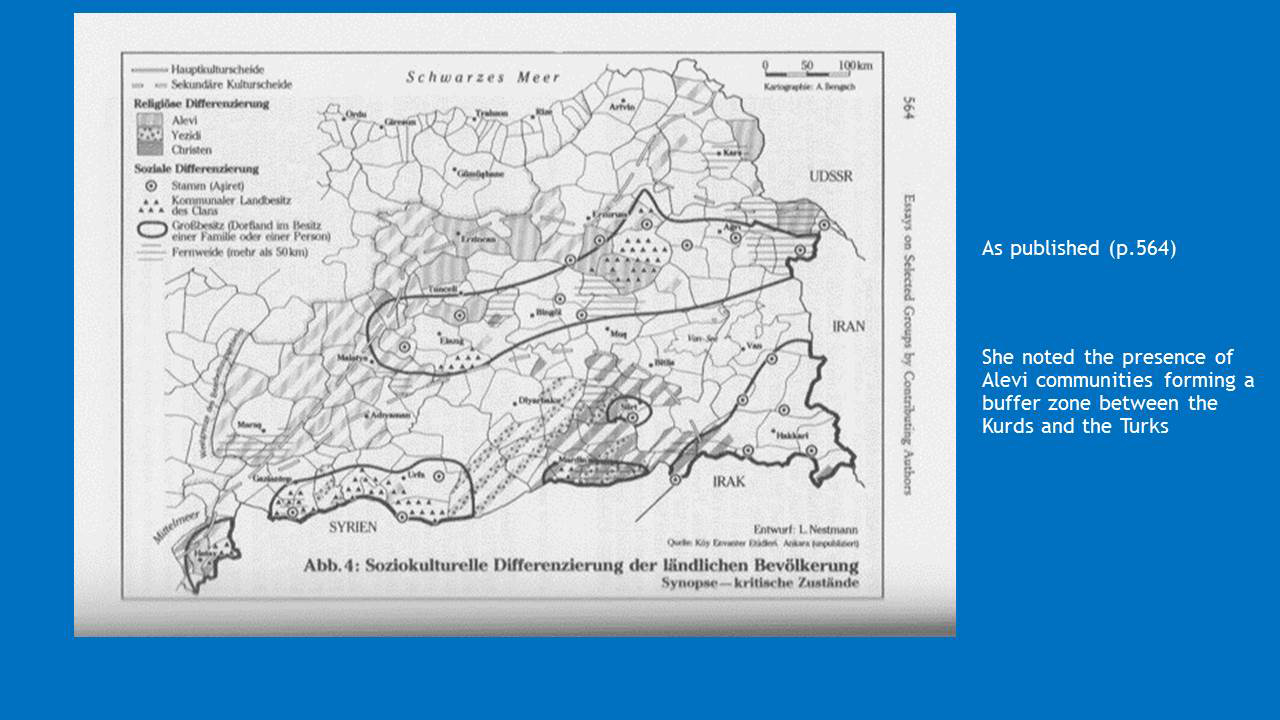
Given the potential for official reaction to our work, it was important to do what I could to make it more acceptable. To begin with, I emphasised that the study was not intended to be divisive by making it plain in the titles to book and maps that the groups were of Turkish nationality, and secondly by dedicating it to mutual respect. Thirdly I edited some contributions, notably those of Anschütz and Nestmann, to remove provocative elements. Nestmann, for example, had used the symbol for a weather front between the Kurds and the Turkish majority in her sketch of socio-cultural differentiation, and I replaced it with a less offensive line. I did not alter the facts, only the expression.
H. RESPONSE, Frames 73-80
Reproof and response. As I expected, the majority of reactions published in Turkey were negative, and seemed to be centred largely on resentment that a foreigner had dared to intrude to this extent on Turkish matters. What was remarkable though, was that not one of the commentators made any attempt to get in touch with me and learn more of the way in which the work came about. One, the rector of Muğla University, whom we had known for many years, refused even to meet me on his campus. Much of the criticism arose from outdated ideas of ethnology, and especially the confusion of ethnicity with nationality. Sadly, some academics whom I had hitherto respected were prepared, from my point of view, to sell their souls to the official dogma. Journalists did not even bother to establish my nationality correctly.
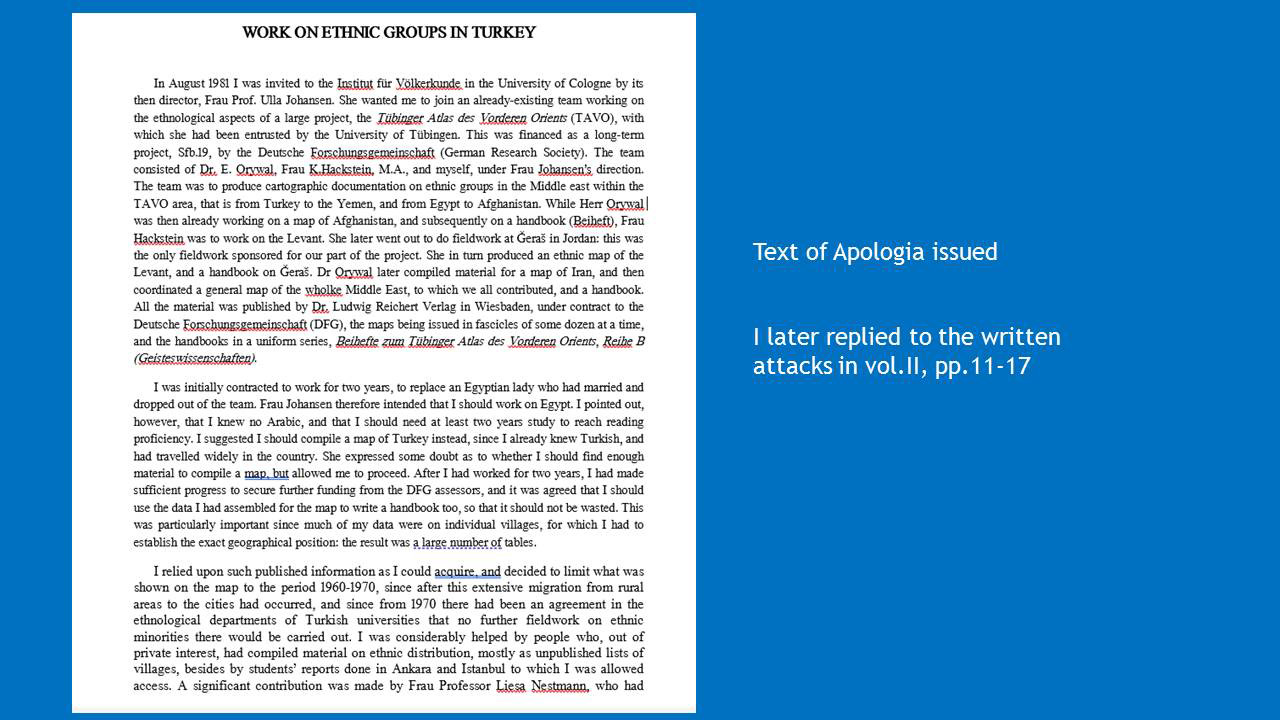
The level of misunderstanding, as misapprehension or deliberate misinterpretation, was such that I felt constrained by 2003 to issue an apologia, which I put on my web-site (Appendix I below).
Piracy
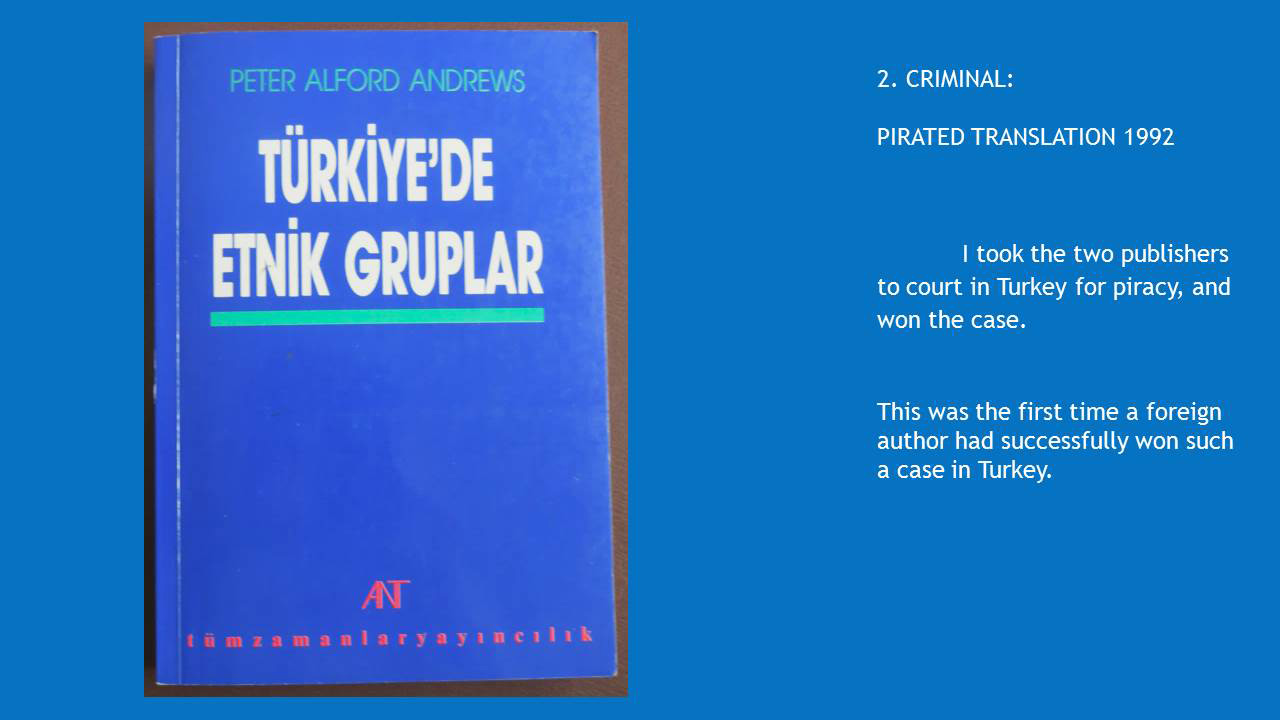
On 24.12.1992 two publishing houses in Istanbul, Ant Yayınları and Tüm Zaman Yayınları, wrote to the GEO-Center in Stuttgart, distributors for my book, announcing that they had already published a Turkish translation of it: they had omitted the maps and the geographical section (meaning the tables of geographical coordinates for villages), and had updated other parts. They requested a grant of the copyright. When Reichert referred the matter to me, I immediately protested to the two firms by letter and fax, denying them permission to publish.
Attempts to remonstrate with Cemal Şener, the proprietor of Ant Yayınları, by telephone were of no avail. He himself finally said “alırım, basarım, satırım: burası Türkiye”. It was good of him to encapsulate his attitude so succinctly.
I took the publishers to court in Turkey, using a family lawyer to avoid his being bent, and eventually won, with costs. I lost only about DM 150. This was the first successful action by a foreign author against literary piracy in Turkey. The police destroyed some, but not all copies available.
Regrettably, many Turkish readers continued to assume the pirated book really represented my work, and criticised me on that basis. Although the real book was available at the TDK and TTK in Ankara, and at several universities, they did not bother to check.
Again I was constrained to issue an explanation (Appendix II).
Official Turkish notice and acceptance
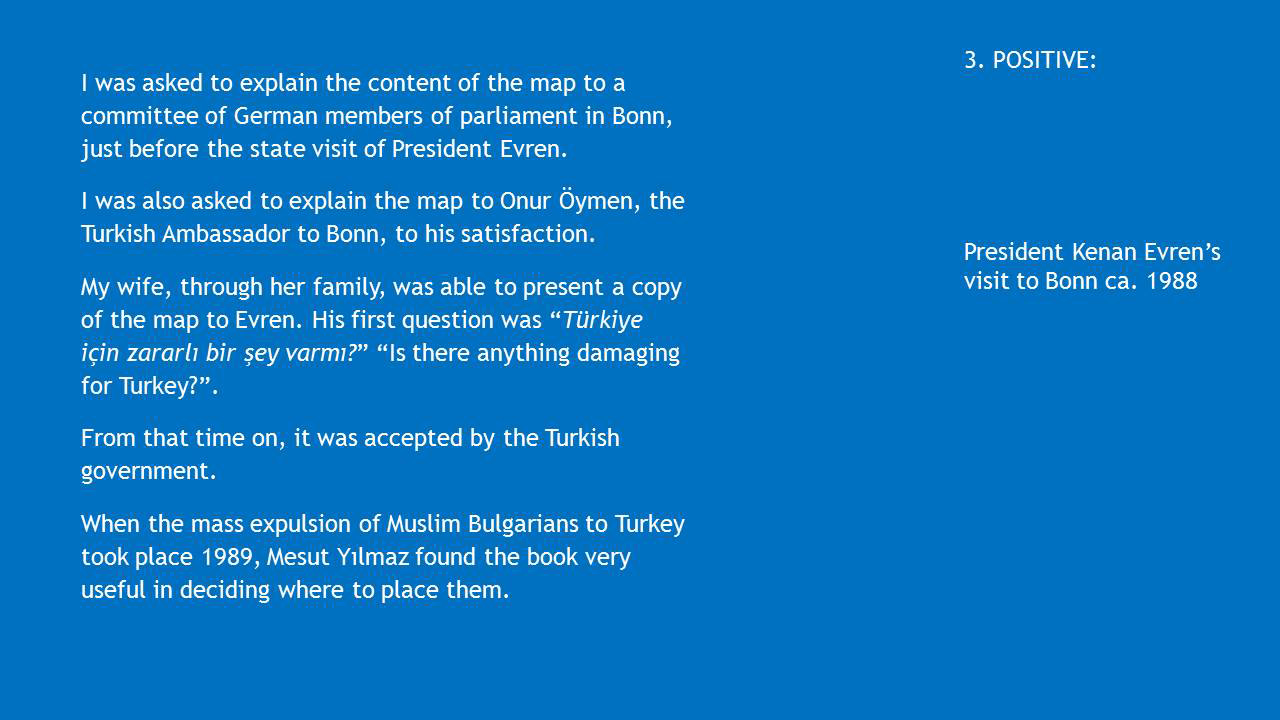
With the help of my wife’s political connections, she was able to present the map to President Evren and Mesut Yılmaz in Bonn, and get the work accepted by them, with the result that it was never subject to a ban in Turkey.
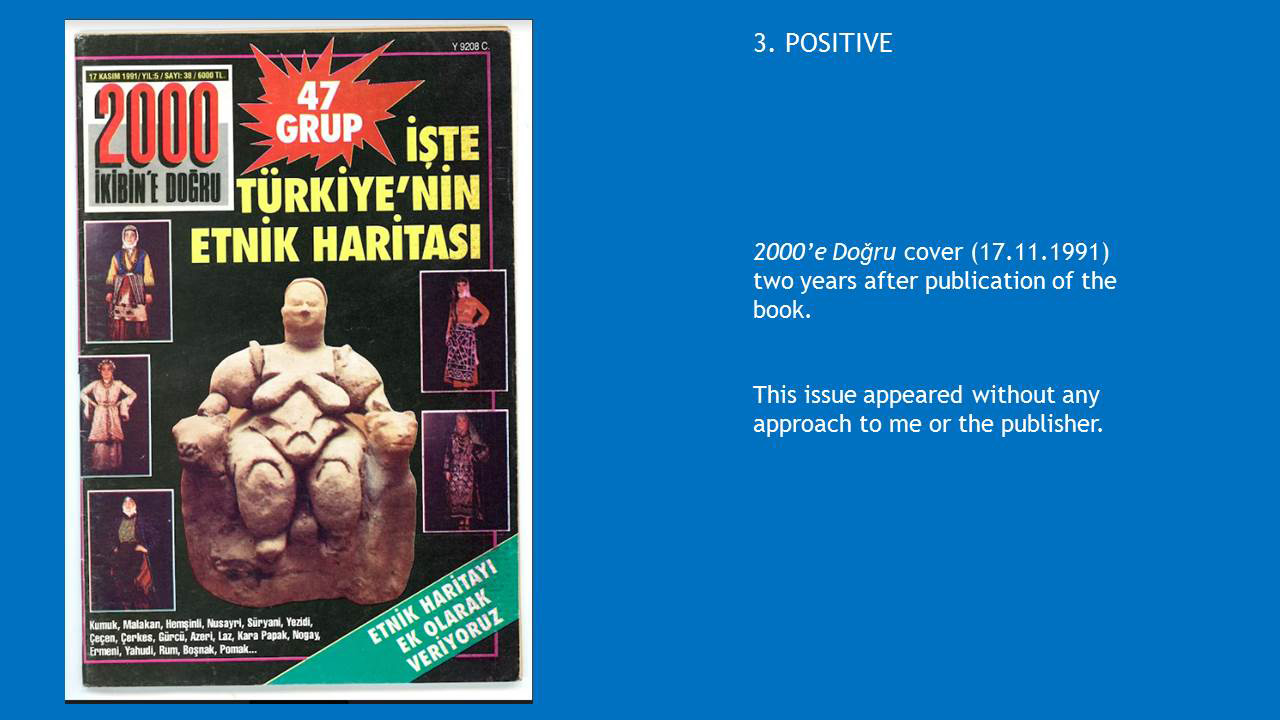
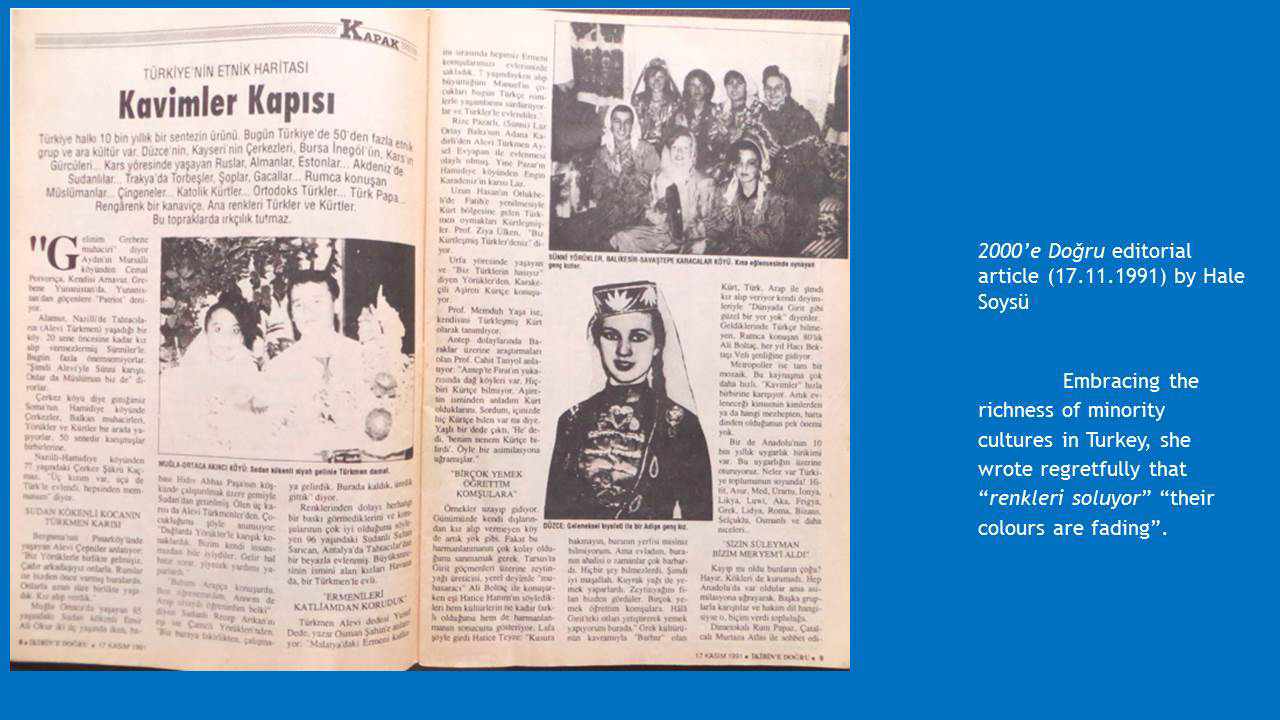
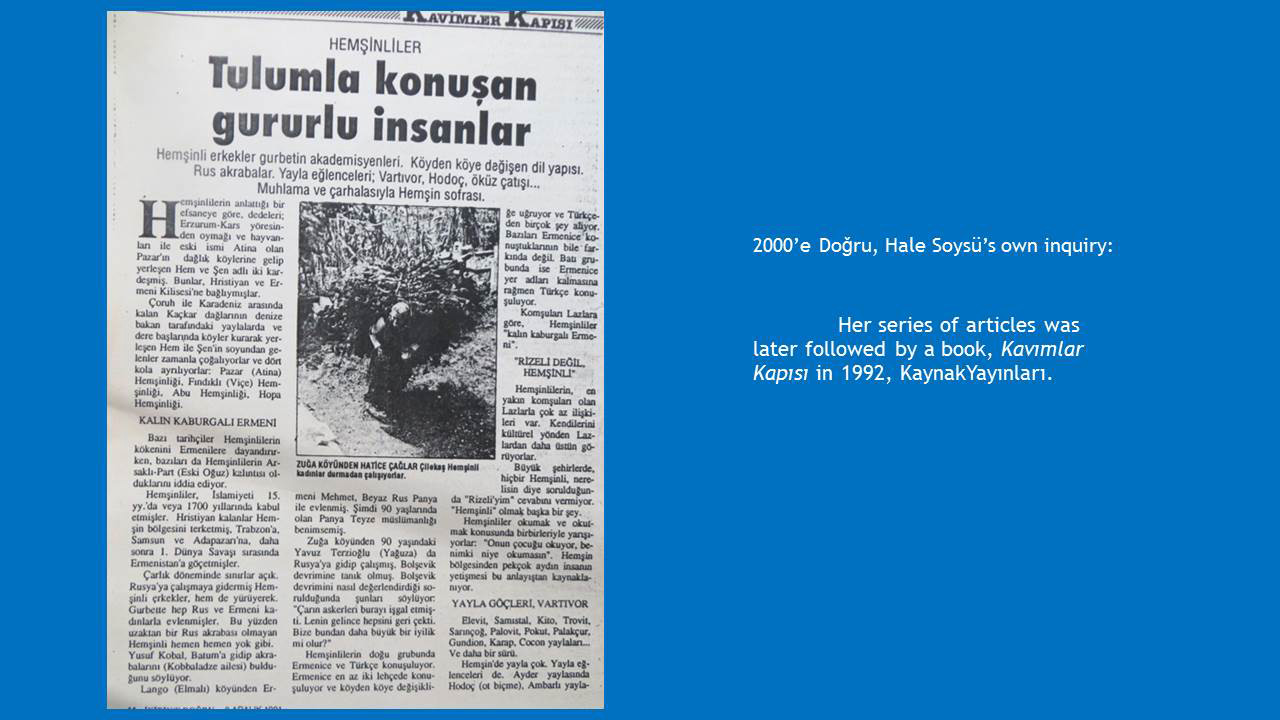
Not long after the book appeared, it and the map were given cover-treatment by the magazine 2000’e Doğru (17 Kasım 1991). Far from being hostile, the editor Hale Soysü understood the need to recognise the existence of ethnic groups in Turkey, and not only republished the map (without permission), but embarked on a series of articles in subsequent issues based on her own visits to ethnea we had identified. Although the issues appeared without any approach to me or the publisher, I admired her courage: I understand she was arrested, but acquitted. She later re-published her own articles as a book, Kavimler Kapısı (1992).
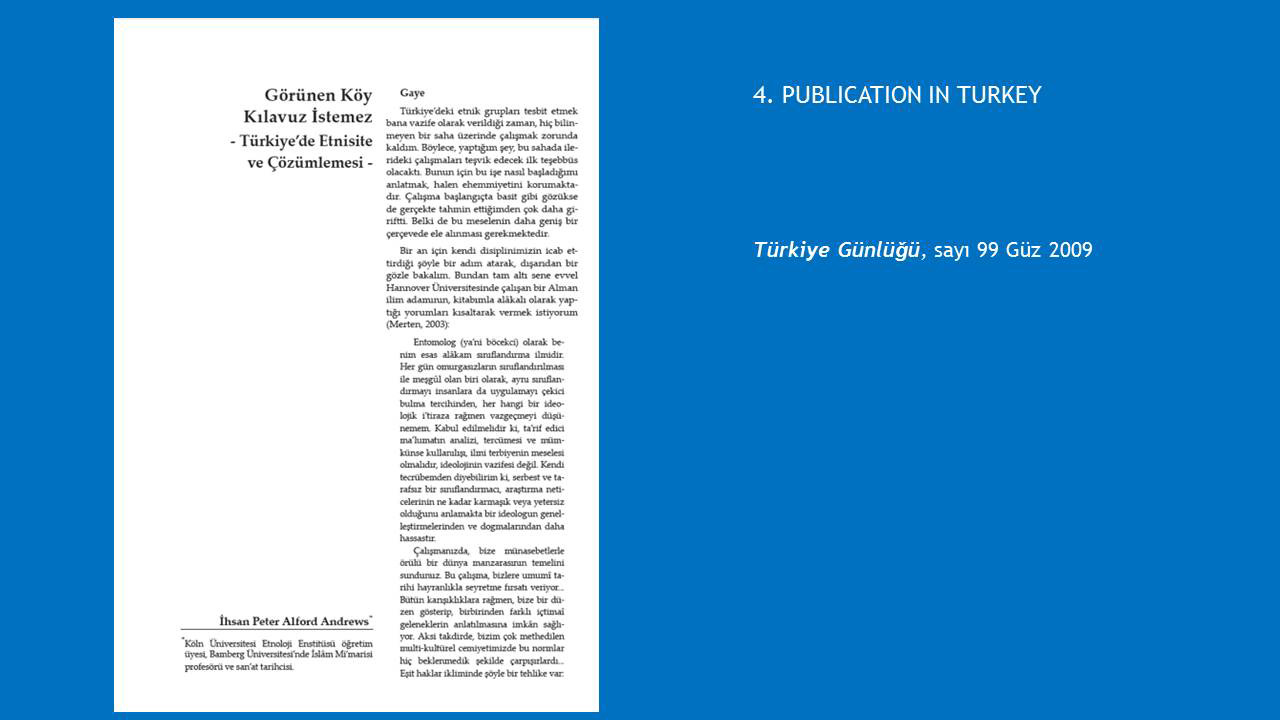
Finally, in 2008, twenty years after the map had appeared, I was invited to speak at a conference in İstanbul organised through Koç Üniversitesi on Kimlik ve Kültür (Identity and Culture). However, as I refused to convert my Turkish to the neologistic jargon unfortunately still favoured by ethnologists in Turkey, my paper was not included in the conference publications. This time the editor, Prof. Gönül Pultar, accused me of sounding like a fossilised imam! Rather that than ruin the Turkish language. Instead I published it in Türkiye Günlüğü, sayı 99, Güz 2009.
Our work on the map took roughly four years, from October 1981 to October 1985, with three months absence for a different project in India in 1981. Vol. I of the handbook was completed by November 1986. Vol.II was completed, largely at home in my free time, in February 2001.
I. AUGMENTATION: Vol. II, Frames 81-88
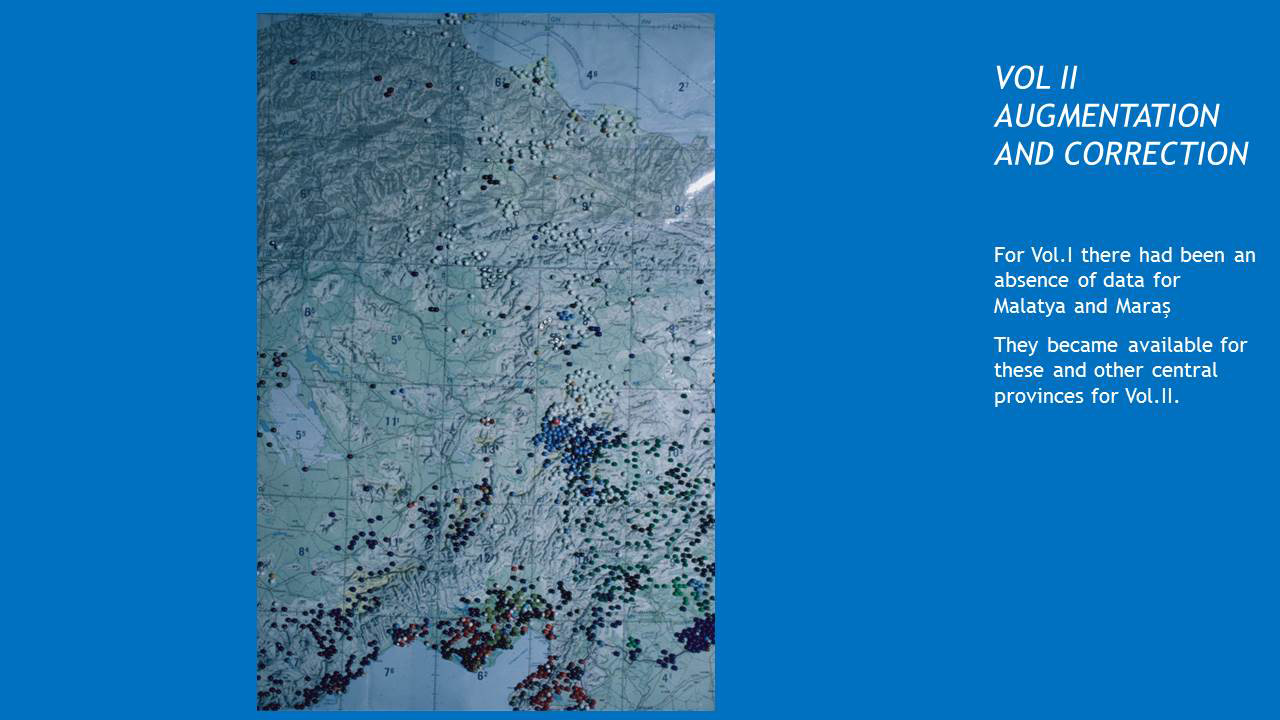
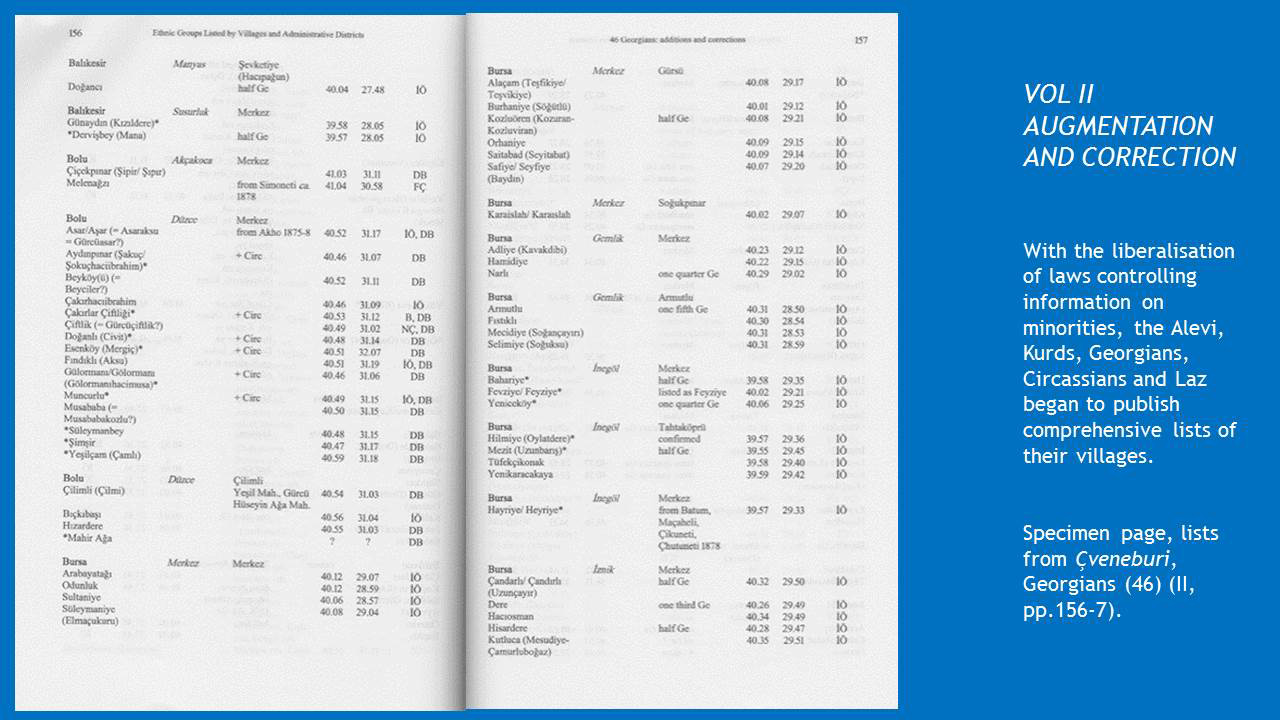
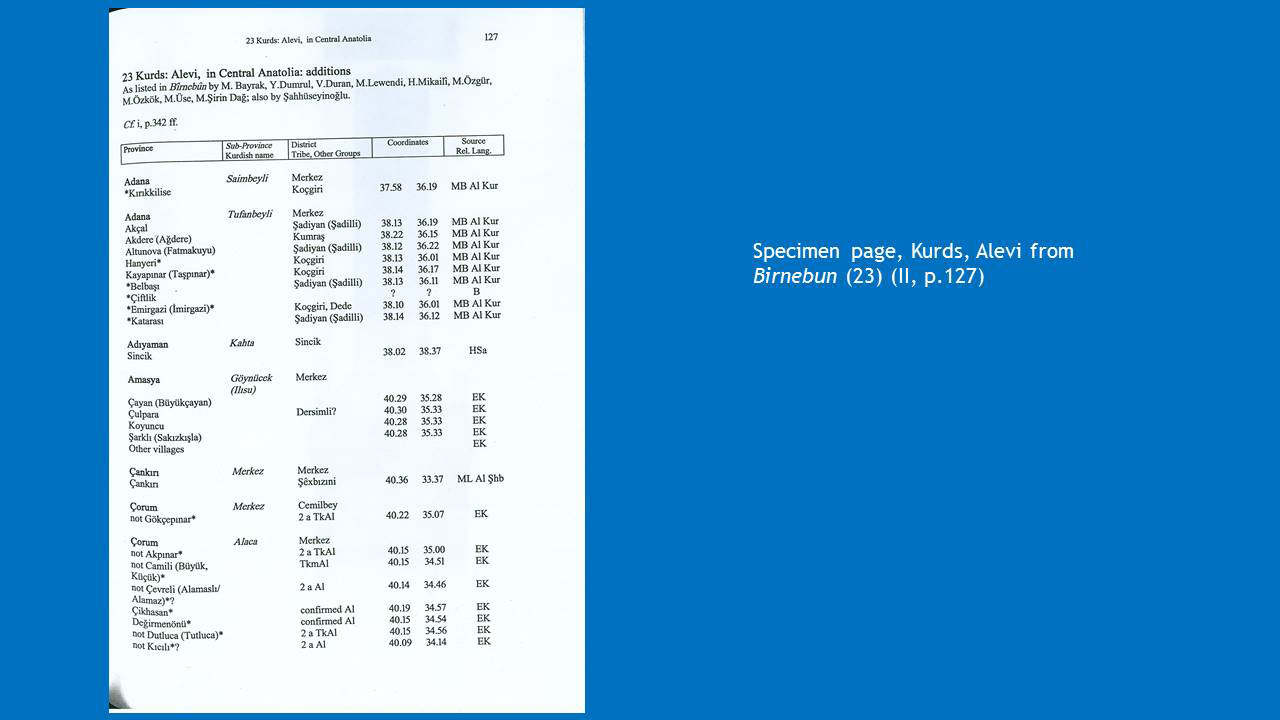
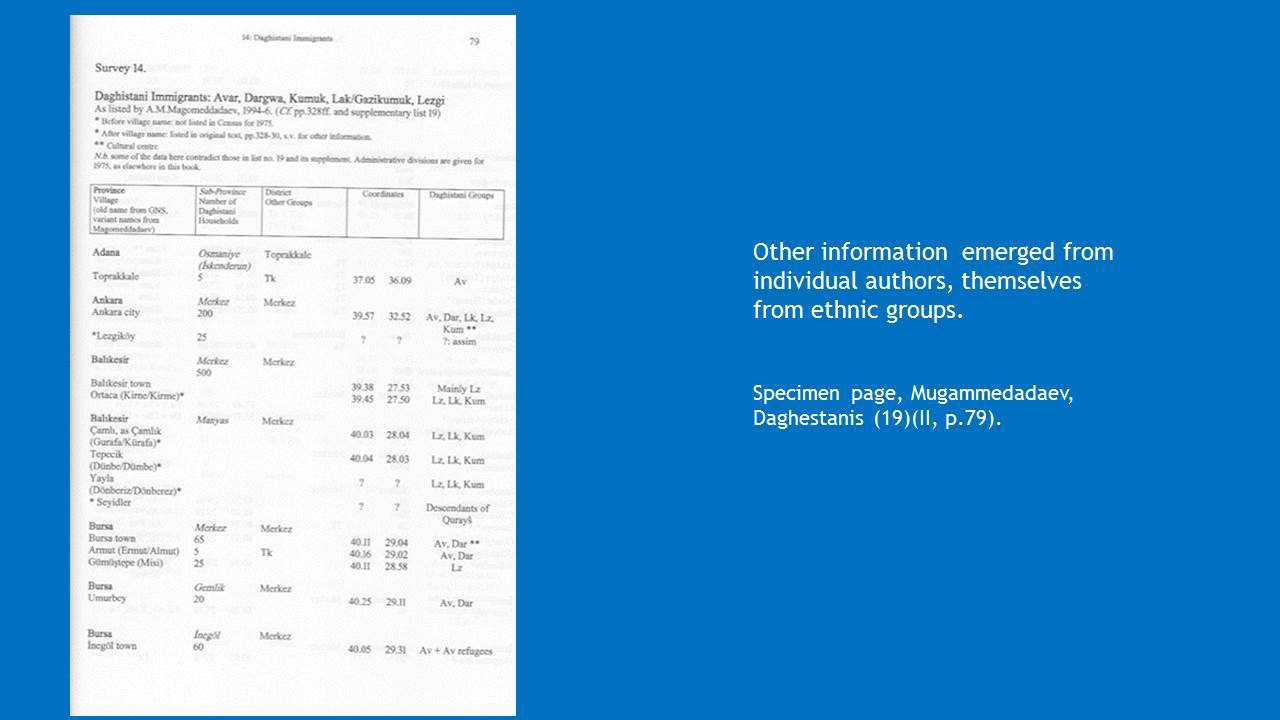
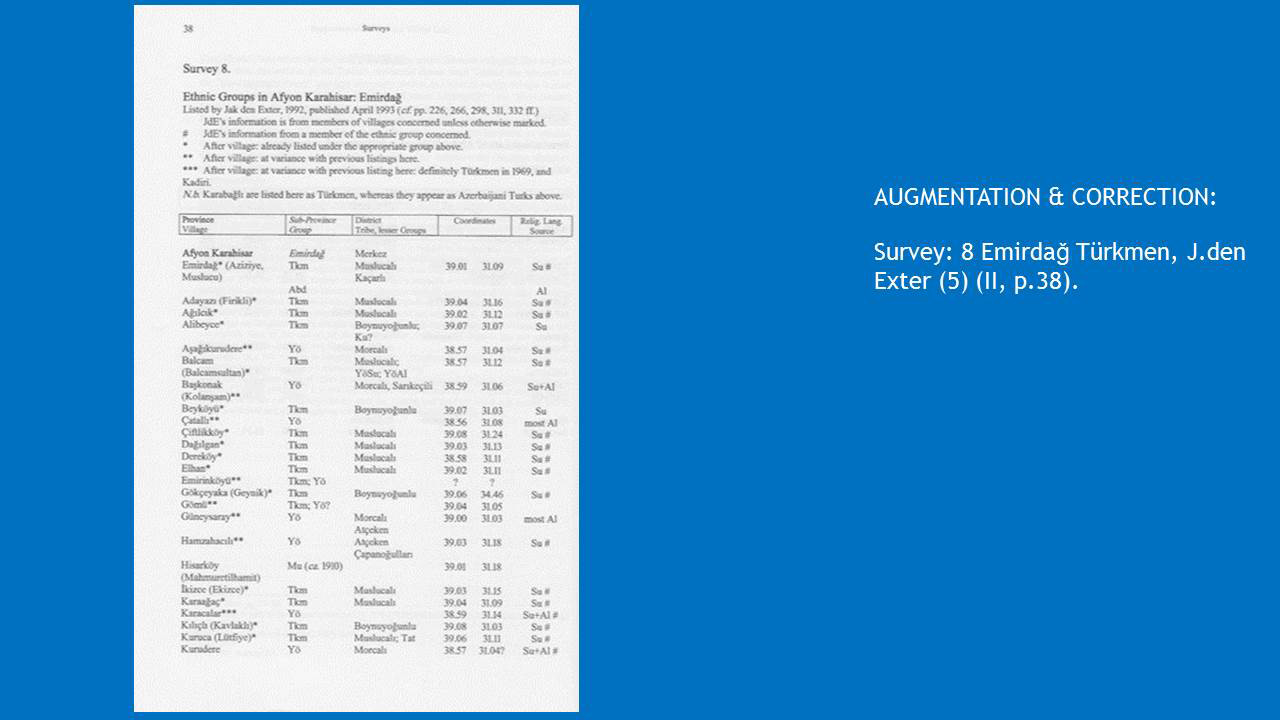
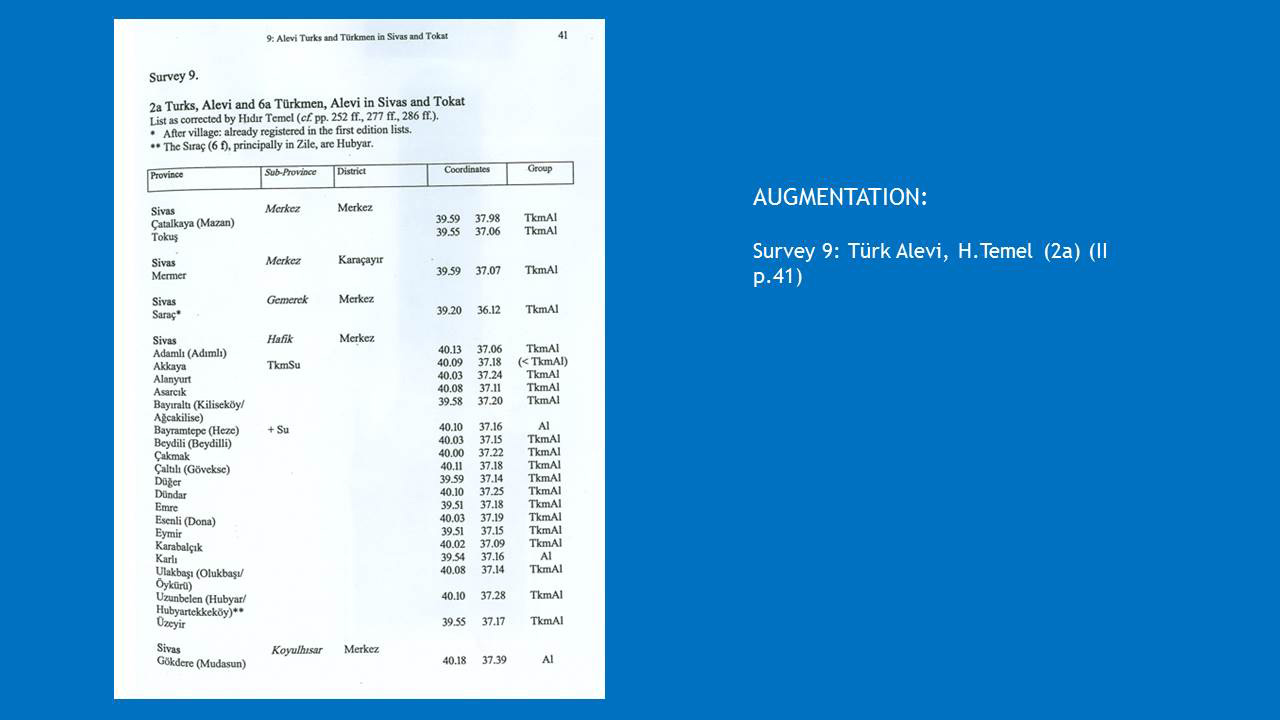
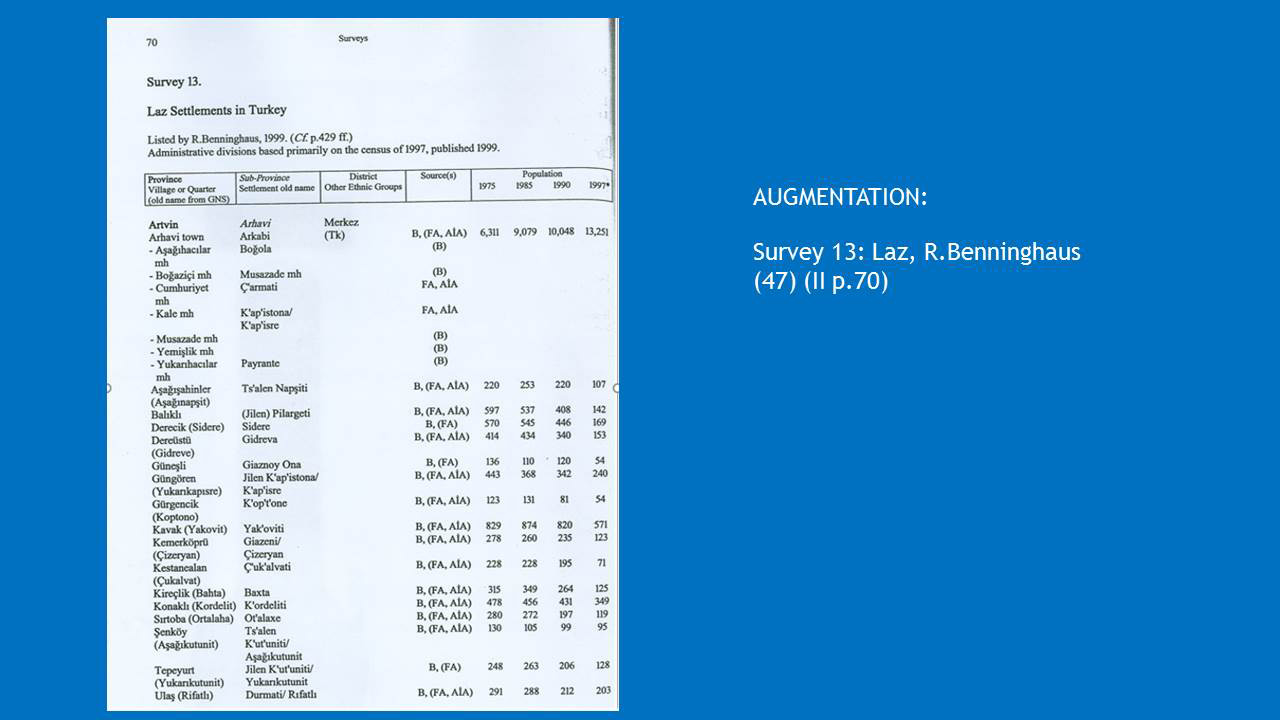
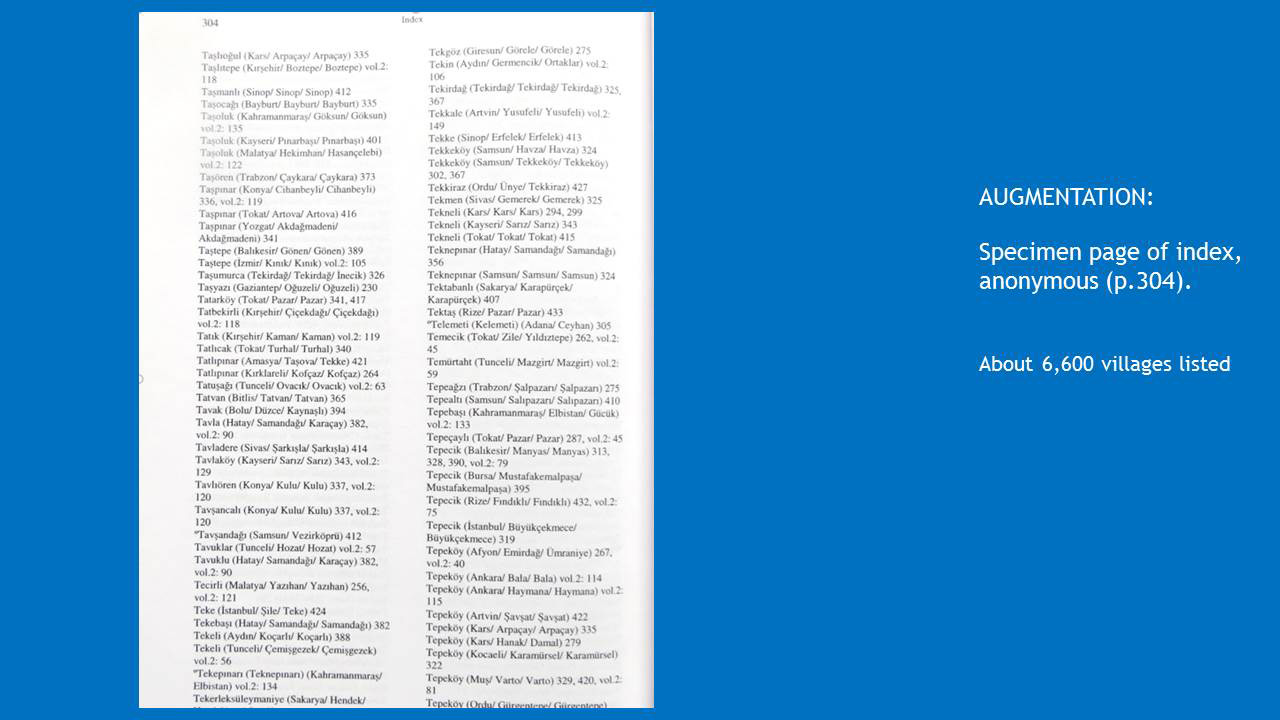
Ten years after the book had been published, Frau Ursula Reichert of Reichert Verlag, approached me to ask if I thought it would be appropriate to publish a second edition. She had it in mind, I think, that the Kurdish problem was very much in the news. I pointed out that in the interim a large amount of new information had become available, and suggested that she publish a second volume, leaving the first as it was. She agreed. Thereupon I and Rüdiger Benninghaus set about compiling the new material from no less than 24 journals which had recently been issued by particular ethnic groups. There was a fundamental difference of material, as these were self-initiated emic publications. We adhered to the previous format.
I used the introduction to the new volume to reply at some length to the criticisms made of Vol.I, and to clarify the distinctions between nationality and ethnicity, which had already been identified as a potential pitfall in 1924-5, by those who wished to name the Republic Anadolu to obviate its consequences.
We had been aware of a lack of data on Kurds and Alevi in Central Anatolia, notably in Malatya and Maraş, and were pleased to find that the gap had been filled. We could include lists published for example by the Kurds in Birnebun, or the Georgians in Çveneburi. As before, we also acquired material from private individuals such as Ergül Karakuş for the Kurds and Alevi, or Hıdır Temel for the Turkish and Türkmen Alevi in Sivas and Tokat. Prof. W. Arnold corrected and added to the ‘Alawiyya in Hatay, and Benninghaus himself drew up a new list of Laz.
In one case, a detailed survey of a particular area, Emirdağ, inhabited by Sunni Türkmen, allowed some of the previous data to be adjusted in such a way as to show where contradictions existed.
We also raised the question of whether a 48th ethnic group, the Mhallamiye, should be incorporated, and Benninghaus wrote an essay to explain what they were.
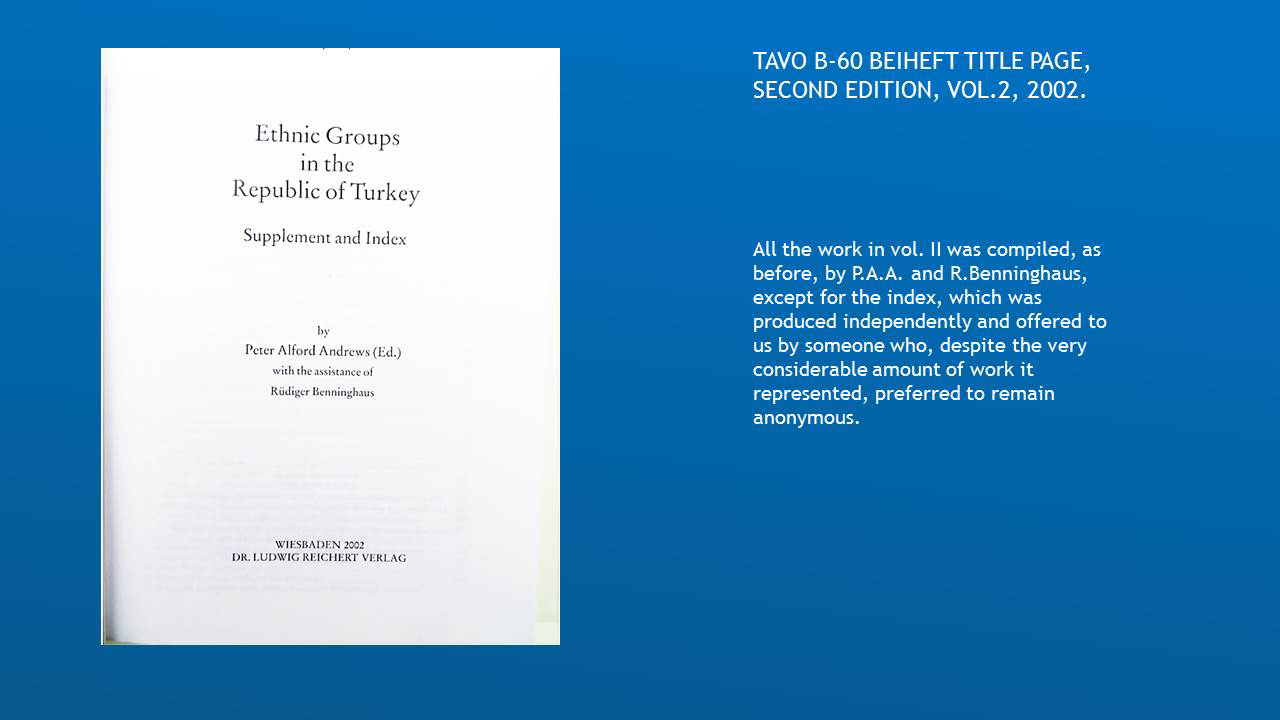
Without our knowledge, someone in Istanbul compiled an accurate and comprehensive index of villages mentioned in the text of Vol.I, and offered it to us. He then broadened it to include the villages mentioned in Vol.II. to a total of some 6,600. As he wished to remain anonymous, his extraordinarily generous offer remains unacknowledged.
The new text was completed in 2001, and published in 2002. I and Rüdiger Benninhaus worked on this material unpaid, as for Tübingen the project had closed with Vol.I

APPENDICES
I. Text of Apologia issued
WORK ON ETHNIC GROUPS IN TURKEY
In August 1981 I was invited to the Institut für Völkerkunde in the University of Cologne by its then director, Frau Prof. Ulla Johansen. She wanted me to join an already-existing team working on the ethnological aspects of a large project, the Tübinger Atlas des Vorderen Orients (TAVO), with which she had been entrusted by the University of Tübingen. This was financed as a long-term project, Sfb.19, by the Deutsche Forschungsgemeinschaft (DFG) (German Research Society). The team consisted of Dr. E. Orywal, Frau K.Hackstein, M.A., and myself, under Frau Johansen’s direction. The team was to produce cartographic documentation on ethnic groups in the Middle East within the TAVO area, that is from Turkey to the Yemen, and from Egypt to Afghanistan. While Dr Orywal was then already working on a map of Afghanistan, and subsequently on a handbook (Beiheft), Frau Hackstein was to work on the Levant. She later went out to do fieldwork at Ğeraš in Jordan: this was the only fieldwork sponsored for our part of the project. She in turn produced an ethnic map of the Levant, and a handbook on Ğeraš. Dr Orywal later compiled material for a map of Iran, and then coordinated a general map of the whole Middle East, to which we all contributed, and a handbook. All the material was published by Dr. Ludwig Reichert Verlag in Wiesbaden, under contract to the DFG, the maps being issued in fascicles of some dozen at a time, and the handbooks in a uniform series, Beihefte zum Tübinger Atlas des Vorderen Orients, Reihe B (Geisteswissenschaften).
I was initially contracted to work for two years, to replace an Egyptian lady who had married and dropped out of the team. Frau Johansen therefore intended that I should work on Egypt. I pointed out, however, that I knew no Arabic, and that I should need at least two years study to reach reading proficiency. I suggested I should compile a map of Turkey instead, since I already knew Turkish, and had travelled widely in the country. She expressed some doubt as to whether I should find enough material to compile a map, but allowed me to proceed. After I had worked for two years, I had made sufficient progress to secure further funding from the DFG assessors, and it was agreed that I should use the data I had assembled for the map to write a handbook too, so that it should not be wasted. This was particularly important since a large part of my data was on individual villages, for which I had to establish the exact geographical position: the result was a large number of tables.
I relied upon such published information as I could acquire, and decided to limit what was shown on the map to the period 1960-1970, since after this extensive migration from rural areas to the cities had occurred, and since from 1970 there had been an agreement in the ethnological departments of Turkish universities that no further fieldwork on ethnic minorities there would be carried out. I was considerably helped by people who, out of private interest, had compiled material on ethnic distribution, mostly as unpublished lists of villages, besides by students’ reports done in Ankara and Istanbul to which I was allowed access. A significant contribution was made by Frau Professor Liesa Nestmann, who had been able to copy data, mainly unpublished, from the Köy Envanteri at Ankara while she was teaching there in the 1960s. This government survey had documented both language and religion, province by province, for eastern Turkey, and her material provided the basis for the only part of my map which could be shown regionally. The data on individual villages, on the other hand, were mainly compiled by people from outside Turkey. I was provided with no funds or time for fieldwork for the project.
My draft of the map (TAVO A VIII 14 a-b) was completed in October 1985, and the text for the handbook (B-60) in November 1986. Meanwhile I was commissioned to compile material for a further map on Labour Migration in the Persian Gulf countries, (A VIII 17), for which the draft was completed in March 1985, and then a for a map on the distribution of Nomad Tent Types in the Middle East (A IX 5), drawing on my own previous fieldwork, for which the draft was completed in December 1986. Again I was asked to compile a handbook with details of the tent types, and the draft for part I of this, on the framed tents, with numerous drawings specially made, was ready by October 1995. Part II, on the velum tents, is in progress. I also submitted material on Saudi Arabia and Turkey for the general map (A VIII 13), completed in December 1984. In all I was paid for work on the Tübingen Atlas from 1981 to 1986, and from 1989 to 1990.
It should be emphasised that my work on the ethnic groups in Turkey was my own idea, although it fitted within the pre-established framework of the TAVO maps. The DFG, which sponsored the project, is an independent, semi-governmental organisation, and is not directed by the German government in its choice of activities: these are approved by committees of academics only. This work can in no way be said to have been done for the German government, by which it was not influenced. Nor, of course, has the British government had anything to do with the project. It is simply academic work, and part of the work on ethnic groups throughout the Middle East, as the other maps testify.
Volume II of the handbook, issued ten years after volume I, differs from it in that I was able to include extensive lists compiled by people living in Turkey who belonged to the ethnic groups concerned: I took some of these over from articles in journals with an ethnic emphasis, though others were given me privately. The new volume, then, contains information on an emic, rather than a largely etic, basis. In both volumes the essays on individual groups are written by specialists who happen to have been concerned with them: I can make no claim to comprehensiveness, since several important groups still remain largely unstudied. I have, of course, avoided any sources which I knew to be politically biased.
Peter Alford Andrews 26.7.2003
II. Notice on Piracy
On 24.12.1992 two publishing houses in Istanbul, Ant Yayınları and Tüm Zaman Yayınları, wrote to the GEO-Center in Stuttgart, distributors for my book, announcing that they had already published a Turkish translation of it: they had omitted the maps and the geographical section (meaning the tables of geographical coordinates for villages), and had updated other parts. They requested a grant of the copyright. The GEO-Center passed their letter on to the publisher, Dr. Ludwig Reichert Verlag in Wiesbaden. Reichert then passed this letter on to me on 12.1.1993, and I immediately protested to the two firms by letter and fax, denying them permission to publish. Reichert also wrote to them to say their translation was illegal. I also wrote to ask the then Rector of Istanbul University, Prof. Demiroğlu, to intervene, as a courtesy from one university to another: this request was answered by the Vice-Rector, Prof. Tonguşı, who offered no help. Dr Faruk Şen of the Zentrum für Türkeistudien also wrote to the publishing houses to protest, but without success.
Attempts to remonstrate with Cemal Şener, the proprietor of Ant Yayınları, by telephone were of no avail. It emerged that his wife was a lawyer, who evidently regarded his position as safe. The first printing of the illegal translation was 1500. He himself finally said “alırım, basarım, satarım: burası Türkiye”.
The translation was advertised in Gerçek of 23.1.93, as Türkiye’de Etnik Gruplar, in my name. It even had an ISBN number. In February we were eventually sent a copy by the publishers, which turned out to be only a quarter of my original book, badly translated and with changes to the text. All the tables, which form the core of the book, were omitted, and most of the essays: it gave a very poor idea of the book, its seriousness, and its purpose. As, however, it sold for only DM 10, it was far more attractive to the Turkish readership than the original costing DM 90.
I obtained power of attorney from the University of Tübingen and from Reichert, and on 2.2.93 briefed a lawyer, Rafet Ataç, to take legal proceedings against the firms. The proprietor of Tüm Zaman Yayınları, Veli Yılmaz, died, so it was only Ant Yayınları that was subject to these proceedings.
In order to obtain an assessment of the damage to my reputation as an academic author, I had to provide two copies of the book, to be read by academically competent adjudicators, and I had to pay a deposit of DM 1784 to open proceedings. Ant Yayınları was represented by Bayan Şener in what, to us, seemed an astonishingly shameless way.
Three years later, on 13.2.95, we received confirmation from our lawyer that he had won the case, and that damages of TL 27.000.000 had been awarded - less than a tenth of what he had demanded. Some copies of the illegal translation were destroyed by the police, but in fact the book continued to be sold throughout Turkey without much concealment, and it still seems to be available.
We appealed against the damages, and were ultimately, on 26.5.95, awarded a total of TL 77.000.000 damages (ca. DM 3229), enough to pay for the legal action. I only lost about DM 150 on my deposit through depreciation of the TL. This was, apparently, the first successful court action taken from abroad against a pirated edition, so it was significant in legal history.
Finally, on 17.5.96 I wrote a letter to the then Prime Minister of Turkey, Mesut Yılmaz, drawing his attention to the unsatisfactory legal situation with regard to piracy of books in Turkey. I gave him the letter personally, in Bonn. It seems that some legislation is now at last ready, though it hardly addresses the problem with the required rigour.
Peter Alford Andrews, 26.7.2003