Sinan Kuneralp + Selim Kuneralp hybrid presentation: ‘Zeki Kuneralp Memoirs’, 8 April 2024 - flyer:
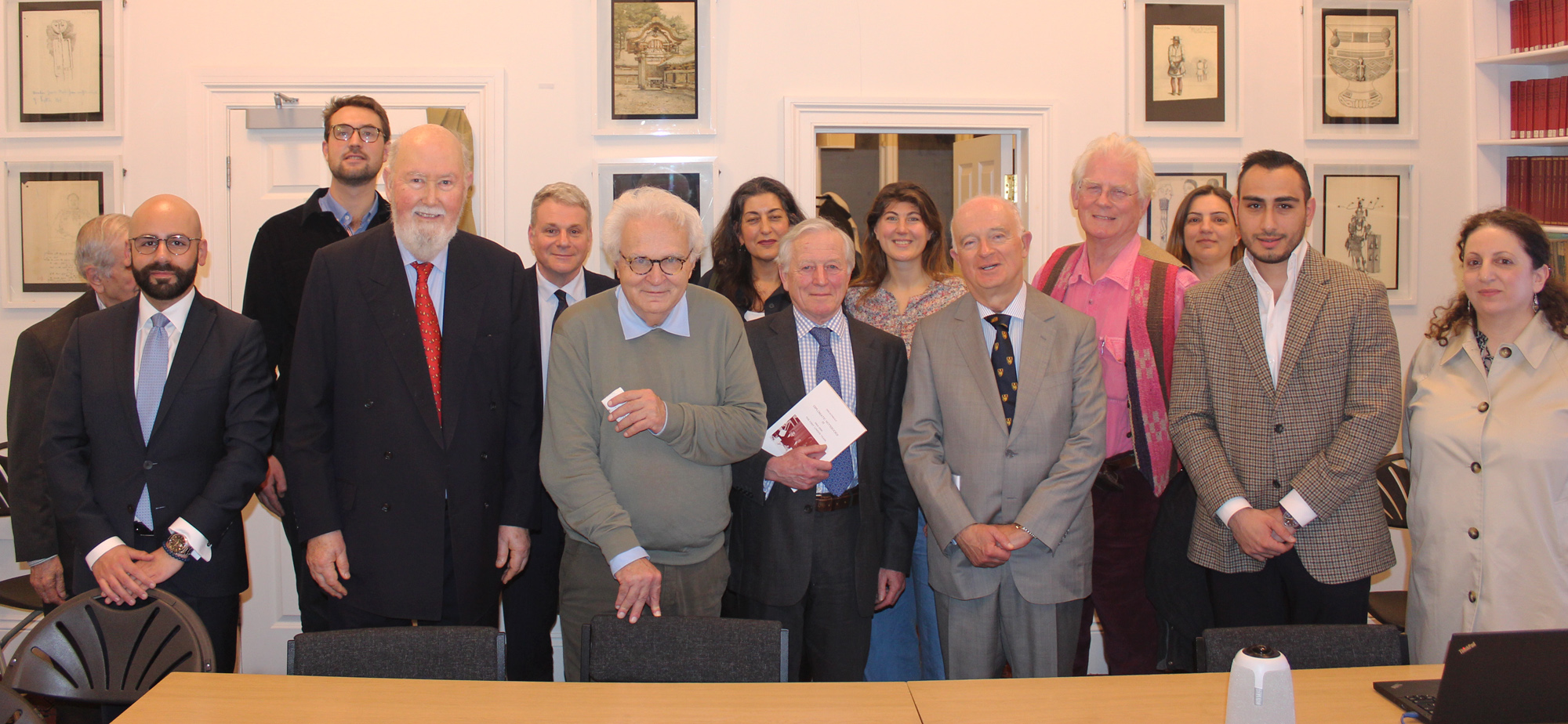
Sinan Kuneralp (in grey cardigan) & Sinan Kuneralp (in navy spotted tie) post lecture with friends.
Sinan Kuneralp + Selim Kuneralp hybrid presentation: ‘Zeki Kuneralp Memoirs’, 8 April 2024 - flyer:
1- Your father was brought up in exile in Switzerland and after his education he returned to Turkey and, with the express approval of President İsmet İnönü, entered the Ministry of Foreign Affairs. He obviously could speak French fluently and would have a clear understanding of the ways of European think. Do you think these qualities were recognised by his superiors allowing him to rise up the ranks of bureaucracy which clearly still had a strong impetus to Westernise Turkey along Ataturk’s lines?
At the time when father joined the Turkish Foreign Service in 1941, most of its members were French speakers who had been educated at Galatasaray, the school in Istanbul where the medium of teaching is still French. English-speakers were rare and German-speakers even more so. That is why he was put to work in the section of the Trade department that dealt with Germany, a country with which Turkey as a neutral power in WWII conducted normal trade relations. His knowledge of English did not come in useful until Turkey became a member of NATO in 1952 and he was appointed to the first representation of Turkey to the alliance. Though one of the few German speakers around he never received a posting in Germany throughout his career and only served in Switzerland once. So while command of three Western languages was important, it was not the dominant factor in his career. Also, his first two postings were Bucharest (during the war) and Prague in the early Cold War years and his career only took off after his stint at NATO from 1952 to 1957.
2- Zeki Kuneralp survived an assassination attempt which claimed the lives of his wife and her brother in Madrid in 1978. Clearly this was a huge family tragedy but do you think this changed him fundamentally and was a factor in his retirement a year later?
The assassination of his wife and brother-in-law was naturally a terrible tragedy for him and the whole family but he continued in his post until reaching normal retirement age because not doing so would have given the perpetrators of the despicable outrage reasons for self-congratulation. Also, the Spanish authorities and his friends and colleagues displayed enormous sympathy throughout his remaining time in the country and that provided a boost to his morale.
3- Your father published his autobiography in 1992. How much did you got to know your father and his work through that book. Was he private person or did he regale you with reminiscences and gossip of the past, presumably some of which couldn’t be published!
In his conversations, he was quite ready to share his experiences some of them quite amusing anecdotes, particularly from his early time working on relations with German diplomats during the war in Ankara, and later in Romania which was allied to Germany when he was first posted to Bucharest and subsequently occupied by the Soviets while he was still there. In fact, he published a separate small booklet about that period.
4- Zeki Kuneralp was strong believer in Turkish-Greek friendship, Kuneralp worked hard but unsuccessfully to repair the damage done to Turkish-Greek relations by the rift over Cyprus between 1954 and 1964. Do you think in hindsight this was an impossible mission as neither side was and perhaps still have the political courage of meaningful dialogue and therefore painful compromises for their own position? Do you think facts on the ground and the passage of time means any major change in the island such as unification is now highly unlikely?
The early 1950s was a honeymoon period in Greek-Turkish relations. The civil war in Greece had ended, a pro-western government was installed there, both countries joined NATO simultaneously, the Greek king paid a state visit to Turkey which was returned by the Turkish President. From 1954 till 1959 the Cyprus problem created a lot of bad blood between the two countries but the London Agreements of 1959 that provided for the creation of an independent bi-communal Republic of Cyprus brought temporary respite. Indeed, after the conclusion of these agreements, the Turkish and Greek Prime ministers each appointed a senior representative, father being the Turkish one and Dimitrios Bitsios the Greek one, who jointly drew up a catalogue of the outstanding issues between the two countries that they presented to their respective leaders. However, nothing came out of it. Father probably hoped that the two countries could live together harmoniously but he was too sensible to think that this was really possible in the circumstances.
Nowadays, problems have accumulated, and none have been solved. The Cyprus problem has become completely intractable after the accession of the island to the EU without a solution being found to it beforehand. I do not see any chance of any bilateral problems with Greece being settled in the near future either. The best that one can hope for is that the present situation does not deteriorate, and the status quo is maintained.
5- The publication you did the book launch presentation on is of a series of 6, this being no 3 of different periods of your father’s diplomatic postings with his daily memos / diary in English, sometimes in French and occasionally in Turkish. Presumably your father was comfortable in all 3 languages but did he keep his notes mostly in English to allow for a wider audience when these could be made public? How did you edit what entries were kept in and what was kept out?
The notes from his time as Ambassador in Berne are almost entirely in German and remain to be published. His practice was to record a conversation immediately after it was conducted, in the language in which it was held. He used these notebooks as material when writing his memoirs but never intended to publish them in his lifetime. However, they are unique in the sense that no other Turkish diplomat has done such a thing over such a long period of time, 22 years in all.
Editing was not much of an issue. We published the notebooks as they were without any redacting. No entry was cut out. The only editing we did was more of a stylistic nature when necessary.
6- There are only 2 photos showing your father with a British politician / official and presumably there are loads more available. Did you consider a full photo album inclusion in the book was unnecessary as it is primarily intended for a specialist audience who can access the source material to analyse the workings of Turkish diplomacy vis-a-vis world affairs at the time? For that reason did you deliberately make the minimum introduction to Zeki Kuneralp and have the briefest footnotes to explain who is who?
These notes are essentially intended for researchers rather than the general public. That is why they do not contain too many photographs.
7- On page 110 of this book there is an interesting entry from 11-1-1965: ‘Dinner party at the Pakistani High Commissioner. The Ceylon High Commissioner says that Sukarto is ill and a fool. However he thinks that thanks to the flexibility of the British it will be possible to find a solution to the conflict between Indonesia and Malaysia. The Chinese Charge Hsiang-Hui says that the conflict could be solved if the Americans and the British would not interfere in their selfish purposes. He says that the same applies to conflicts elsewhere as in Vietnam and Cyprus. With regards to relations to Turkey, he says that these relations ought to be established but that they can wait.’ There is a lot to unpick here including the revelation that as late as 1965 there was no diplomatic relations between Sri Lanka and Turkey. There is a lot of refreshing honesty in these records that only a personal diary would reveal. Do you think this is the true value of these records and the reason why it is important that a wider readership could access them through their publication as you are doing?
Absolutely. He never redrafted anything that he taken down even when subsequent events showed that some predictions about the future that were made during conversations were completely unfounded. In the conversation that you quote what is most interesting is that as the Turkish Ambassador, he could sit at the same dinner table with the Chargé of the PRC, a country that Turkey did not recognize at the time, as Turkey along with most NATO countries continued to consider the Republic of Chine (Taiwan) as the legitimate government of China until 1971. The UK was one of the few exceptions (the only other that I am aware of is France from 1963 onwards) because Hong Kong was still under British rule and that required regular contacts with mainland China. However, both countries were represented in each other’s capital by a Chargé d’Affaires rather than a full Ambassador.
8- A huge amount has changed in the world and Turkey since your father’s tenures. Do you think Turkey and perhaps the wider world now considers the work of diplomats and their soft power through cultivating friendships secondary to the role of the leaders of nations who have increasingly taken on, or try to take on this role, sometimes with unfortunate consequences?
It is true that leaders have many more contacts among themselves than was the case in earlier times. However, relations between countries have become much more intricate and cover a much broader range of areas than in the past. Leaders cannot be expected to handle them all in the time available to them for bilateral meetings, which rarely last more than 1-2 hours. Nor can they be expected to do any useful work during such meetings if the ground has not been adequately prepared by their officials beforehand. So there will always be work for diplomats.
9- Selim would you consider writing your own autobiography in the future as you have also pursued a diplomatic career?
I have never thought of writing memoirs because unlike father, I have never kept notes of meetings and cannot trust my memory. Instead, I write a weekly column for an internet website in Turkish. I might one day make a book about them as I am sometimes encouraged to do. Meanwhile, I have participated with his widow in the publication of a book about one of my bosses and principal mentor, İlter Türkmen who likewise did not leave memoirs but wrote a column for “Hürriyet” for about 9 years, from 1999 to 2008. These articles form the basis for the book which will come out in the next few weeks.